




Heavy weapons boomed across the hills above Uvira this week as rebel fighters picked their way along the ridgelines, skirting the Congolese troops and militiamen dug in along the Ruzizi River road below. Phone networks still cut out, though shops and markets in town remain open. Civic leaders in the lakeside city on Congo’s border with Burundi called a “dead city” shutdown for Friday to protest the war. The mayor’s office banned it.
Word raced through town that the rebels had reached Kawizi, a village about 5 miles out. The army denied it, and the provincial governor, Jean-Jacques Purusi, called Uvira a “fortress,” accusing the rebels of waging a media war to spread panic, according to a local radio report.
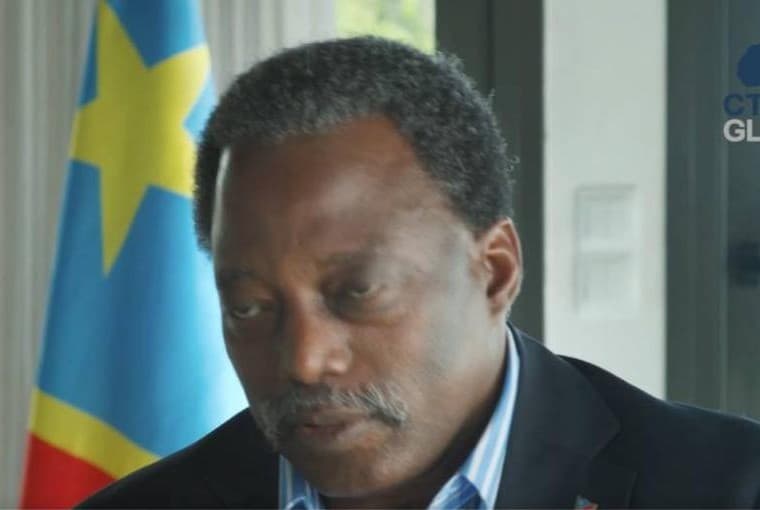
The fighters, however, no longer march under the M23 banner. Since October 12, they have answered to Joseph Kabila, who ruled the Democratic Republic of Congo for 18 years and was condemned to death last year by his own country’s military court for helping the rebellion he now leads.
Kabila, 55, unveiled the Front for the Refoundation of the Nation, known by its French initials FRN, at his residence at Goma, the eastern city M23 seized in January 2025. The Congo River Alliance, M23’s political umbrella often referred to as the AFC, dissolved and handed over its rights and obligations to the front. Rebel leaders Corneille Nangaa and Bertrand Bisimwa became vice presidents. Commander Sultani Makenga runs the military.
In April, the U.S. Treasury Department sanctioned Kabila, accusing him of bankrolling the rebels’ political wing and urging Congolese soldiers to defect to it.
Not everyone is convinced the new name means much yet.
“For now, it’s only a rebrand of M23/AFC,” a professor at the Institute of Development Policy at the University of Antwerp, Kristof Titeca, tells The New York Sun.
In any case, can a man who once commanded Congo’s army turn a Rwanda-backed insurgency into a national cause? And what is left of last year’s Washington Accords, the fragile peace brokered by President Trump, if he tries?
From the Presidential Palace to a Rebel Command in Goma
Kabila took power in 2001 at age 29, after his father, President Laurent-Désiré Kabila, was fatally shot by one of his own bodyguards. The younger Kabila then stretched his tenure more than two years past the end of his second term by delaying elections.
He handed the presidency to Félix Tshisekedi in 2019 under a power-sharing deal that left his own coalition with a parliamentary majority and the prime minister’s office. Mr. Tshisekedi tore it up in December 2020.
The rift turned hostile after M23 came back in 2022, allegedly backed by thousands of Rwandan soldiers. Kabila was stripped of his immunity and convicted in absentia of treason, war crimes and crimes against humanity. He called the trial political. Kigali denies arming the rebels.
The Front for the Refoundation of the Nation is already peeling soldiers away from the army.
“While we have not seen any major alignment of other political opposition figures to FRN, we can observe some high-level Congolese army defections to FRN,” a senior researcher on conflict prevention, management and peacebuilding at the Institute for Security Studies, Bram Verelst, tells the Sun.
“The major immediate risk is a renewed offensive in South Kivu, possibly leading to a renewed capture of Uvira, which was briefly occupied by M23 in December and January last year.”
A former South African lawmaker, however, sees more than a name change. The FRN is “an additional entity entering the fray,” a professor of practice and director of the Africa Initiative at Brown University’s Watson School of International and Public Affairs, Wilmot James, tells the Sun.
He expects it to change the war on the ground in an already fraught region.
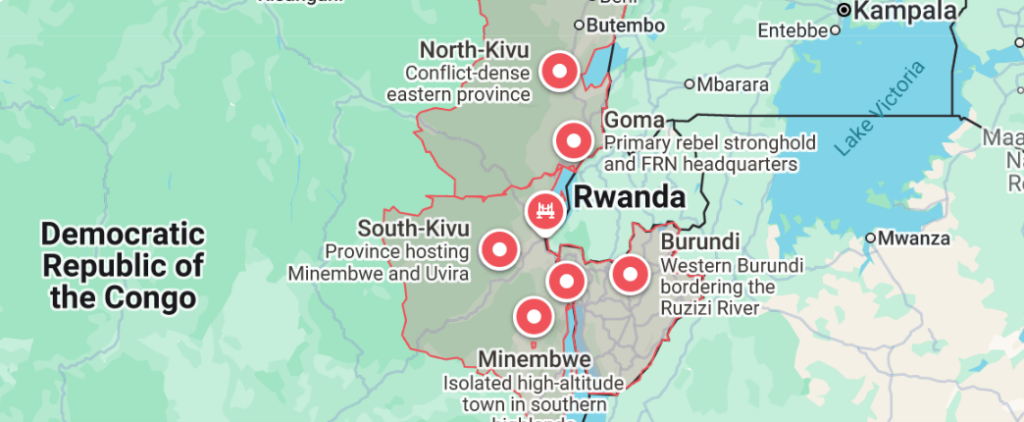
That change is already showing on the map. Since early October, front fighters have clashed with the army and allied Wazalendo militias from Masisi in North Kivu to the hills around Kaziba and the high plateau near Minembwe in South Kivu, with both sides trading drone strikes and artillery fire.
Fighting around Kaziba alone has displaced more than 12,000 households, according to one conflict tracker. Kabila casts the war as a constitutional duty, citing Article 64 of Congo’s charter, which obliges citizens to resist anyone who seizes power by force, and vowing to end what the front calls tyranny by any means, including force.
M23 took up arms in 2012 over grievances rooted in the east, ranging from the safety of Congolese Tutsi to the fate of its fighters. The front’s ambitions run wider. Its founding declaration calls for a wholesale overhaul of how Congo is governed and an inclusive national dialogue. It also accuses Kinshasa of stonewalling on peace talks with the rebels in Qatar.
A Peace Process Signed by Rebels Who No Longer Exist by Name
Qatari mediators brought Kinshasa and the rebels to Doha in November 2025 to sign a framework for peace. In December, Mr. Tshisekedi and Rwanda’s Paul Kagame signed the Washington Accords at a ceremony hosted by Mr. Trump.
The next round of talks is expected in November. The FRN says it will honor every pledge M23 signed, but Kinshasa has not said whether it will negotiate with a man it has sentenced to death.
That sentence has never come close to being carried out. Kabila was tried in absentia and has never been in custody. He lives in the rebel-held eastern city of Goma, where M23 has protected him since 2025.
“The implementation of the talks on the ground is already going slowly and badly,” Mr. Titeca says, underscoring that Kabila’s call for a “revolution” clouds any path to a deal.
Mr. Verelst notes that both sides still profess loyalty to the Doha process. However, the talks “were already in a state of deadlock for some time and did not make any significant progress on key political and security issues.”
“Yet, fighting has never stopped, and an escalation has only become more likely with Kabila’s arrival,” Mr. Verelst adds.
Whether both sides can be kept at the table now is questionable. “It would take an act of extraordinary diplomacy to sustain talks about a negotiated peace,” Mr. James says.
Cobalt, Copper and an Ebola Epidemic in the Same War Zone
America signed a strategic partnership with Kinshasa in December 2025, giving American investors priority in the world’s largest cobalt producer. In February, Swiss-based Glencore PLC agreed to sell 40 percent of its stake in its Congolese copper and cobalt mines to the American-backed Orion Critical Mineral Consortium.
“The U.S. has had a degree of leverage over what’s happening on the ground: It for example played a key role in having the M23 withdraw from certain areas,” Mr. Titeca explains. “The U.S.’ primary interest in all this has indeed been the mineral partnership in the area.”
Mr. Verelst says the front’s rise “also exposes the failure of the U.S. mediation between the DRC and Rwanda in bringing peace to eastern DRC.” He adds that the minerals pact “does not guarantee political survival for Tshisekedi.”
The longer the fighting drags on, the harder it may become to reach those mines and the less certain it will be who profits from them.
“My sense is that access to the mining areas will become even more difficult; a lot more illegal and damaging mining will take place, and the ore will end up in China,” Mr. James observes.
The war is also moving through provinces gripped by Ebola. As of Tuesday, Congo had logged 10,141 confirmed cases of the rare Bundibugyo strain and 4,928 deaths, according to European disease monitors, making it the worst outbreak in the country’s history. No vaccine is approved, though the first volunteer in a vaccin etrial received a shot Monday. Cases have reached Kenya and Nigeria.
“Since September, the epicenter of the Ebola outbreak has increasingly shifted towards North Kivu, mainly in the government-held areas in the Grand Nord, and has been very difficult to contain,” Mr. Verelst points out.
Mr. Titeca stresses that the fighting already hampers contact tracing.
“Tragically, there will be more space and opportunity for uncontained and uncontainable spread and [the war will] bedevil the current effort by the Africa CDC, WHO and partners to get this thing under control,” Mr. James adds. “We are extremely concerned about the security of the Ebola samples from a nonproliferation risk point of view.”
