
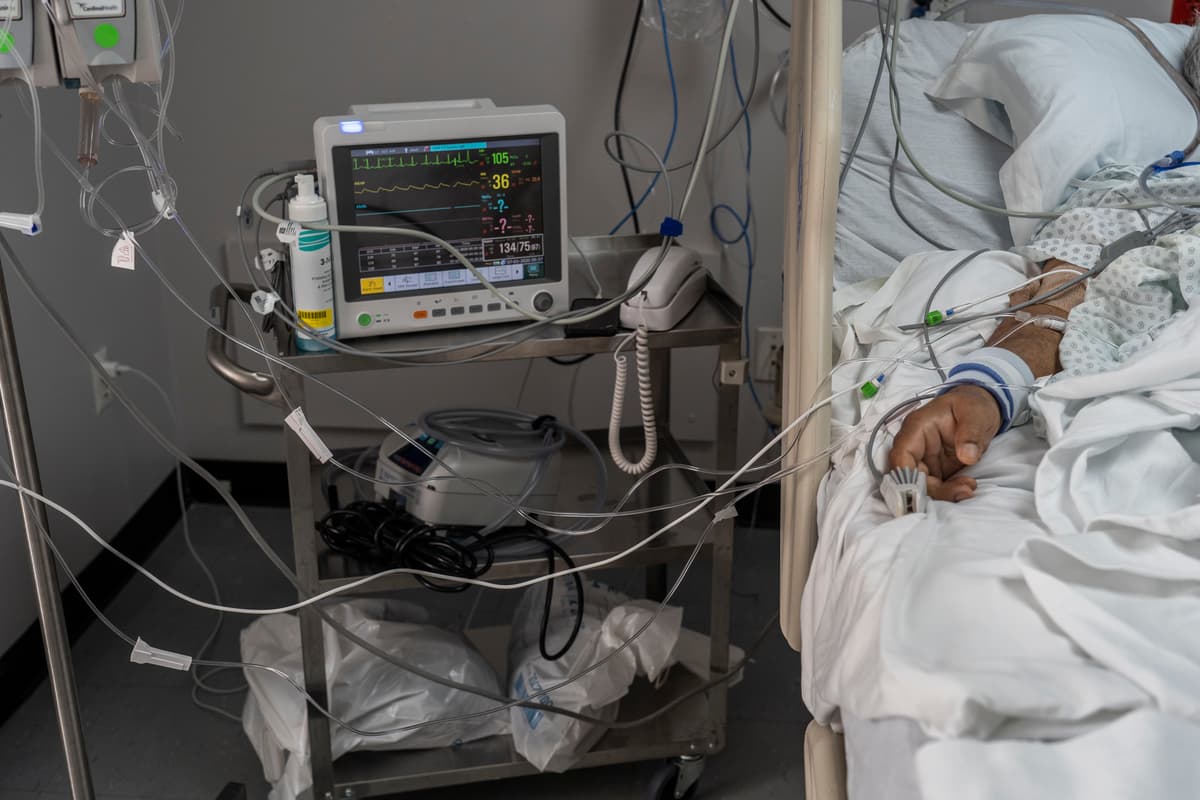








New York has assisted up to 20 patients to die after a change in the law permitting the practice came into effect last month, a doctor close to the program tells The New York Sun.
From August 5, terminally ill people have been allowed to apply to die, under the state’s new Medical Assistance in Dying program, better known as MAiD.
The New York Department of Health declined to answer questions from the Sun about how many people have been “assisted to die” so far. However a bioethicist involved in New York’s implementation tells the Sun that “about 20 cases, all terminal” have been processed.
Assistant professor of professional practice in bioethics at Columbia University, David Hoffman explained that he knows the figures because his organization, the Completed Life Initiative, “has been providing technical and clinical assistance with the implementation of the law.”
Disability justice activists warn that the New York euthanasia program could pressure people to end their lives.
Anita Cameron, who has spent 44 years organizing around disability rights, tells the Sun that she herself is eligible for assisted dying in New York because her health condition has become “terminal” in recent months.
“It’s frightening that in a dark moment, I can request to die and will be helped to do so,” Ms. Cameron says. “Making assisted suicide legal here in New York has now made it easier to kill, rather than care for those of us who already live with discrimination and injustice because when faced with the loss of access to services and supports, some may feel that they have no choice but to die.”
The Sun asked The New York Department of Health for statistics on the number of prescriptions written or deaths reported under the Medical Aid in Dying law since it took effect.
The department responded that it “will provide a publicly available report containing relevant data regarding utilization of Medical Aid in Dying on an annual basis.”
No Public Registry
The new law took effect on August 5. It requires a terminal diagnosis with a prognosis of six months or less, mental capacity, physical ability to self-administer the medication, and sign-off from two physicians. There has to be a five-day waiting period between prescription and dispensing, a psychiatric evaluation to confirm decision-making capacity, an audio or video recording of the patient’s oral request, and a residency requirement limiting the option to New Yorkers.
The law also states that the health commissioner must compile an annual report.
A member of the New York State Assembly representing the 150th District, Andrew Molitor, tells the Sun the public deserves more than silence when it comes to interim numbers.
“It is not good policy for New York to keep the public in the dark about how many people have requested and utilized assisted suicide,” Mr. Molitor says.
“The public should be told, at a minimum, what the person’s socio-economic status is, whether they have private health insurance or Medicaid, what was the terminal condition they were diagnosed with, when the prescription was filled, and where it was administered.”
A state senator representing the 57th District, George Borrello, tells the Sun the Health Department is already sitting on the relevant data and has no excuse to withhold it.
“The Department of Health is already collecting information from physicians who prescribe these medications,” Mr. Borrello says. “There is no reason New Yorkers should have to wait until the first annual report to receive basic information about how many prescriptions have been issued and how the law is being utilized.”
Finding a Willing Doctor
Under the law, patients have to make the first move. A family member, a health care proxy, or an advance directive cannot request medical aid in dying on someone else’s behalf, and doctors are barred from bringing it up first.
“Physicians are not required to participate” in MAiD, the executive director of End of Life Choices New York, Mandi Zucker, tells the Sun. The nonprofit does not prescribe or dispense medication itself. It counsels patients and families on end-of-life options and refers individuals to physicians willing to participate in MAiD.
Ms. Zucker stresses that there is no state-run public registry of participating doctors, and no visible push to create one. “This is a deeply personal medical and ethical decision, and no physician should be forced to participate.”
“Most doctors do not want to participate,” the executive director of the Patients’ Rights Action Fund, a national group that opposes assisted-suicide laws on behalf of patients, people with disabilities, and older adults, Matt Vallière, tells the Sun. “Some state-level proponent organizations boast of facilitating over 90 percent of the assisted suicides in their state, so people just call them and get referred to one of the assisted suicide docs in their cadre.”
How Euthesia Works in Other States
New York is now the 14th state — 13 states plus Washington, DC — to legalize medical aid in dying. This brings the number of Americans living under such laws to over 100 million.
More than two decades of data out of Oregon, the first state to legalize the practice, show medical aid in dying accounting for less than one percent of deaths.
A report from the New York State Bar Association’s task force found the same holds nationally: fewer than one percent of deaths in any legal jurisdiction, in any given year.
New York’s law does not extend to disability, mental illness, or non-terminal conditions.
Just across the border, the picture looks nothing like that. Canada legalized medical assistance in dying in 2016 for the terminally ill, then expanded it in 2021 to people with incurable but non-terminal conditions. By 2024, MAID accounted for roughly one in 20 deaths nationwide — 16,499 people, a record, and more than 76,000 since legalization.
Ottawa has twice delayed a further expansion that would let people qualify based on mental illness alone, now pushed back to March 2027.
A professor emeritus and past head of the division of medical ethics at NYU Grossman School of Medicine, Arthur Caplan, tells the Sun the slow start in New York reflects patients and providers alike still finding their footing.
“There will be very few cases initially as people figure out what to do,” Mr. Caplan says, noting that he considers the confidentiality no cause for alarm on its own but believes attorneys drafting wills and advance directives “need to mention MAiD and its limits.”
Most wills and advance directives were written before MAiD existed as an option, so they never spell out whether a client actually wants it, or how the law’s own limits, like capacity requirements or waiting periods, would apply.
Declining a ventilator isn’t the same as requesting MAiD, and unlike other end-of-life decisions, MAiD generally can’t be pre-authorized years in advance. Most laws require the person to have capacity and reaffirm the request close to the actual time. That’s why he says attorneys need to raise it directly with clients rather than assume standard language already covers it.
Will New York Expand Criteria?
Whether New York’s own criteria will eventually broaden splits the opinion of experts. The executive director of the Patients’ Rights Action Fund argues it already has elsewhere, just not by legislative vote.
“Proponents in other legal states have already expanded the law via interpretation. For example, they are helping young women with anorexia, which is obviously not a terminal illness, to kill themselves under substantially similar laws in other states,” Mr. Vallière tells the Sun.
It is not an isolated claim. A peer-reviewed review published in Frontiers in Psychiatry in July 2024 documented at least three American cases in which patients were approved for assisted death under a disputed diagnostic label, “terminal anorexia,” despite living in states that restrict the practice to the terminally ill.
Ms. Zucker, however, rejects the comparison outright, pointing to the specific wording of the New York statute rather than other countries’ trajectory.
“There is no provision in New York’s law that says those criteria automatically expand over time,” she says. “If New York ever wanted to change the eligibility criteria, that would require a change in the law.”
That reading has real support among people who track the law closely. In the 30-year history of MAiD in the United States, no state has ever expanded access beyond terminally ill patients with fewer than six months to live, according to a clinical assistant professor and ethics consultant at SUNY Upstate Medical University’s Center for Bioethics and Humanities, Edward McArdle, who also notes that a health care proxy or other surrogate has never been permitted to request it on a patient’s behalf.
“I don’t see any state expanding its MAiD laws to cover more people any time soon,” he tells the Sun.
Mr. Hoffman makes a similar argument from the clinical side, saying the law’s own terms work against expansion to conditions like dementia.
“It is doubtful that any dementia patient could qualify for MAiD, now or in the future,” Mr. Hoffman continues, explaining that a patient early enough in the disease to retain the capacity to request it typically will not yet have a six-month prognosis. By then, they are unlikely to still have that capacity.
Not everyone finds that reassuring. A state senator who voted against the law, Mr. Borrello, says he considers expansion all but certain.
“When Canada first legalized this practice, it was limited to people who were approaching the end of life. In 2021, the law was expanded to include some people with serious illnesses and disabilities who are not dying,” he emphasizes. “Now, Canada has approved another expansion that would allow people to qualify based solely on mental illness, scheduled to take effect in 2027. This could easily be a slippery slope. A future Legislature could broaden who qualifies, and the limits in place today could look very different five or ten years from now.”
For the likes of Ms. Cameron, the debate over data and eligibility circles back to something much closer to home.
“I am personally affected. I cannot get health care or my medications, and a condition I have that was once chronic has become terminal, making me eligible for assisted suicide,” she adds, reiterating that at any moment of struggle, she could ask to die. “I’m terrified.”
