
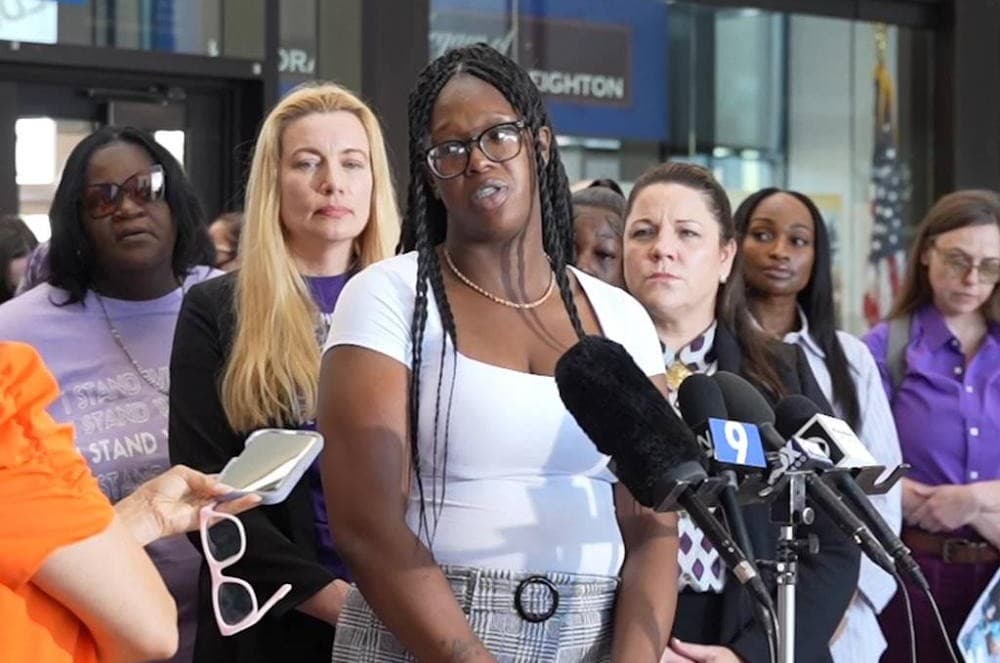








Keshia Golden was eight months pregnant when her baby shower, thrown to celebrate the daughter she was carrying, ended in violence. Ms. Golden says that hours after the guests left, her boyfriend, Calvin Sidney, slammed her head into the kitchen counter, over and over. She says she grabbed a knife from that same counter and stabbed him once, to keep herself and her unborn child alive.
Ms. Golden was slapped with a first-degree murder charge in Mr. Sidney’s death up in Cook County Jail on $2 million bail, facing the possibility of giving birth behind bars until a community group scraped together the money to post her bond.
Police had been called to the couple’s home more than 50 times before that night. Advocates point to Ms. Golden’s case as proof that the system keeps failing women who kill the men who beat them. Her outcome, though, is the rare one — most women who fight back against an abuser do not walk free.
Ms. Golden’s ordeal dragged on for nearly four years before it ended. She was days from a bench trial that could have sent her to prison for two decades when Cook County prosecutors offered her a plea to involuntary manslaughter instead.
Ms. Golden took it, choosing two years of probation over the risk of raising her newborn daughter from behind bars, and on August 24 she walked out of a Chicago courthouse having finally heard the word her attorneys had spent years fighting for: probation.
Her case is not an outlier so much as a rare win.
Stand-your-ground laws, now in effect in more than half of American states, remove a person’s legal duty to retreat before using deadly force, allowing a self-defense claim even when escape was possible. But self-defense law, some experts contend, was not built with a pregnant woman fighting for her life in mind.
According to a frequently cited study published in 1989 by the National Coalition Against Domestic Violence, women who killed their domestic partners were sentenced to an average of 15 years in prison while men who committed the same crime faced an average of just two to six years.
More recent national sentencing data is not readily available but a statistical analysis of 237 stand-your-ground cases in Florida between 2005 and 2013 found that, in cases involving a domestic partner, women faced conviction at twice the rate of men — roughly 80 percent compared with 40 percent — even after researchers controlled for the same circumstances.
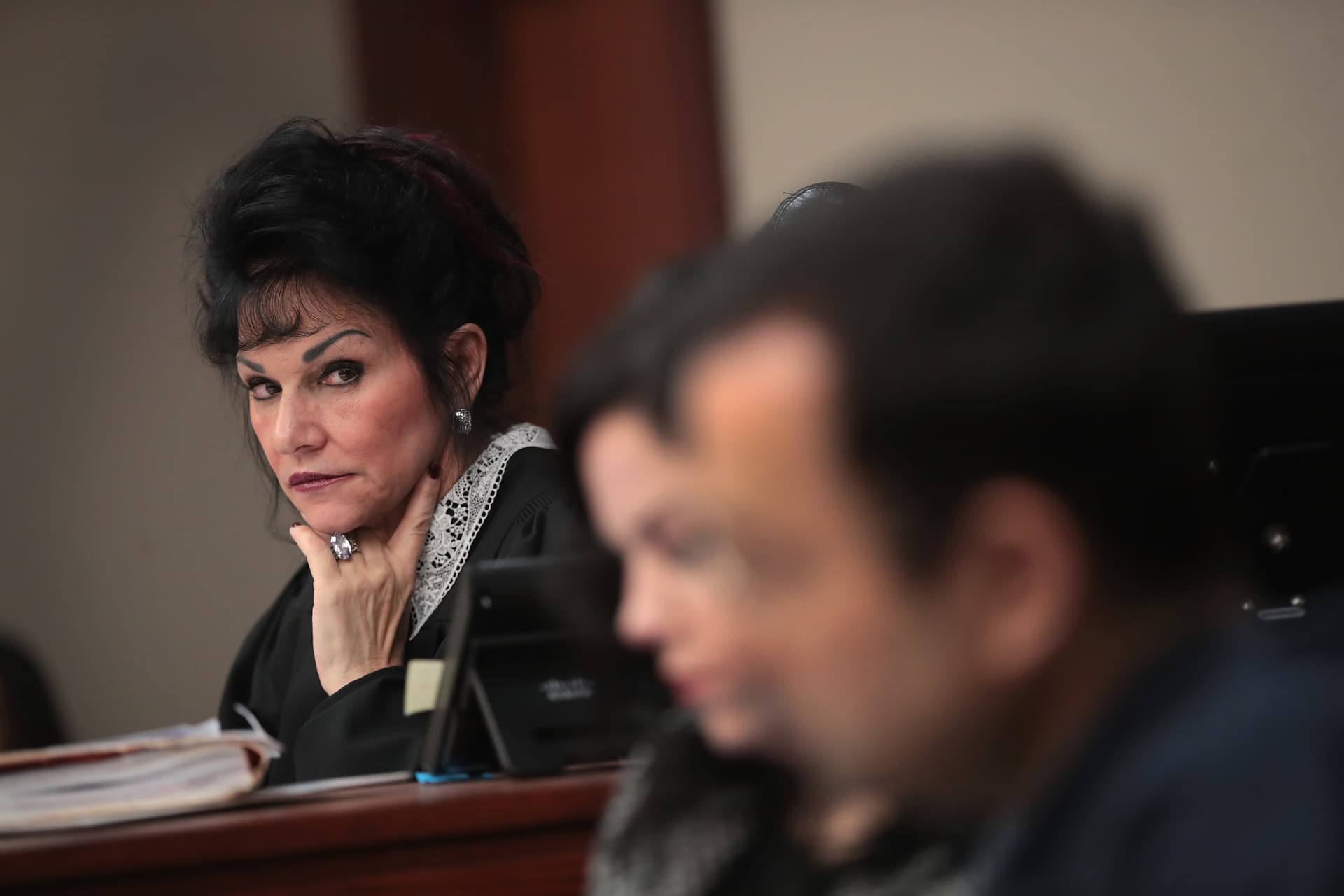
“Self-defense law wasn’t designed for women,” a professor of law at the University of Maryland, Leigh Goodmark, tells The New York Sun.
Self-defense doctrine, Ms. Goodmark says, assumes two people of similar size reacting to a single, isolated incident — not a man and a woman who is often smaller and weaker than her partner after enduring months or years of escalating violence, and who may turn to a weapon precisely because she cannot match him with her bare hands.
So why does a woman defending her own life, and her unborn child’s, so often draw a harsher sentence than the man who beat her would have if their roles were reversed?
One answer shows up in the data on self-defense claims themselves.
A Standard Built for Strangers, Not Spouses
Ultimately, self-defense law in America grew up around one scenario: A stranger, a sudden attack, nothing more. Courts have long required that the danger be imminent — not looming, not likely, but happening right then.
North Carolina’s Supreme Court put it plainly in the oft-cited State v. Norman: the threat has to be immediate. That standard was built for a single violent encounter between people who don’t know each other. It was never built for a marriage.
If a masked man corners a woman on the street and she kills him to escape, a jury has little trouble calling it self defense. Domestic violence, however, rarely plays out that way. The danger compounds over months or years, through isolation and threats, until the survivor believes, often correctly, that the next incident could be fatal — a history a jury weighing “imminence” at a single moment in time is not always allowed to hear in full.
It is precisely that disparity between the law as written and the reality of abuse that a wave of Survivors Justice Acts, now on the books in six states, is meant to close. New York passed the first, the Domestic Violence Survivors Justice Act, in 2019; Illinois, California, Oklahoma, and Georgia followed over the next several years, and New Jersey became the sixth state to sign one into law this past January.
The laws don’t touch the self-defense standard itself. What most of them do instead is let a judge weigh a documented history of abuse as a mitigating factor at sentencing and let people already locked up apply, years later, to have that sentence looked at again. That’s the promise, anyway. In practice, it hasn’t always held up.
Petitions can sit in the courts for months, sometimes years. Prosecutors often fight to keep the evidence of abuse out entirely. And judges, even with the new law on the books, still tend to side with the state’s version of what happened over the survivor’s account of what led her there.
That mismatch between the law and the reality of abuse, stacked on top of a deeper double standard in how courts judge violence committed by women, is what keeps the sentences so lopsided.
“There is a profound gendered double standard when it comes to women who commit violence against their male abusers versus men who commit violence against their female partners,” says the executive director of Rights4Girls, Yasmin Vafa, who has spent over a decade tracking what her organization calls the “abuse-to-prison pipeline.”
A man who kills his partner is often viewed as someone who simply lost control in a moment of anger, she tells the Sun. A woman who fights back is viewed in a different light, as someone who crossed a line. Often, Ms. Vafa says, systems meant to protect abuse victims end up funneling them into confinement.
“These women and girls are underprotected and overpoliced,” she stresses.
What that mismatch means in practice has played out in courtrooms nationwide for more than a decade, in cases where women describe defending themselves against years of violence and are met with sentences that treat the killing as if it came out of nowhere.
Marissa Alexander, a resident of Jacksonville, Florida, fired a single warning shot into a wall in 2010 after she says her husband choked her and threatened to kill her; no one was hurt. Still, Florida’s mandatory-minimum gun law sent her to prison for 20 years — longer than many men in the state serve for actually killing a partner.
A 2014 plea deal capped her sentence at time served, but she wasn’t fully free until 2017, when her probation finally ended — the tail end of a five-year fight that had already turned her case into a rallying point for critics of Florida’s self-defense statutes.
In Oklahoma, both April Wilkens and Tyesha Long say the men they killed had strangled, raped, and beaten them for years before the fatal encounter. Ms. Wilkens says the abuse ran through her entire two-year relationship with Terry Carlton, whom she killed in 1998.
Ms. Long says her four-year relationship with Ray Brown, whom she killed in 2020, turned abusive not long after it began when she was 17 and he was 53.
Both women applied for resentencing under the state’s 2024 Survivors Act, asking judges to weigh that history the way the law intends. Both were denied within the past year and are now appealing, a reminder that a state passing a survivors’ law is not the same as a judge applying it.
What the Data Says About Who Gets Punished
Beyond these individual cases, the broader numbers on incarcerated women paint much the same picture. Around 90 percent of women incarcerated for killing a man had previously been abused by him, and more than two-thirds of the judges deciding those cases were men, according to figures cited in reviews of clemency and sentencing data.
Researchers who study courtroom outcomes say that unfamiliarity with the dynamics of long-term abuse can shape how a judge, or a jury, interprets a woman’s account of fear and survival.
Separate research has found that stand-your-ground protections do help a woman who kills a stranger, raising her odds of a justified ruling much as it does for men; It is specifically in cases involving an intimate partner that the odds turn against them.
In practice, self-defense is still measured against a male template, some researchers point out.
“Self-defense is still defined by male behavior, for example, by two men duking it out with guns or fists,” the founding director of the Michigan Women’s Justice & Clemency Project at the University of Michigan, Carol Jacobsen, tells the Sun.
Coercive dynamics and threats, Ms. Jacobsen explains, land more forcefully on women and other vulnerable people because of how they are socialized, while prosecutors, judges and juries tend to lean on gender and racial stereotypes when deciding who to charge and how harshly.
