The Scopes Centenary
America marks a century of condescension toward religious fundamentalists that spread from the trial in Tennessee of a teacher who taught Darwin.
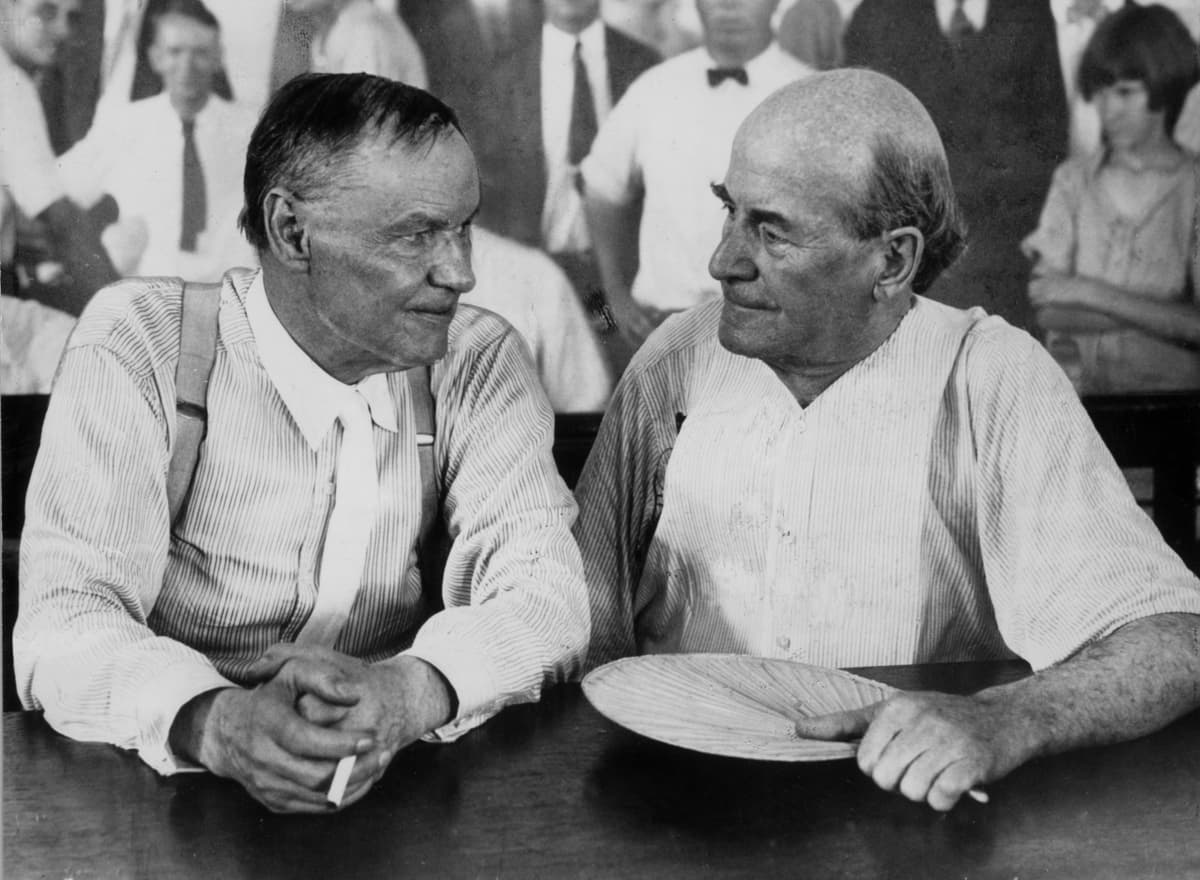

The amazing thing about the 100th anniversary of the Scopes trial being marked this month is the enduring nature of the questions it brought to the fore. These are live disputes in the courts today. What is the proper extent of faith in the public sphere? Is it legal to exclude religious teachings and rules of conduct from public curricula? Can the Ten Commandments be taught in public schools? Are religious schools eligible to receive taxpayer funding?
The trial itself, State of Tennessee v. John T. Scopes, took place at Dayton, Tennessee, in July 1925 as the Volunteer State prosecuted a teacher for breaking a law against teaching Darwinâs evolution theory in the public schools. The case pitted two legal titans, the leftist defense attorney Clarence Darrow and the populist three-time Democratic presidential candidate William Jennings Bryan. Darrow, an avowed agnostic, represented Scopes.
Bryan represented the state whose law sought to block Darwinâs theory and protected religious believers. Even though he won a conviction of Scopes, the ordeal of the trial was such that Bryan died shortly after its conclusion. The contretemps ended in what might be called a pyrrhic victory for Scopes. Tennesseeâs supreme court upheld the constitutionality of the anti-evolution law but acquitted Scopes on a technical question regarding the fine.
Then again, the trial proved a hollow victory for Bryan, too. His cause, writ large, is still being litigated in the land. The condescension, if not outright hostility, evinced during the trial toward the religious fundamentalists abides. Far from conceding the legitimate differences of opinion on the issue of the trial, Darrow insisted: âWe have the purpose of preventing bigots and ignoramuses from controlling the education of the United States.â
From the distance of a century, Darrowâs tone of smug superiority sounds a familiar ring amid debates today between believers and secular elites. At the same time, Bryan did his cause few favors by overstating the stakes in the dispute, The New York Sun argued in an editorial, headlined âMr. Bryan at Dayton.â Before the trial began, Bryan arrived on the scene in a âhuge pith helmet,â the Sun reported, and âsolemnlyâ announced: âChristianity is on trial.â
The Sun editorial disagreed with Bryanâs appraisal: âThis is nonsense.â It was âyoung Mr. Scopesâ â but 24 years old â who was on trial, the axiomatic Sun said. Further, the editorial noted that ânothing in the purely scientific theory of evolution tends to subvert the Christian belief in the divine attributes of the human soul.â So, the Sun averred, Bryan blundered by calling âthe contest between evolution and Christianityâ a âduel to the death.â
The Sunâs more nuanced view of the dispute offered a kind of modus vivendi for believers and secularists to navigate contentious questions of faithâs place in the public sphere. Yet others in the press instead took Darrowâs approach of mocking Bryan. H.L. Mencken, who coined the term âMonkey Trial,â called Bryan âa charlatan, a mountebank, a zany without sense or dignityâ and âa poor clodâ who was âdeluded by a childish theology.â
Something of that contempt lingers today in, say, the Timesâs op-ed on the Scopes trialâs centenary by Georgetownâs Michael Kazin. Marking the persistence of faith in the nationâs rural precincts, he says, âDemocratic politicians will have to figure out how to work around such wrongheaded notions.â Meantime, the Supreme Courtâs conservative majority has been busy protecting the free exercise rights, set forth in the Constitution, of religious believers.
Feature, say, the right of bakers to hew to their faith, or of religious schools to get public funding for playground upgrades or to be eligible for state vouchers, or of nuns to be exempted from having to provide their employees insurance coverage for contraception. Such vindications of believersâ rights establish safe space in the public sphere for those of faith. What a contrast to the liberalsâ contempt of fundamentalism that erupted in Tennessee a century ago.