A ‘Sickening Shrine to Hezbollah’: AP Draws Criticism for Story About the ‘Path to Recovery’ of Injured Terrorists

‘It’s an utter disgrace that this ‘news’ agency is writing puff-piece articles designed to garner sympathy for terrorists,’ Congresswoman Claudia Tenney writes.

AP/Hassan Ammar
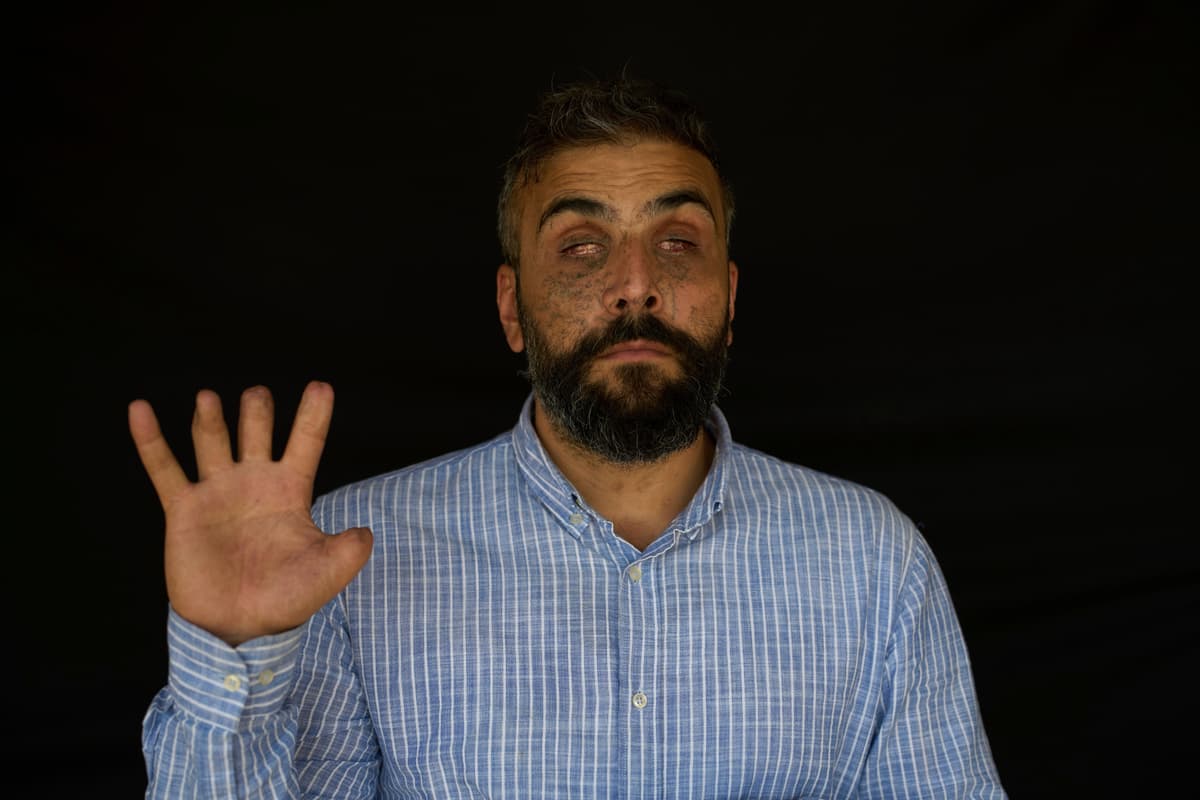
One of the photographs from the Associated Press's feature on the 'road to recovery' for Hezbollah fighters injured in last year's pager attacks on the terrorist group. AP/Hassan Ammar

The Associated Press is being accused of serving as a propaganda arm of Hezbollah after the wire service published an article and photo essay that appears to portray Hezbollah operatives as sympathetic victims rather than members of a designated terrorist organization.

The article, posted on Wednesday, chronicles the experiences of six “Hezbollah officials or fighters or members of their families” who were injured in Israel’s September 2024 pager operation. The story details the Hezbollah operatives’ “slow, painful path to recovery” and includes striking photographs showing injuries sustained in the attack.

The feature, however, drew sharp rebukes from lawmakers and journalists who questioned the AP’s editorial approach. “If you think this sounds insane, it’s because it is. AP is literally treating Hezbollah terrorists as victims,” a conservative reporter, Stephen L. Miller, wrote online

An economic historian at Hebrew University, Yannay Spitzer, lambasted the AP for including sources that were “simply hand-picked” by Hezbollah and suggested that the piece was no different from a Hezbollah “PR document with an AP seal of approval.” The AP notes in the article that a member of Hezbollah helped source contacts. 

A seasoned journalist, Peter Savodnik, took the article as a sign that there is “no saving legacy media.” On Capitol Hill, the AP’s article got a rise out of Representative Claudia Tenney, who chided the news agency for “writing puff-piece articles designed to garner sympathy for terrorists” and claimed that revoking the AP’s access to the Oval Office was “one of the best decisions of the last 6 months.” 

A representative from Georgia, Mike Collins, mocked the AP for appearing to plead, “Won’t someone PLEASE think of the terrorists?” Representative Esther Panitch similarly quipped: “those poor, poor terrorists.” 

The article in question was touted by the AP as “a rare glimpse into the human cost” of the Israeli pager attack. The sophisticated operation was carried out by Israel’s Mossad, which secretly manufactured and sold to Hezbollah thousands of pagers with hidden explosives. In September 2024, the explosives were detonated nearly simultaneously, injuring some 3,000 Hezbollah members and killing at least 30. 

The attack wasn’t designed to eliminate Hezbollah terrorists en masse, but rather to inflict wounds that would strain Hezbollah’s resources and limit its fighter force. The operation was praised for its accuracy and low civilian death rate. 

The AP’s article focuses on several individuals who were directly affected by the attack. One of the interviewees includes 23-year-old Hezbollah fighter, Mahdi Sheri, who lost his left eye when his pager detonated. 

“For a while, he could see shadows with his remaining eye. With time, that dimmed. He can no longer play football. Hezbollah is helping him find a new job. Sheri realizes it’s impossible now to find a role alongside Hezbollah fighters,” the AP wrote.

Notably absent from the article is the word “terrorist.” The AP, rather, opts to describe the Hezbollah combatants as “fighters” or members as a “militant group” or “a major Shiite political party with a wide network of social institutions.”

Hezbollah, which serves as a powerful Iranian proxy in Lebanon and has been behind numerous attacks on Western interests, has been designated by America and several other countries as a terrorist group. 

The article does, however, include dozens of images of the combatants and their wounds. Several of them are staged portraits. The high-contrast lighting and black background emphasizes their scars and lost limbs. 

“The disfigured Hezbollah operatives appear mythic, stoic, tragic. Not for what they’ve done, but for what’s been done to them,” a media watchdog group, HonestReporting, wrote. “The visual language here is not accidental. It mimics portraiture used for cancer survivors, injured veterans, and victims of domestic violence. The kind of images that demand empathy and suspend judgment.”

HonestReporting branded the article a “sickening shrine to Hezbollah” and lambasted the AP for not once mentioning “what these men were doing before they were injured: actively working to kill Israelis.” The group adds: “These were not bystanders caught in crossfire. These were operatives of an Iranian-backed terror group.” 

The AP has not yet responded to the Sun’s request for comment.


The New York Sun

© 2025 The New York Sun Company, LLC. All rights reserved.

Use of this site constitutes acceptance of our Terms of Use and Privacy Policy. The material on this site is protected by copyright law and may not be reproduced, distributed, transmitted, cached or otherwise used.

The New York Sun

Sign in or  create a free account

or
By continuing you agree to our Privacy Policy and Terms of Use