After a Deadly Weekend in Ukraine, Kremlin Warns British Tanks ‘Will Burn’
Ukraine also was on the counterattack in multiple areas, with reports indicating a renewed drone assault on Russian-occupied Crimea.
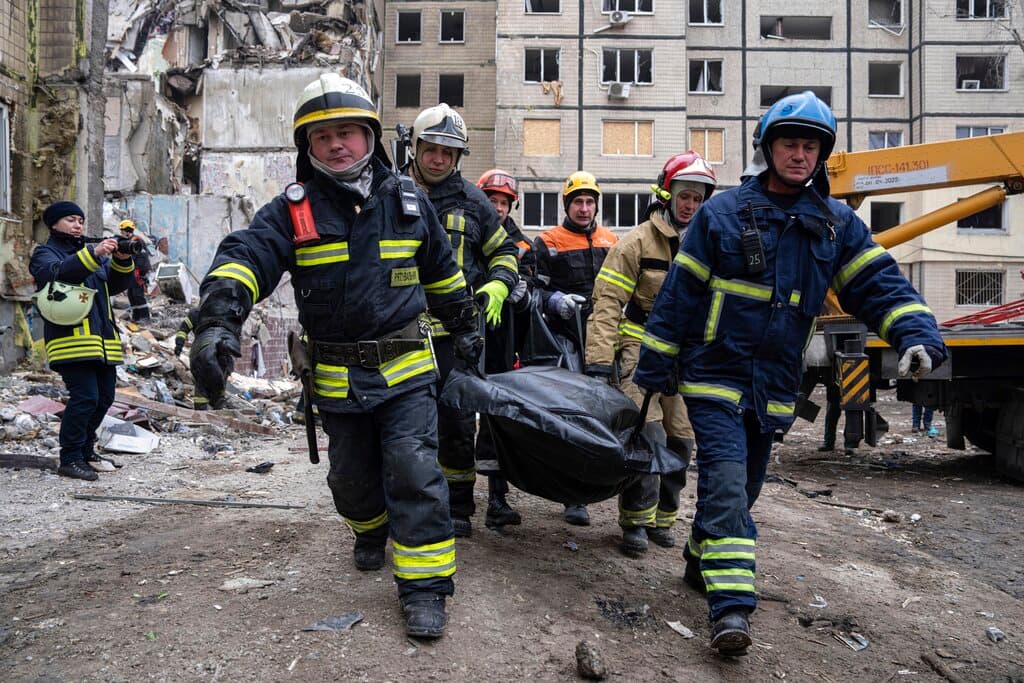

Any hopes of a winter lull in the Ukraine hostilities have been dashed, as Russia on Monday launched a rocket attack on the central city of Zaporizhzhia, injuring five people including two children. That follows a weekend of terror that saw 40 people killed and 75 injured, including children, in a Russian missile strike on Dnipro and three killed and 14 injured during heavy Russian shelling of the Kherson region.
The death toll from the Russian attack on an apartment building at Dnipro made it the deadliest attack in a single Ukraine location since a September 30 strike in the Zaporizhzhia region, one of the four Ukrainian areas Moscow has illegally annexed. In his nightly video address, President Zelensky said one of the victims of the attack was a 15-year-old girl.
Ukraine also was on the counterattack, not only at the eastern salt-mining town Soledar, where Russia’s claim to victory may be premature, but at lso in the Russian-annexed Luhansk region, where the Russian state-run news agency Tass reported on periodic incoming Ukrainian fire.
There were also reports of a renewed Ukrainian drone assault on Russian-occupied Crimea on Monday. The Russian news agency Interfax reported that incoming drones had set off Russian air defenses over the city of Sevastopol.
Against this volatile backdrop, the U.S. military has begun expanded combat training of Ukrainian forces in Germany. The AP reported that the training started on Sunday, with a goal of getting a battalion of about 500 troops back on the battlefield to fight the Russians in the next five to eight weeks, according to the chairman of the Joint Chiefs of Staff, General Mark Milley, who will visit the Grafenwoehr training area on Monday.
In the meantime, the Wall Street Journal reported that Ukraine is using up Western-supplied artillery shells about twice as fast as America and allies are producing them. At the current pace, American and European stocks could be reduced to a critical level by the summer. The newspaper noted Ukraine’s own defense industry has been destroyed during the Russian military operation, making the country almost completely dependent on the supply of weapons from the West.
By the time U.S. and European stockpiles are likely to hit critical levels, Russia could expand its own production. Although the West will ramp up munitions production, it won’t have much impact until next year. This creates, according to the WSJ, a “potentially dangerous gap between the firepower of Ukraine and Russia in the second half of 2023.” This is exacerbated by Russia’s defense industry being on a war footing while in Washington and the West the industry is largely following peacetime procedures and schedules.
That led a retired British air marshal, Edward Stringer, to assess that the West is “just prolonging the war” by continuing to supply Ukraine with a limited amount of weapons — so much “so that Ukraine does not lose.” Mr. Stringer added: “Whether we realize it or not, Russia has challenged the West. And although our troops are not fighting there, we are fully involved in this conflict, and we must provide equipment in order to win.”
The Pentagon will be sending 50 Bradley armored fighting vehicles, which can transport infantry in combat zones, to Ukraine soon. There are additional signs that the thinking on what weapon systems could be deemed too escalatory is shifting in Kyiv’s favor. Britain will be sending 14 Challenger 2 tanks to Ukraine.
Prime Minister Sunak said over the weekend that a window has opened in the Russian-Ukrainian war in which London and partners could exert “maximum influence.” While the Challenger tanks are part of that equation, it is likely that Ukraine needs several dozen more at least to be able to press its advantage on the front lines.
The Russian response to the news of Britain’s provision of the tanks was frosty: “These tanks are burning and will burn just like the rest,” the Kremlin spokesman, Dmitry Peskov, said on Monday. He was possibly unaware that the vehicles had not yet arrived in Ukraine.
More troublingly, Mr. Peskov said last week that the Kremlin was seeing “certain problems with the military-industrial complex” of America and its allies in connection with the continuation of supplies to Ukraine.
According to the latest British ministry defense assessment on January 16, over the last six weeks Russia and Ukraine have “achieved hard-fought but limited gains in different sectors.” In such circumstances, a “key operational challenge for both sides is to generate formations of uncommitted, capable troops which can exploit the tactical successes to create operational breakthroughs.”
As of mid-January, amid a constantly evolving geopolitical picture one inescapable fact is that in the eastern Donbas at least, a brutal war of attrition is under way. Whether major new hostilities will erupt around Zaporizhzhia and Mykolaiv in southern Ukraine, which given the poorly trained and ill-equipped Russian army could help turn the tide in Ukraine’s favor, remains to be seen.

