After Bombing of Polish Train, Fingers Point to Russia 

‘Russia is really trying to test how far they can go,’ the European Union’s top diplomat avers. ‘We should fight.’

AP/KPRM
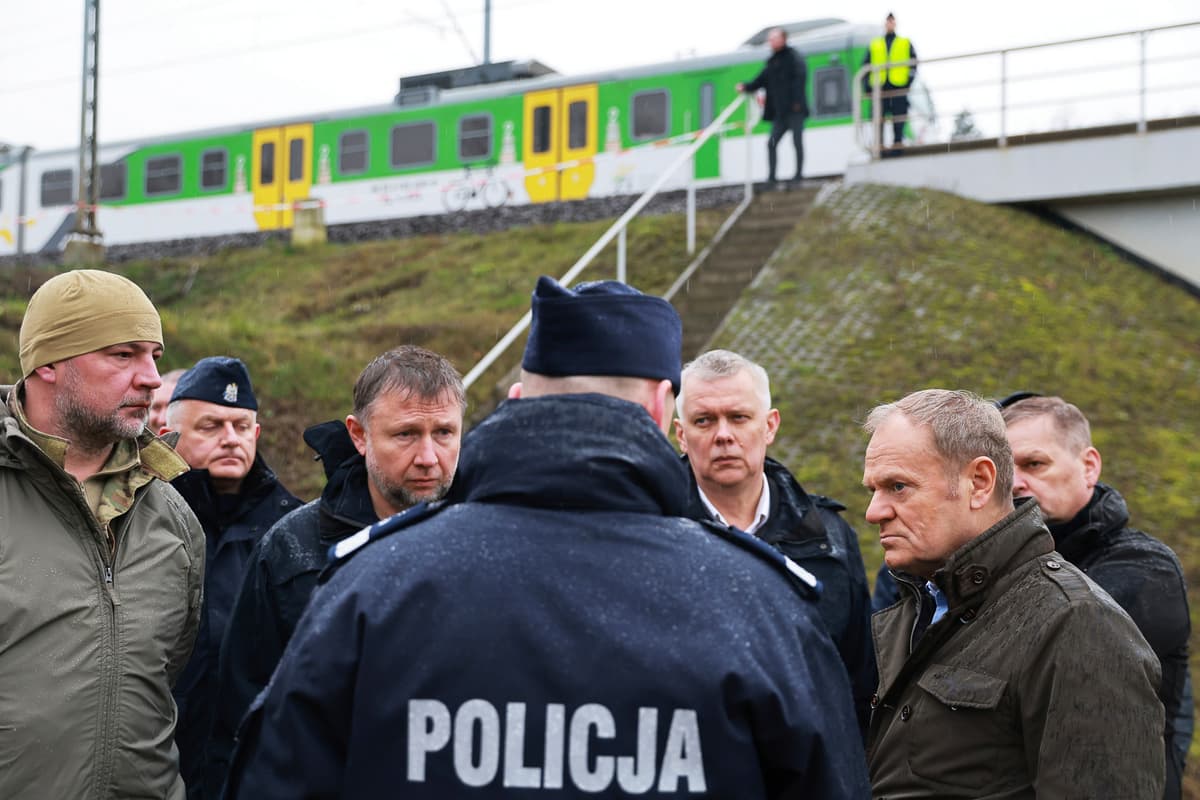
Prime Minister Donald Tusk, second right, visits site of the rail line Mika, that was damaged by sabotage, near Deblin, Poland, November 17, 2025. AP/KPRM

Two Ukrainian saboteurs, apparently in the pay of Russia, used military grade C-4 explosives to blow up a busy rail line in Poland, Prime Minister Donald Tusk charged yesterday. A cell phone had been set up to film what was designed to be a mass casualty event on Saturday, he said. The two suspects were recorded returning to Belarus, a Russian satellite state. Polish authorities say today that they have arrested multiple suspects in the attack and will close Russia’s last consulate in Poland, at Gdansk.

The sabotage comes as Russia seems to be moving toward more concrete actions after testing NATO’s responses. On Monday, Russian drones hit a gas tanker flying the flag of Turkey, a North Atlantic Treaty member. The enormous fire at Ukraine’s Izmail port forced evacuations of two villages across the Danube River in Romania, another NATO state. 

These acts against three NATO nations should be considered “state-sponsored terrorism,” the European Union’s top diplomat Kaja Kallas told a Bloomberg event  yesterday. Ms. Kallas, a former prime minister of Estonia, another NATO nation, said: “These sabotage acts they are organizing on our territories in different countries are extremely, extremely serious.”

The Poland explosion was one of two sabotage attacks over three days on a main line that connects Warsaw and Lublin, the largest city in Eastern Poland. This rail line carries 115 trains a day, a mix of passengers and freight. With Poland serving as the prime logistical hub for Western arms to Ukraine, many shipments pass through Lublin.

Several passenger trains went over the bomb before it exploded beneath a freight train, Mr. Tusk told reporters. “The goal was to cause a rail catastrophe,” he briefed Poland’s Parliament yesterday. He said it was  “probably the most serious” act of sabotage in Poland since the start of Moscow’s full-scale invasion of Ukraine almost four years ago. Over the last two years, 55 people had been detained in Poland on suspicion of sabotage, Mr. Tusk said. 

Russia touches three NATO states in a day — and the Alliance barely blinks,” Atlantic Council senior fellow Michael Bociurkiw wrote yesterday.  “Russia didn’t ‘accidentally’ brush up against NATO this week — it engineered a 24-hour stress test of the alliance.”

Ms. Kallas, a hawk on Russia, said yesterday: “Russia is really trying to test how far they can go. We should fight.”

In retort, Kremlin spokesman Dmitry Peskov told reporters in Moscow: “It would be very strange if Russia were not the first to be blamed.” In Poland, he said, “Russophobia is flourishing.”

The bombing comes after weeks of drones buzzing European airports, causing temporary closures in Belgium, Denmark, Germany, Norway and Sweden. Apparently designed to gather intelligence and to test air defense responses, many of the drones appeared to take off from Russian mother ships moving through international waters.

For its part, Ukraine sent long range drones toward Moscow yesterday, forcing the city’s two busiest airports, Sheremetyevo and Vnukovo, to suspend all air traffic for several hours.

Sixteen months ago, exploding packages caused fires in air cargo warehouses in Britain, Germany, and Poland. Yesterday, the Washington Post reported that Western countries are fighting with Russia to extradite from Azerbaijan a 37-year-old Russian man,  Vladimir Mikhailov, suspected of orchestrating the firebomb attacks. In Poland and Lithuania, more than 20 others are facing terrorism or other charges in the scheme.

Noting that several “test” packages had been sent to Ottawa and Washington, investigators told the Post that they fear the goal was to bring down trans-Atlantic cargo flights. To avoid details coming out in a trial, the heads of Russia’s three Russian intelligence services — the FSB, SVR, and GRU — “have been directly involved in pressuring Azerbaijan to return Mikhailov to Russia,” the Post reported.

In Poland, Russia’s use of two Ukrainians may have been to stir up anti-Ukrainian feelings in Polish society. Noting that Poland is home to 1 million Ukrainian refugees, Mr. Tusk told Parliament: “What the Russian authorities care about is not only the direct effect of this type of action, but also the social and political consequences.”

Last year, Russian sabotage events in Europe were about three times higher than in 2023, according to a new report by the International Institute for Strategic Studies. The attacks boost support in Poland for rearmament. Dedicating almost 5 percent of GDP to defense next year, Poland plans to build a million-man army, the largest NATO army in Europe.

“As NATO countries we will mount a decisive resistance, we will essentially build Cold War 2.0,” the Polish Army chief of general staff, General Wiesław Kukuła, told Radio Jedynka, last weekend, before news of the rail sabotage emerged. “We will invest heavily in defense capabilities.” 

Meanwhile, the sabotage has alarmed Poland, a heavily rail-dependent nation of 38 million people. During the first half of this year, 40 million passengers rode the kind of intercity trains that connect Warsaw and Lublin. 

Starting today, says the Polish defense minister, Władysław Kosiniak-Kamysz, police and military  forces are reinforcing patrols of potentially vulnerable points in the 11,700-mile network — bridges, viaducts, tunnels, stations, and control systems.


The New York Sun

© 2025 The New York Sun Company, LLC. All rights reserved.

Use of this site constitutes acceptance of our Terms of Use and Privacy Policy. The material on this site is protected by copyright law and may not be reproduced, distributed, transmitted, cached or otherwise used.

The New York Sun

Sign in or  create a free account

or
By continuing you agree to our Privacy Policy and Terms of Use