Ahead of Columbus Day, Trump Burnishes the Explorer’s Legacy
Restoring the holiday’s proper name jibes with the president’s push to restore ‘truth and sanity to American history.’
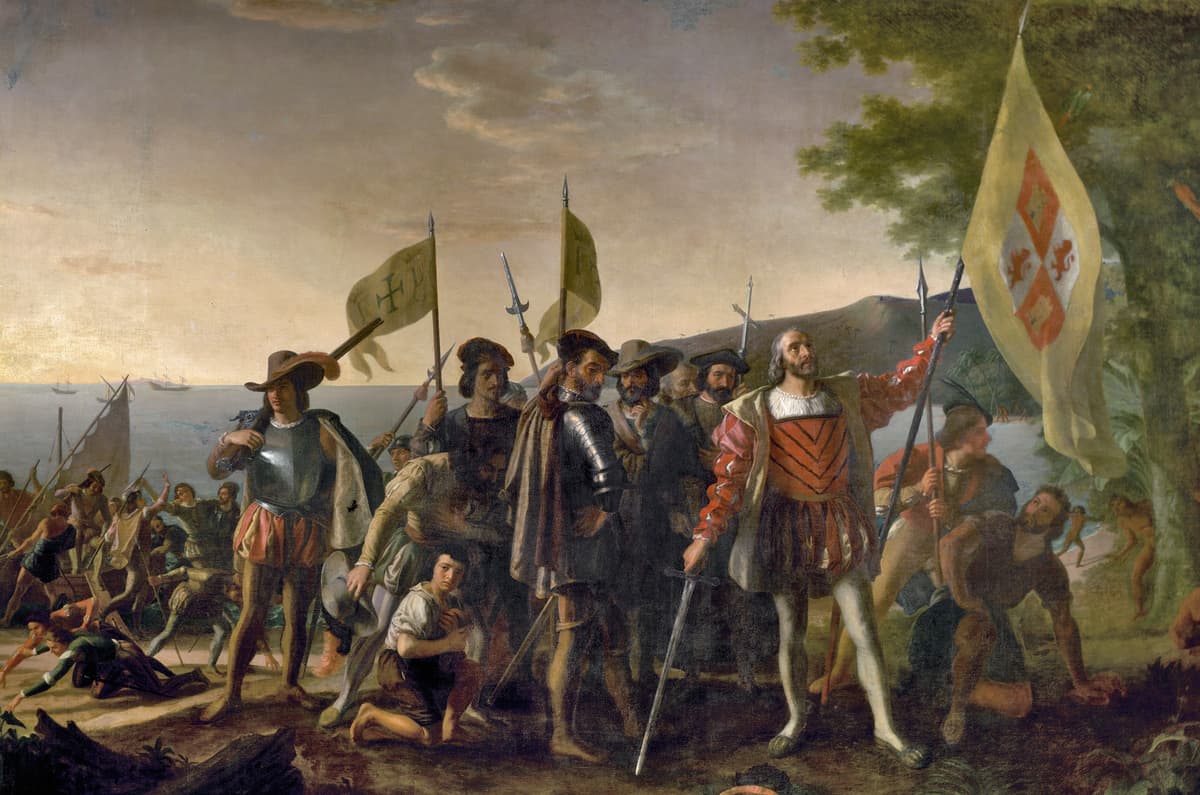
Nice to see President Trump burnishing the legacy of “the original American hero,” Christopher Columbus, by restoring the explorer’s name to the federal holiday first celebrated in 1892. The nod to the Admiral of the Ocean Sea follows attempts to downplay, or even denigrate, Columbus’s achievement by renaming the occasion as “Indigenous Peoples Day.” Mr. Trump’s move jibes with his push to restore “truth and sanity to American history.”
“Outrageously, in recent years, Christopher Columbus has been a prime target of a vicious and merciless campaign to erase our history, slander our heroes, and attack our heritage,” says the proclamation signed Thursday by Mr. Trump. No one is suggesting that celebrating Columbus’s achievement needs to come at the expense of the peoples of the Western Hemisphere at the time of the explorer’s discovery.
The Columbus Day holiday has always been an occasion to mark the scale of the explorer’s achievement — which, among other things, made possible the birth of America — while also acknowledging the downsides of the encounter between the Old and New Worlds. There’s no need to whitewash the fact that the arrival of Europeans on these shores ravaged the native population, if inadvertently, via disease, nor to ignore the scourge of slavery.
Too often, though, in recent decades, the pendulum of sentiment among left-leaning intellectuals, academics, and politicians has swung to overlooking the courage displayed by Columbus and his fellow explorers and to shrugging away the transformative implications of the European discovery of America. The editors of The New York Sun, in an editorial on October 12, 1892, made no such muddle of the meaning of Columbus’s landfall.
“Four hundred years ago, on Oct. 12, at two o’clock in the morning, a gun fired on the Pinta announced to the little fleet of COLUMBUS that at last the unknown land actually had been sighted,” the Sun’s editorial began. Four hundred years to the day after “the Pinta’s signal gun gave the welcome intelligence,” the Sun hailed “the culmination of the great celebration of that discovery in New York.”
Of Columbus, the Sun noted, “the New World he found is not an earthly paradise, a land of perfect happiness, but of a verity it has proved to be a land of hope and promise for all mankind.” The editorial, grasping the stakes of the discovery of America, added that “here in this republic seventy millions of people are enjoying to-day a larger measure of political freedom and material prosperity than ever before fell to the lot of any nation.”
Such sentiments might sound quaint at a time when the candidate leading in the polls to become mayor of New York City, Zohran Mamdani, in a tweet in 2020 made a coarse gesture in respect of a Columbus statue at Astoria, Queens, with the message “take it down.” That kind of animus is best seen as being directed not merely to the person of the explorer, but to the glories of Western civilization that Columbus has come to symbolize.
In 1892, by contrast, the Sun marveled on Columbus Day how “from one end of the town to the other, in the streets of the poorest and the avenues of the richest,” the “popular enthusiasm is fairly bewildering.” Like Mr. Trump today, the Sun saw that “it is the celebration of an event which in the true popular estimation is the greatest in all history, the discovery of a new world and the opening up of the land which brought the highest benefits to mankind.”