

America and Ukraine Follow a Similar Strategy: Pinch the Oil Exports of Your Enemy

Turkey’s president holds a face-to-face meeting with his Russian counterpart and asks for a ‘ports’ ceasefire.
AP/Efrem Lukatsky
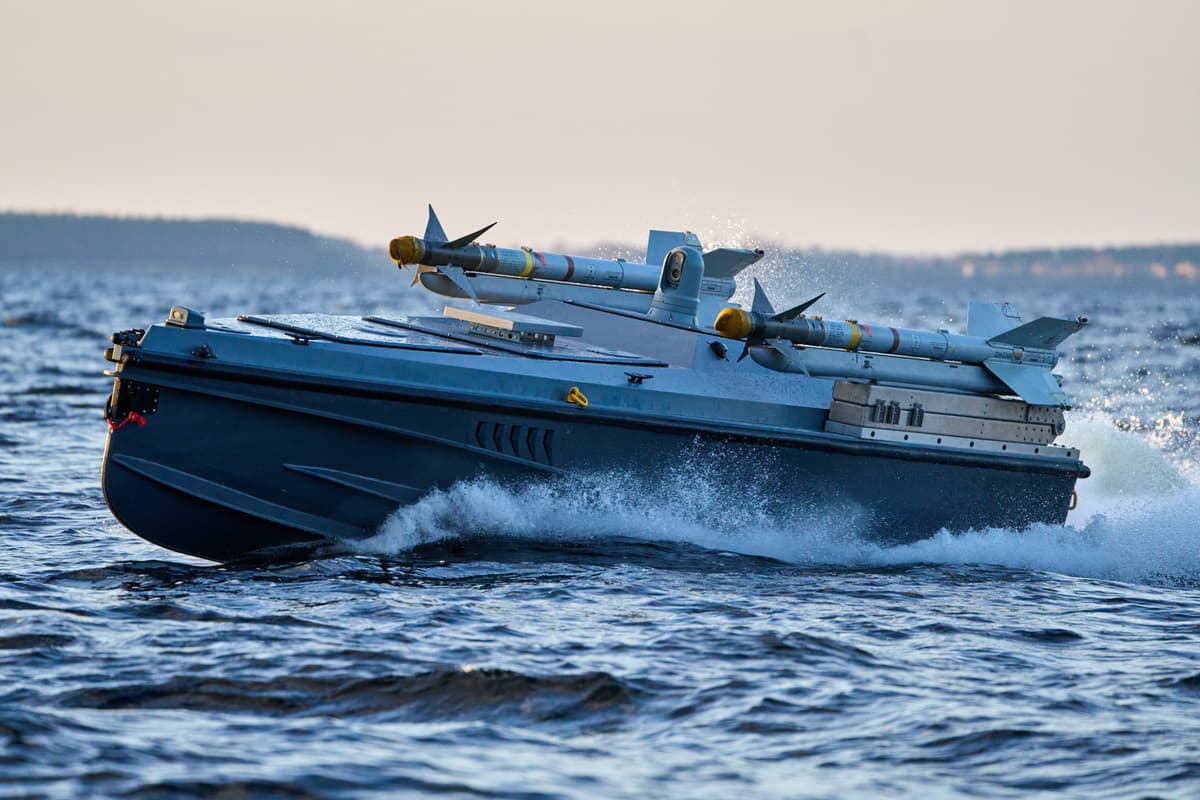
A sea drone Magura V7 of Ukraine's Defence Intelligence equipped with surface-to-air missiles at an undisclosed location, December 6, 2025. AP/Efrem Lukatsky

While Ukraine peace proposals pingpong across the Atlantic, Russia and Ukraine fight naval warfare — 21st century-style. Yesterday, Russian drones and missiles hit three Turkish ships in two Ukrainian Black Sea ports. The attack came hours after Turkey’s president held a face-to-face meeting with Russia’s president to ask for a “ports” ceasefire.

President Recep Tayyip Erdoğan’s appeal to Vladimir Putin came after Ukrainian “Sea Baby” maritime drones hit three oil tankers over the last two weeks in Turkish Black Sea waters. In response, insurance rates for Black Sea shipping have doubled and tripled. Turkey controls the Bosphorus, a key strait for transporting Ukrainian grain and Russian oil to the Mediterranean and the wider world.

On the cheap, Ukraine is following the same tactic America is using against Venezuela. On Wednesday, the United States seized a tanker that was leaving Venezuelan waters with a cargo of oil for export. By squeezing oil exports, both countries seek to cripple their oil-rich adversaries.

oil
An oil tanker is moored at the Sheskharis oil and petroleum complex on the Black Sea port of Novorossiysk, Russia in 2022. AP

“What the Ukrainian armed forces are doing now is piracy,” Russia’s leader fumed in televised remarks 10 days ago. Over the last year, Ukrainian frogmen around the world are believed to have attached limpet mines to seven tankers carrying Russian oil. Undeterred by the Russian leader’s threats, Ukraine last week opened a second maritime war front — the Caspian Sea.

For the first time, Ukrainian cruise missiles on Wednesday hit Russian oil and gas rigs in the Caspian Sea, about 500 miles east of Ukraine’s border. Realizing that the rigs were billion-dollar sitting ducks, the Ukrainian returned the next day to hit one platform a second time. Production at 20 wells has stopped, impacting about 5 percent of production at Russia’s second-largest oil company, Lukoil.

Separately, Ukraine claimed authorship of attacks on two Caspian ships carrying arms to Russia from Iran. Figuring on American and British sanction lists, the ships, the Kompozitor Rakhmaninov and the Askar-Saridzha, had their cargo and movements relayed to Kyiv by Black Spark, a Russian rebel group, report the Ukrainian Special Operations Forces.

sea drones
A sea drone Magura V7 of Ukraine’s Defence Intelligence equipped with surface-to-air missiles at an undisclosed location, December 6, 2025. AP/Efrem Lukatsky

The maritime attacks come as the Russia-Ukraine land war is a see-saw. After an 18-month long siege, Russia has taken most of Pokrovsk, a district capital. By contrast, between 1942 and 1943 Soviet soldiers bested the Nazis after five months in the Battle of Stalingrad.

In a reversal for Russia, a surprise Ukrainian counterattack this week succeeded in liberating much of Kupyansk, 130 miles east of Pokrovsk,  from Russian occupiers. Taunting the Russians, President Volodymyr Zelensky yesterday posed for a selfie in front of a bullet-ridden “Welcome to Kupyansk” sign. About 200 Russian soldiers are reported to be encircled at a city suburb.

From Washington, Trump Administration officials lean heavily on Mr. Zelensky, believing that Russia is winning the war. However Russian advances are pyrrhic. This year, Russia is believed to have expanded its control of Ukraine by 1 percent. The price is expected to be 400,000 Russian soldiers killed or wounded in 2025. This will be the bloodiest year of the nearly four-year war.

Mr. Putin often defaults to a comforting Soviet propaganda slogan: “Our troops are advancing on all fronts.” However, when compared to Stalin’s Red Army, Mr. Putin’s soldiers have performed poorly since February 2022.  During the same period — three years and 10 months — Soviet soldiers fought for a thousand miles, from the western suburbs of Moscow to the eastern suburbs of Berlin.

Cargo ships wait to cross the Bosphorus Straits at Istanbul, Turkey, November 1, 2022.
Cargo ships wait to cross the Bosphorus Straits at Istanbul, Turkey, November 1, 2022. AP/Khalil Hamra

On the economic front, warning signals flash red for Russia. Oil and gas revenues will fall in December to about half the level of December 2024. For all 2025, oil and gas export revenues are to be 25 percent below those of  2024. Revenues are dropping due to low world oil prices and oil and gas sanctions by America and Europe. 

European payments for Russian oil and gas are now $1.8 billion a month, down from $15 billion a month at the start of the war. Within two months, the European Union and the Group of Seven nations are expected to ban use of their tankers to move Russian oil.

After the Trump Administration imposed sanctions last month on companies dealing with Russian oil, India, the world’s largest buyer, cut its purchases in half. About half of Russia’s oil and gas earnings pay for military and domestic security.

“Offloading the cargoes is proving a major challenge,” Bloomberg reported Tuesday, calculating that nearly 180 million barrels are stuck in tankers. “Shipments are stacking up at sea, weighing on prices and undermining Moscow’s ability to finance its war in Ukraine.”

With money flows slowing, the Kremlin has taken a hammer to Russia’s piggy bank, the liquid assets of the nation’s sovereign wealth fund. These reserves have dwindled to $52 billion today from $117 billion at the state of the war. Help is not on the horizon. 

zelensky
On December 12, 2025, President Volodymyr Zelensky records a video at the road entering Kupiansk, Ukraine. Press service of the president of Ukraine via AP

Yesterday, the European Union agreed to indefinitely freeze almost $250 billion in Russian assets held in Europe. Next week, the EU is expected to move to use this money as collateral for loans designed to tide Ukraine through 2026 and 2027.

On the seas, Ukraine’s security services “take active measures to reduce petrodollar revenues to the Russian budget,” a Ukrainian official, told Reuters Wednesday. Hours earlier, Ukrainian Sea Baby drones had hit a Russia-bound Suezmax class tanker, the Dashan, with a capacity for 1 million barrels. 

Shippers are taking note. Last month off the coast of Senegal, four “external explosions” —  probably limpet mines — hit the Mersin which was carrying 39,000 tons of Russian oil. After the drone attacks off the coast of Turkey, the owner, Istanbul-based Besiktas Shipping posted a statement.

“The security situation in the region has escalated considerably,” the company announced. “Effective immediately, we will no longer undertake any Russia-related voyages.”


The New York Sun

© 2025 The New York Sun Company, LLC. All rights reserved.

Use of this site constitutes acceptance of our Terms of Use and Privacy Policy. The material on this site is protected by copyright law and may not be reproduced, distributed, transmitted, cached or otherwise used.

The New York Sun

Sign in or  create a free account

or
By continuing you agree to our Privacy Policy and Terms of Use