An Opportunity To Clarify Birthright Citizenship 

All would benefit by the Supreme Court revisiting a key provision in the 14th Amendment.
Chip Somodevilla/Getty Images
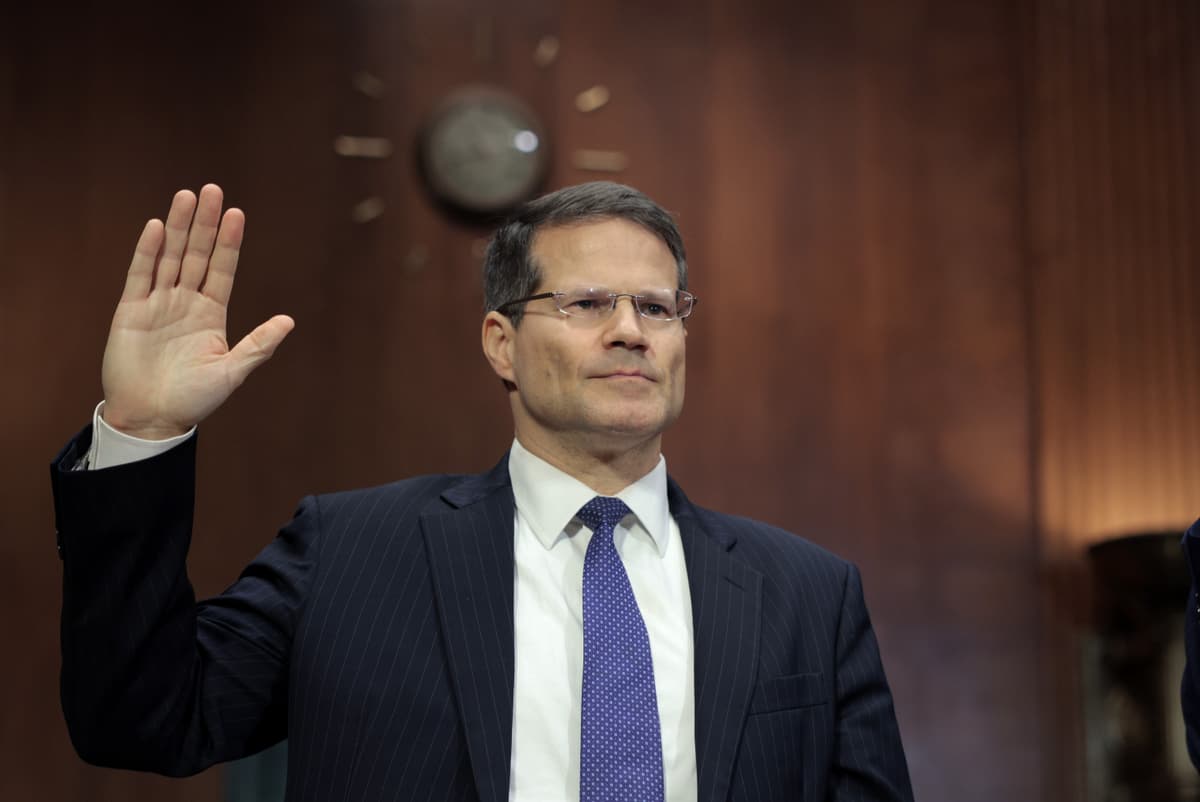
The solicitor general, John Sauer, during his confirmation hearing before the Senate Judiciary Committee on February 26, 2025. Chip Somodevilla/Getty Images

As the Supreme Court weighs whether to hear President Trump’s appeal over his birthright citizenship policy, one can imagine the conservative justices could be hesitant to revisit a precedent that dates back to 1898. That’s when the Nine, in United States v. Wong Kim Ark, held that being born on American soil, even to non-citizen parents, effectively guaranteed citizenship. Yet longevity did not spare the Roe v. Wade precedent finding a right to abortion.

Nor did the venerability of Plessy v. Ferguson, decided in 1896, cause the Nine in 1954 to shrink from overturning racial segregation in Brown v. Board of Education. In short, it’s rare for the Supreme Court to reverse long-held precedents, but when it does it can signal a seismic change in American political and cultural life. That is what the Trump administration is asking the Nine to consider by seeking to end the custom of automatic birthright citizenship.

The outcome of the birthright citizenship dispute, which the high court is considering whether to hear, centers on the meaning of the 14th Amendment. Ratified in 1868, the amendment states that “All persons born or naturalized in the United States, and subject to the jurisdiction thereof, are citizens of the United States.” Lower federal courts have pointed to that text to find that Mr. Trump’s executive order of January 20 ending birthright citizenship is invalid.  

A panel of judges of the Ninth Circuit of the United States Court of Appeals in July found that Mr. Trump’s order breached the 14th Amendment, pointing to Wong Kim Ark. Since that 19th-century decision, the circuit riders noted, “the Judiciary, Congress, and the Executive Branch have consistently and uniformly protected the Citizenship Clause’s explicit guarantee of birthright citizenship regardless of the immigration status of an individual’s parents.”

In the First Circuit, another panel of judges on October 3 ruled similarly. The question of birthright citizenship is not a “difficult one,” they found. The circuit riders at Boston sniffed that it has been “more than a century since a branch of our government has made as concerted an effort as the Executive Branch now makes to deny Americans their birthright.” They, too, found Wong Kim Ark’s precedent to be valid some 127 years after it was issued.

Yet Mr. Trump’s solicitor general, John Sauer, is not daunted by the survival of the Wong Kim Ark precedent. In his appeal to the Nine, General Sauer avers that the 14th Amendment’s Citizenship Clause “was adopted to confer citizenship on the newly freed slaves and their children, not on the children of aliens temporarily visiting the United States or of illegal aliens.” Mr. Trump’s order, he reckons,  “restores the original meaning of the Citizenship Clause.” 

General Sauer explains that this means, “on a prospective basis only,” that the “children of temporary visitors and illegal aliens are not U.S. citizens by birth.” Limiting the order’s effect to future births, as opposed to revoking the citizenship of those already born here under the previous interpretation of the 14th Amendment, could foreseeably limit the potential disruption caused by Mr. Trump’s effort to clarify the meaning of the Citizenship Clause. 

General Sauer contends that, in part due to misinterpretation of the scope of the Wong Kim Ark, “in the 20th century, the Executive Branch came to misread the Clause as granting citizenship to nearly everyone born in the United States.” Yet, he avers, “those developments do not control the resolution of the question.” The problem on the southern border seems to have been addressed without discarding a century of constitutional precedent.

The Sun’s position over the years has been in favor of expanding legal immigration to the United States. We cherish human capital. On the question of birthright citizenship, though, we’ve reserved judgment. This is one of those constitutional issues on which a review by the Supreme Court could be illuminating and could go a long way to answering a question about which millions are wondering. And we, at least, find the outcome hard to predict.


The New York Sun

© 2025 The New York Sun Company, LLC. All rights reserved.

Use of this site constitutes acceptance of our Terms of Use and Privacy Policy. The material on this site is protected by copyright law and may not be reproduced, distributed, transmitted, cached or otherwise used.

The New York Sun

Sign in or  create a free account

or
By continuing you agree to our Privacy Policy and Terms of Use