
As Afghanistan’s Economy Nosedives, Its Authoritarian Overlords Thrive on Foreign Aid, Illicit Earnings

Afghanistan is broke only on paper. The flow of revenue into the Taliban’s coffers tells a story of extortion, bribery, smuggling, and seizures.
Russian Foreign Ministry Press Service via AP
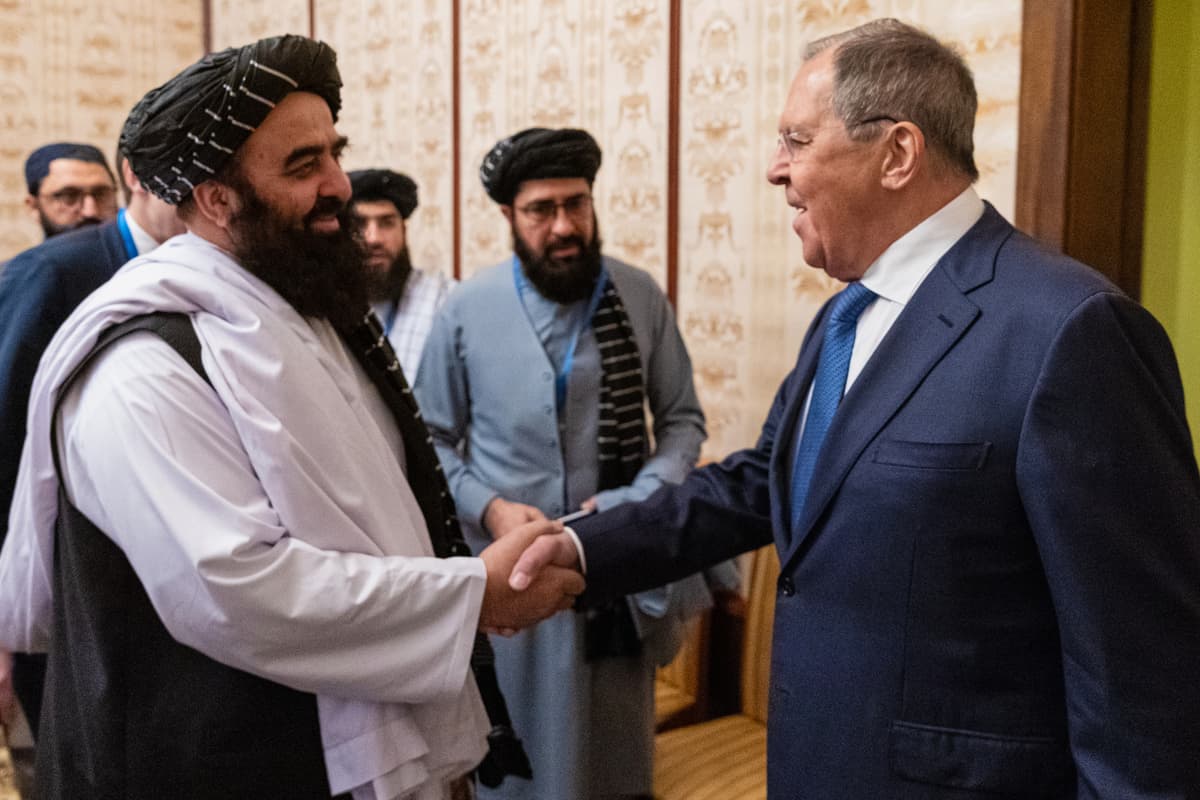
Afghanistan's acting foreign minister, Amir Khan Muttaqi, shakes hands with Foreign Minister Sergey Lavrov of Russia prior to talks at Moscow on October 7, 2025. Russian Foreign Ministry Press Service via AP

As ordinary Afghans sink deeper into poverty and food insecurity, the Taliban’s rulers in Afghanistan sit atop a diversified revenue machine — a system that now reaches into customs duties, religious taxes, illicit mining, narcotics trafficking, land seizures, and a share of siphoned foreign aid.

Since sweeping into Kabul in August 2021, the militant Islamic group has overseen one of the world’s steepest economic collapses. The economy has shrunk by nearly one-third. More than half a million jobs have vanished. Three-quarters of the 44 million-strong population is now considered “subsistence insecure,” lacking reliable access to food, services, or basic supplies. 

Contrary to the numbers, however, the leadership is not presiding over a bankrupt state. Intelligence and research estimates put the Taliban organization’s revenues in the billions of dollars a year, rivaling the budgets of smaller nations and giving the regime staying power despite international isolation.

The group’s internal finances are driven by an increasingly centralized revenue system that blends the trappings of statehood with the coercive mechanics of an insurgent mafia.

“It is difficult to track details of the Taliban’s sources of revenue,” a former Afghan diplomat and a senior advisor for the University of Notre Dame’s Kroc-Pulte Peace and Development Research Program, Aref Dostyar, tells the New York Sun. “Customs, taxation, including religious taxation like ushr and zakat, extortion fees, service fees, and mining pay directly to the regime.”

Ushr is a traditional Islamic agricultural tax on crops, while zakat is a mandatory alms payment required of Muslims to support the poor and community welfare.

What has evolved in the last four years, Mr. Dostyar explains, is a system in which human suffering, impoverished institutions, and minimal operating costs are propped up in large part by humanitarian injections and remittances from Afghans abroad.

The Taliban’s restrictive ways keep the country afloat as ordinary families struggle. The system has been refined to advantage the authoritarians as they control the heavy levers of power.

“Remittances sustain ordinary families, especially in major cities, but they do not directly benefit the Taliban regime,” Mr. Dostyar says, while foreign aid “helps maintain the economy in general, and the Taliban benefits from it directly too, but we don’t know the size of this benefit.” 

If the regime tolerates this parallel financial ecosystem, it is partly because its own operating costs remain strikingly low. It has eliminated vast portions of the former Afghan government’s expenses — including the multimillion-dollar costs of an army, air force, and foreign diplomatic travel. 

“There is no war, so the Ministry of Defense is inexpensive to maintain compared to the Republic time,” Mr. Dostyar says. “The Taliban fighters did not drink Pepsi during their insurgency years. Their expectations are low, and they seem happy with a modest monthly pay.”

Low costs, however, do not equate to low ambition. The Taliban views Afghanistan’s institutions as spoils for its efforts. Patronage plays a big role as Taliban fighters and their families remain a priority for the regime. 

For outside experts tracking Taliban finances, the pattern is unmistakable. The director of global policy at the George W. Bush Institute, Natalie Gonnella-Platts, describes the Islamic leadership “essentially as a mafia.”

“They are ravaging Afghanistan and its people for profit, and that’s how they maintain control,” she tells the Sun. “Their governance capacity is woefully inadequate, but they’ve learned from other authoritarian regimes how to survive isolation and sanctions.”

Even lower-ranking members have carved out lucrative channels, Mr. Dostyar explains,  taking advantage of private-sector businesses by “selling contracts and becoming shareholders,” among other strategies.

Centralized Corruption, Not Clean Governance

One of the most disingenuous aspects of Taliban rule is its claim to have reduced corruption. At face value, traders moving goods across Afghanistan’s borders do report fewer bribe payments. But Ms. Gonnella-Platts says the explanation is simple: corruption wasn’t eliminated — it was consolidated.

“They’ve been meticulous about grabbing every penny they can. A lot of commentators say, ‘Well, at least they reduced corruption at the borders.’ I think it’s far too early to give them that credit,” she says. “What they’ve done is centralize corruption: instead of paying 20 different officials to move a truck, you now pay once — directly to the Taliban.”

The result is a tighter, more profitable extortion machine framed as state authority. From customs houses to district checkpoints, Taliban officials now collect taxes, fees, and levies with a combination of paperwork and threat of force. Loyalty, Ms. Gonnella-Platts notes, is built not on bureaucratic legitimacy but on “fear and payment.”

A Kabul-based businessman, speaking from the ground and requesting his name not be used for safety reasons, reached a similar conclusion. 

“Taxes, tariffs and other governmental fees, and they are excellent at putting these in place wherever and however they can,” he says. “Nothing is missing their grasp.” 

The source adds that the system is organized and sweeping.

“They mainly collect taxes on businesses, land, trade, and also tariffs on imports and exports. Plus, there are various fees for licenses and services,” he continues, explaining that Afghans have had no choice but to adapt, and have even expanded manufacturing, trading, and other businesses to pay the reapers. 

“People have adjusted themselves as there is no other option,” he says.

Aid Diversion: A Lifeline and a Leverage Point

Global humanitarian aid in recent years has provided another perverse stabilizer for the Taliban. More than $2.9 billion in hard currency has entered the country through United Nations cash shipments since the Taliban’s return. Those funds are intended to keep basic services and relief operations running during crises. But they also move, in part, through institutions that the Taliban control.

“SIGAR and UN reports say 30 to 40 percent of aid never reaches intended beneficiaries,” says Ms. Gonnella-Platts. “They co-opt distribution lists, force NGOs to put Taliban loyalists on boards, impose conditions, especially on religious minorities and women, steal aid outright and resell it, and have created hundreds of fake Taliban-run NGOs to capture funds.”

The Taliban’s manipulation of aid does not mean the United States  is funding the group directly, she stresses. 

“Over the last four years, roughly $4 billion in U.S. assistance has gone into Afghanistan, almost entirely through U.N. agencies and international NGOs — never directly to the Taliban,” she tells the Sun. 

Still, indirect benefits persist: theft, taxation, fake partnerships, and forced hiring.

“Some diversion is inevitable when operating inside territory controlled by a terrorist group,” Ms. Gonnella-Platts asserts. 

Cutting aid, she notes, would only punish the Afghan public. “The alternative would punish 23 to 24 million Afghans while barely denting Taliban finances.”

Despite financial opacity, piecing together budget records, trade volumes, mining contracts, and the illicit economy paints a picture of a regime far more solvent than its national budget.

Internal revenue — from customs, taxes, and service fees — is estimated at $1.2 to $1.5 billion annually. Off-the-books earnings from mining, narcotics, extortion, and smuggling likely add hundreds of millions more.

The Taliban has also capitalized on natural resources. They have signed mining and extraction agreements with entities from China, Russia, Iran, the UAE, and Central Asia. Ms. Gonnella-Platts points out that buyers primarily operate through dense fronts.

“Mostly Chinese and Russian entities, some Emirati and Iranian players, and a web of opaque middlemen” have jumped into the mix, she explains. All of them require Taliban partners.

U.S. Policy Shifts

The Biden administration had maintained humanitarian channels despite concerns about Taliban diversion. But the policy has shifted this year under the Trump team. President Trump has directed the State Department to suspend all aid that could reach the hands of the Taliban. 

“To this end, all foreign assistance funding into Afghanistan ceased effective April 4, 2025,” a spokesperson for the United States Department of State tells the Sun. 

The administration, the spokesperson highlights, is focused on ensuring “every dollar spent by this department makes America safer, stronger, or more prosperous.”

Whether this approach puts any pressure on the Taliban is yet to be seen. Experts note that the regime’s financial resilience from its domestic extraction and illicit markets may blunt any impact.

However, some analysts point to the historical context of the first Taliban rule as a potent reminder of the catastrophic security risks that arise when an isolated regime becomes cash-desperate. Facing sanctions, cut off from international financial systems, and strapped for cash to manage even basic state functions, the Taliban between 1996 and 2001 was economically vulnerable. 

It was into this vacuum that Osama bin Laden stepped, providing a reported $100 million in financial and military aid over several years, cementing a symbiotic relationship in which Al Qaeda provided elite fighting forces and money in exchange for sanctuary and operational freedom. This financial lifeline allowed bin Laden to effectively own and operate the Taliban, directly enabling the terrorist attacks of September 11, 2001.

Still, Ms. Gonnella-Platts stresses that closing the loopholes that weaken sanctions and enable money laundering will bring a change in behavior. 

“Every single time the Taliban sit down — including in Doha — the very first thing they demand is the lifting of sanctions. That alone shows how critical sanctions are,” she says. “Taliban officials and their families still travel internationally, park money in Dubai and elsewhere, and face almost no personal sanctions consequences.”

The question looming over Afghanistan is not whether the Taliban can survive financially — they can. It is whether their consolidation of wealth, and the growing gap between Taliban coffers and public desperation will harden the regime’s long-term hold on power. For Ms. Gonnella-Platts, the answer hinges on transparency and accountability. 

“One of our strongest recommendations is full enforcement of existing sanctions and financial-crime tools — especially targeting the banks and jurisdictions that let Taliban money flow freely,” Ms. Gonnella-Platts says. “The more daylight on Taliban financing, the harder it is for them to keep profiting from Afghanistan’s misery.”

For Afghans trapped between poverty and predation, the stakes could not be higher.


The New York Sun

© 2025 The New York Sun Company, LLC. All rights reserved.

Use of this site constitutes acceptance of our Terms of Use and Privacy Policy. The material on this site is protected by copyright law and may not be reproduced, distributed, transmitted, cached or otherwise used.

The New York Sun

Sign in or  create a free account

or
By continuing you agree to our Privacy Policy and Terms of Use