As Trump Puts Caracas in the Crosshairs, White House Says His Posture ‘Is Not a Bluff’

A source close to the White House tells the New York Sun the administration is committed to dismantling the cartels and bringing Venzuela’s de facto ruler, Nicolas Maduro, to justice.
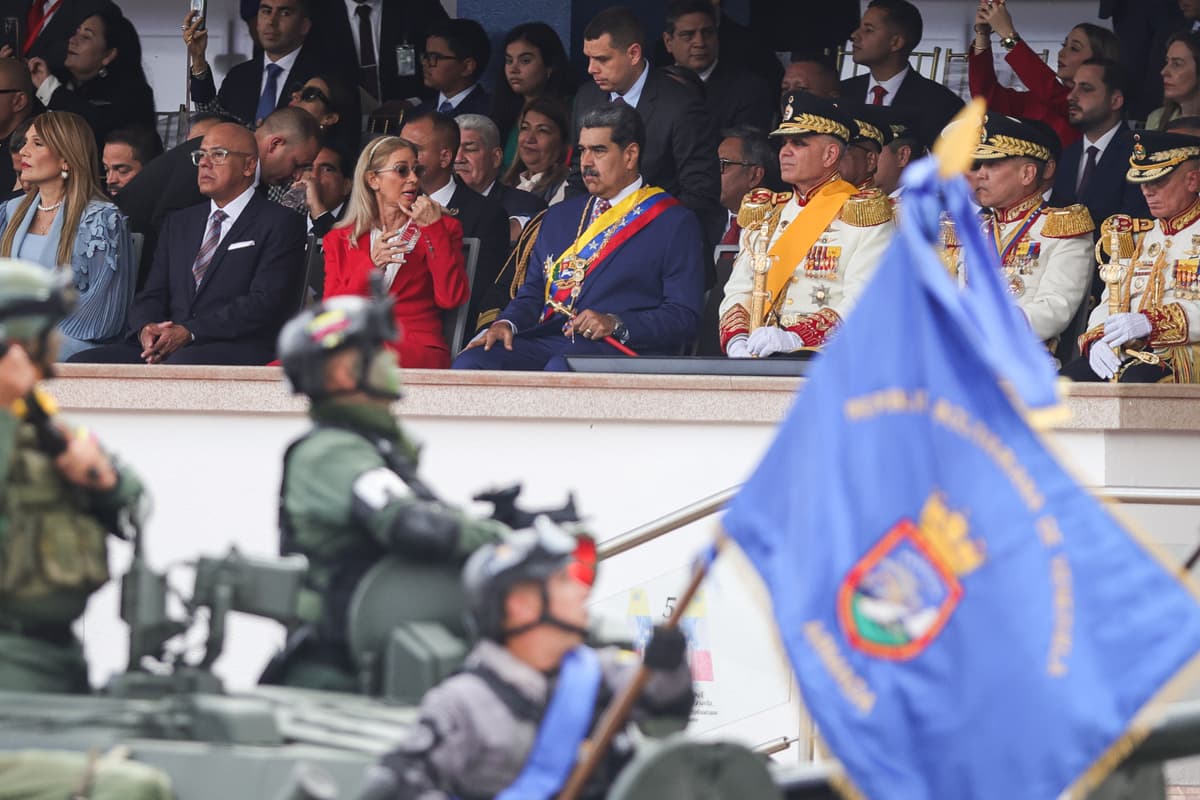

Venezuela’s de factor ruler, Nicolas Maduro, attends military parade marking the nation's independence celebrations at Caracas on July 5, 2025.

The sun had not yet risen over the Caribbean on October 3 when a United States Navy vessel struck a suspected Venezuelan drug-running boat. The engagement lasted only minutes; by dawn, at least four people were dead, and the wreckage was slipping beneath the waves.

It was the fourth such strike in less than a month and — despite a claim by Colombia’s president that the boat was Colombian, not Venezuelan — for many in Washington, the clearest sign yet that America’s standoff with Venezuela is edging toward open confrontation.

A source close to the White House, deeply familiar with operational discussions, tells the New York Sun on background that “the president, secretary of war, and secretary of state have committed to dismantling the Cartel of the Suns and the Tren de Aragua and bringing” Venezuela’s de facto ruler, Nicolás Maduro, “to justice.”

“The scale and seriousness of this deployment make clear that these actions aren’t symbolic. President Trump’s posture is not a bluff,” the source continued, maintaining that the decisions are rooted in “operational necessity, not messaging.”

For months, intelligence officials have tracked the flow of  smuggled narcotics, weapons, and gold through Venezuela’s ports — a network they say finances Mr. Maduro’s grip on power.

“All options remain active,” the source said. “This is not politics. It’s law enforcement at scale.”

A Fight on the Waterline

On the surface, the sinking of small boats and killing of smugglers appear aimed simply at disrupting the drug trade. But analysts and former law enforcement officials say the operations are part of something much larger.

“These recent U.S. military operations mark the first time in decades that Washington has acted with this level of magnitude, direction, and firmness in the Caribbean theater,” said a former Venezuelan counter-narcotics chief,  Johan Obdola. 

Mr. Obdola, founder of the Global Organization for Security and Intelligence, said the strikes have disrupted trafficking routes, “especially those operating from Venezuelan territory.” But he insists the problem posed by the regime in Caracas goes far beyond narcotics. 

“Venezuela today is not merely a hub for trafficking — it is a narco-terrorist state, a regime that protects and profits from the trade while offering sanctuary to groups such as the Cartel de los Soles, the Sinaloa Cartel, and Hezbollah,” he said.

For a former DEA special agent, Wesley Tabor, who served in Venezuela, the strikes show intent — but also expose the limits of military action. 

“Airstrikes and maritime interdictions can disrupt trafficking routes for a time, but they rarely deliver lasting results on their own,” he tells the Sun. “Cartels are resilient. They adapt fast — shifting from go-fast boats to semi-submersibles or containerized cargo. The real impact comes when integrated military pressure is paired with global financial seizures and coordinated law enforcement action.”

Forces Move, and Maduro Braces

Behind the scenes, the Pentagon has repositioned destroyers, reconnaissance planes, and amphibious assets near Venezuelan waters. Officials depict the buildup as defensive, but the message to Caracas is unmistakable.

In responding, Mr. Maduro has followed a familiar script — arming civilian militias and promising to “defend the homeland.” In late September, he signed a decree granting himself sweeping emergency powers and giving the armed forces control over key infrastructure.

As the military posturing intensifies, Washington’s strategy appears aimed at applying increasing pressure without direct provocation — a careful balance between deterrence and confrontation.

“The regime has already lost” the Venezuelan public, the White House source observed. “Mr. Maduro’s cartel lost the last election in a landslide, despite fraud and repression. This is a country hijacked by a cartel. The Venezuelan people have already made clear they want him out.”

Still, military analysts caution that the road to regime collapse rarely runs in a straight line.

Oil, Allies, and Survival

For years, Mr. Maduro has relied on a web of global partnerships — selling oil to China, buying arms from Russia, and deepening covert cooperation with Iran — to sustain his regime in the face of Western sanctions. These alliances provide both an economic lifeline and a geopolitical shield, helping Caracas endure isolation and pressure.

“Sanctions and diplomatic isolation were only having a limited effect in containing Maduro,” says a research professor at the United States Army War College Strategic Studies Institute, Evan Ellis.

“His regime has found enough resources to survive through oil sales to Russia and China, illicit gold, narcotics, and remittances. The assembly of a force capable of major air-land-sea operations signals that Washington is now willing to force a change in the calculus.”

Mr. Ellis points out that the benefits that Mr. Maduro derives from his diplomatic relationships go only so far. “Russia, China, and Iran may offer rhetorical support,” he says, “but none will commit meaningful military assets to defend Maduro.”

That leaves the loyalty of Venezuela’s generals as a pivotal question. 

“The realistic option for convincing the Venezuelan military to save their own skin is showing them that the U.S. can take down the Cartel de los Soles leadership,” Mr. Ellis said. “But if the regime collapses too fast, chaos will follow — a fractured military, armed militias, and foreign actors waiting to fill the vacuum.”

Opposition politician Leopoldo López views Mr. Maduro’s diplomatic alliances as part of a broader regional threat. 

“Venezuela today is a strategic outpost for Russia, China, and Iran — each using the country to project their power in the Western Hemisphere,” he tells the Sun. “Unless that influence is checked, the risk isn’t just Maduro’s survival. It’s the consolidation of a hostile geopolitical base just hours from U.S. shores.”

The Legal and Moral Gray Zone

As operations expand, legal scholars are questioning how far Washington’s counter-narcotics authorities can stretch their authority before crossing into undeclared war. The administration insists its actions fall under existing statutes targeting transnational criminal organizations. Critics argue that sinking vessels in contested waters demands greater transparency.

The White House source rejects that argument outright. 

“Maduro isn’t a sovereign leader in the traditional sense,” the source said. “He’s a cartel boss masquerading as a president. He’s been indicted by the U.S. for leading a transnational criminal enterprise responsible for thousands of American deaths. Venezuela isn’t a country with a cartel problem — it’s a drug cartel that has a country.”

The Road Ahead

The question now is how far the Trump team is willing to go. Officials describe the operation as open-ended and scalable, designed to apply maximum pressure without explicitly committing to regime change.

Should regime change come, Mr. Ellis says, that will pose an even greater test for Edmundo González, who has been recognized by America and other countries as the rightful president after a fraud-tainted 2024 election in which Mr. Maduro claimed victory.

“If the U.S. intervened and took out most of the leadership, President Edmundo González would have a very brief and difficult challenge in establishing order,” he explained. “If, instead, the regime begins to fracture internally, the danger is that no one has enough leverage to stabilize the transition. That’s when you risk anarchy.”

Still, Washington insiders argue that retreat carries greater risk than escalation. “Let the actions speak for themselves,” the White House source tells the Sun.

Now, as American warships patrol those same waters, the clock is ticking on Mr. Maduro. Each incident signals to allies and adversaries alike that the Caribbean has again become a stage for the exercise of American power and that time may be running out for his rule.

“This isn’t regime change. The Venezuelan people already voted for that change and Maduro stole the election,” the source said. “He is already deemed illegitimate by the U.S. State Department.”

When reached for formal comment, a White House official stressed to the Sun that “President Trump is prepared to use every element of American power to stop drugs from flooding into our country and to bring those responsible to justice.”

“The President has been clear in his message to Maduro,” the official added. “Stop sending drugs and criminals to our country.”


The New York Sun

© 2025 The New York Sun Company, LLC. All rights reserved.

Use of this site constitutes acceptance of our Terms of Use and Privacy Policy. The material on this site is protected by copyright law and may not be reproduced, distributed, transmitted, cached or otherwise used.

The New York Sun

Sign in or  create a free account

or
By continuing you agree to our Privacy Policy and Terms of Use