Can States Police Their Own Borders Against Illegal Immigration?
Supreme Court denies Florida’s bid after an appeals court halts Texas law, saying authority over migration is ‘exclusively a federal power.’
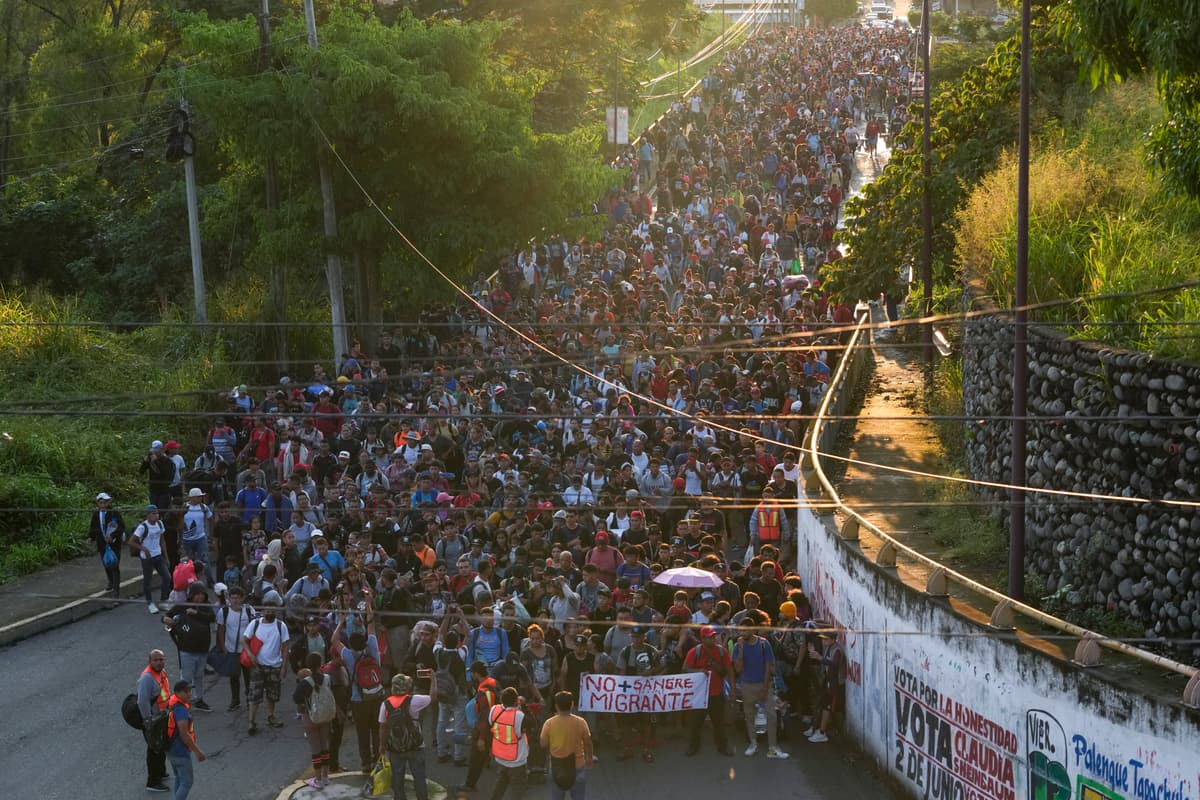

Texas and Florida are taking their licks in federal courts as these two sovereign states try to police their borders. The Supreme Court is, for now, barring Florida from enforcing a state law against illegal immigrants crossing its borders. A similar Texan law is on hold since a panel of riders on the Fifth Circuit reckons that the authority to control immigration is “exclusively a federal power.” Yet that view runs crosswise to the Constitution, if The Great Scalia is any guide.
After all, America “is an indivisible ‘Union of sovereign States,’” Scalia said in his partial dissent in Arizona v. United States. In that case, the majority in 2012 kiboshed the Grand Canyon State’s attempts — like Texas’s and Florida’s today — to deploy state law to police illegal immigration. Yet “the defining characteristic of sovereignty,” Scalia insisted, is “the power to exclude from the sovereign’s territory people who have no right to be there.”
Although the high court found that Arizona lacked power to tame illegal migration, Scalia lamented that “neither the Constitution itself nor even any law passed by Congress supports this result.” Some 13 years later, federal courts, at least so far, seem no closer to grasping Scalia’s comprehension of the union as a compact of 50 sovereigns. The Texas and Florida cases, though, are still making their way through the courts, which could yet see the light.
The Nine yesterday offered no reasoning in their unsigned order barring Florida from enforcing its border law. The order came despite Florida’s plea to be allowed to take action against what the state attorney general, James Uthmeier, quoting Scalia, called in its plea the “evil effects of illegal immigration.” Mr. Uthmeir marked, too, the violent crimes committed by illegals, as well as “rampant fentanyl trafficking and other devastating harms” to Floridians.
The Florida Immigrant Coalition, though, argued that Mr. Uthmeier and other officials “entirely fail to establish any emergency” warranting the high court to intervene while the case plays out in lower courts. The coalition points to the precedent in Arizona, noting that letting Florida’s law go into effect “would impermissibly allow” the state to, as the majority in 2012 put it, “achieve its own immigration policy.”
The Nine, for now, agreed, leaving it to lower court judges to sort out the constitutionality of the Sunshine State’s immigration law. Similarly, a split panel of three riders on the Fifth Circuit is putting Texas’s law on ice while a district judge hears the dispute. The panel included nominees of Presidents George W. Bush, Biden, and Trump. The Bush and Biden nominees oppose the law, pointing in part to the Arizona precedent.
Yet Judges Priscilla Richman and Irma Carrillo Ramirez also griped that Texas’s law “would cause international friction,” which hardly seems relevant to interpreting America’s Constitution. The judges point to Mexico having “signaled that the statute’s enforcement would frustrate bilateral efforts, including alien removals.” Since when do the Mexican government’s complaints carry greater weight in federal court than the concerns of a bona-fide American state?
A clearer-eyed assessment emerged from the dissenter on the Fifth Circuit panel, Judge Andrew Oldham, who is, incidentally, the Trump appointee. Echoing Scalia, he avers that the “majority usurps the State of Texas’s sovereign right to police its border and to battle illegal immigration.” He adds that “the risks posed by” the “millions” of illegals now residing in America “are impossible to overstate — precisely because we know nothing about them.”
Judge Oldham underscores, too, the urgency of this case: “Texas is suffering irreparable injury with each day a federal court stands between the State and enforcement of its law.” That goes for Florida, too, one might add. Both of these sovereign states’ disputes are likely to be resolved, one way or the other, by the high court, where Scalia’s view in Arizona, one likes to imagine, will ultimately be vindicated if the Nine adheres to the Constitution.