Can Trump Make Pasta Great Again?
Truth, justice, and the American spaghetti.

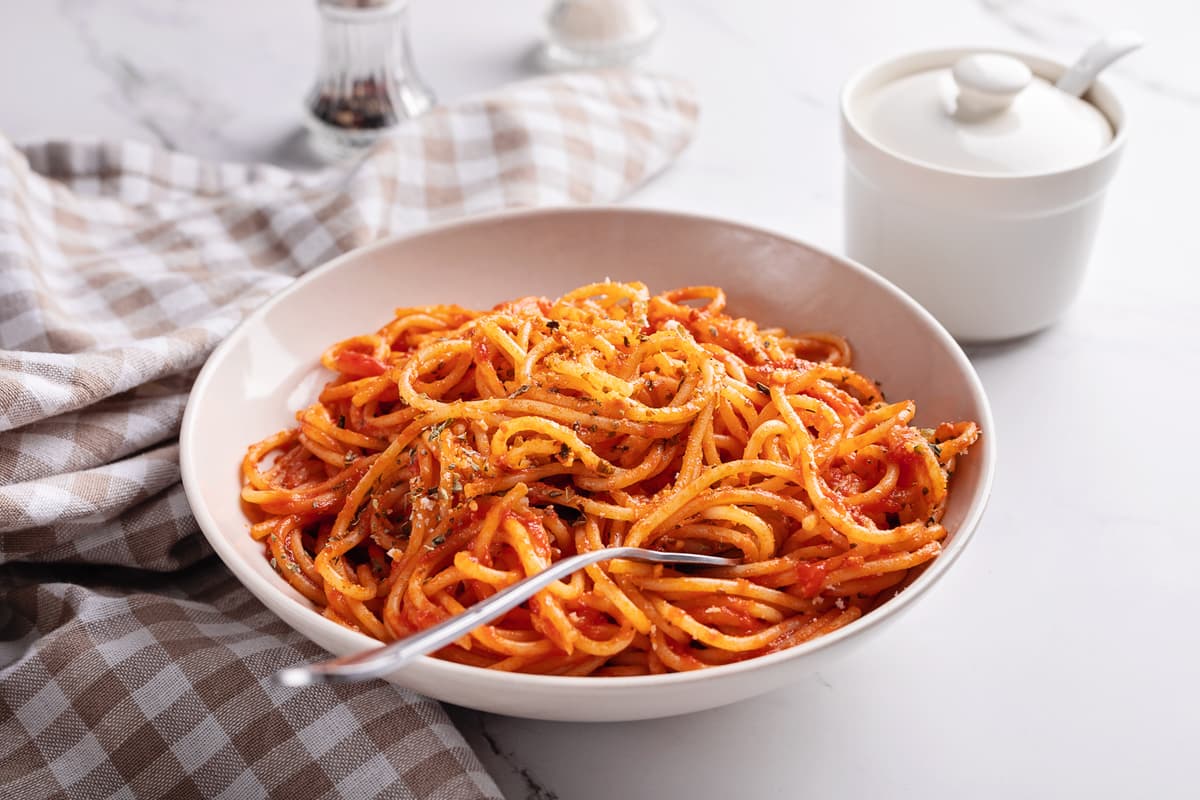
Not since “Yankee Doodle” has macaroni proven so contentious. Italian pasta makers — and American gourmands — are dismayed by the prospect that high-grade noodles could vanish from grocery store shelves here as a result of President Trump’s trade reset. The foodstuffs are subject to a 15 percent tariff, and the Commerce Department is weighing a penalty of some 92 percent on pasta makers for allegedly selling noodles at artificially low prices here.
Saute that with garlic and olive oil and a bit of basil and see if the government has its priorities straight. “It’s shocking,” says the head of a leading Italian macaroni maker, Garofalo. The Atlantic warns that “America’s best pasta is slipping away,” and the Wall Street Journal reports that Italian noodles “are poised to disappear from U.S. supermarket shelves.” The furor over fusilli, at least for now, is entangling Mr. Trump’s approach to global trade.
After all, noodle imports to America run to some $770 million a year, per the Wall Street Journal. That’s a proverbial drop in the pasta pot compared with the some $3.3 trillion worth of goods that in 2024 America imported from abroad. When it comes to the trade deficit — and the larger concern of the hollowing out of America’s manufacturing base — imports of pasta would seem to be but a side dish.
More broadly, though, the tumult over tortellini calls to mind one of the home truths about free trade. The reason many Americans are distraught to lose access to Italian pasta is that it’s seen to be a higher-quality product than the domestic variety. That’s in part because, per the Atlantic, “most of the pasta made and sold in America is not bronze-cut, but extruded using plastic molds coated with Teflon.” Che peccato.
That Italy’s pasta makers can sell a superior product — and often at a lower, or at least competitive, price — here is a reflection of what economist David Ricardo called Comparative Advantage. The idea, as Ricardo saw it, is that if any two countries focus their resources on making the goods they can forge more productively, then trade with each other, both countries can consume more of those goods than if they try to make the products on their own.
Writ large, Comparative Advantage served as the rationale for the vast expansion in free trade in the post-World War II era. With few barriers to trade between nations, the most efficient companies and nations were rewarded with more business. The system, by and large, led to greater prosperity for all parties concerned, especially when the free trade regime was grounded in a stable monetary system centered on a specie standard with gold as the basis of value.
When countries distort the underpinnings of Comparative Advantage, though, the system breaks down. State subsidies of domestic industries reward inefficiency. Manipulation of currencies — an epidemic since the breakdown of Bretton Woods — disrupts the free market in goods. That’s why Communist China, which specializes in both practices, has played such a malign role on the global stage, requiring Mr. Trump’s reset of trade rules.
Viewed through this lens, the battle over bucatini suggests that Italian pasta makers are, for now, collateral damage in a larger conflict that needs to be settled to restore balance to a trade system knocked askew by Communist China’s self-serving mercantilism. It’s hard to imagine any need to keep Italian macaroni off American shelves, though, once Mr. Trump reaches his goal of revived fairness in trade — an achievement that would surely be a noodle in his cap.