Caregivers, Combatants, and, Above All, Victims: The Complicated Roles of Women in the Battle for Darfur

While women have suffered horribly in the conflict in western Sudan, some have served as propagandists, relief workers, and even as front-line fighters.

Norwegian Refugee Council via AP
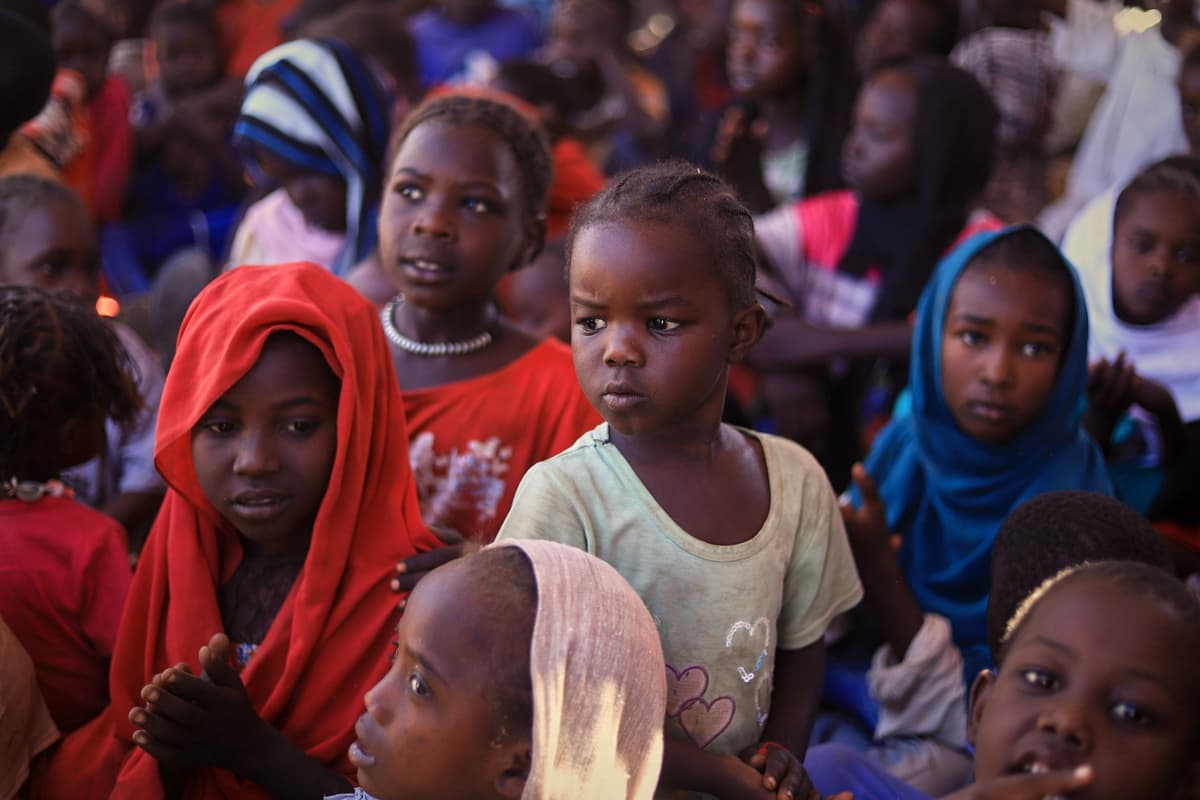
Displaced children from El-Fasher receive refuge at a camp at Tawila in the Darfur region of Sudan on November 3, 2025. Norwegian Refugee Council via AP

Women were among the primary victims when El Fasher, the capital of Sudan’s North Darfur, fell to the Rapid Support Forces after a brutal 18-month siege in late October.

Within days, the once-bustling streets emptied. Hundreds were killed, homes looted, and women and girls subjected to horrific abuse and sexual violence. Tens of thousands fled to camps or makeshift shelters, leaving behind everything they knew. Aid groups warned of a humanitarian crisis unfolding in real time.

The assault on El Fasher was only the latest chapter in Darfur’s long history of war – a cycle of displacement, racial violence, and survival that has defined the region for two decades. But largely lost in the reporting of the latest tragedy is a more complex story about the role women play on both sides of the conflict.

Women in the RSF: Participants in a Male Force

“Women play different roles within RSF,” a Darfurian activist and community leader, Abdelillah Douda, tells The New York Sun. 

“To identify the roles of women in RSF, one needs to look closely at the composition of the organization, which is completely tribal in nature.” 

Mr.Douda says that  women from the main tribes making up the RSF “fully support the militia,” working as propagandists and even as armed combatants, though most “are mere supporters following the militia in battles to encourage them to fight.”

With roots in the Janjaweed militias that ravaged Darfur in the early 2000s, the RSF remains overwhelmingly male and defined by tribal loyalty. Yet, as Mr. Douda explains, “many women carry arms side by side with male fighters. They believe their goal is to achieve their tribal domination in Sudan.” 

Such participation, though limited, demonstrates the force’s reliance on tribal allegiance rather than formal recruitment, with most female members serving supportive or symbolic functions rather than participating in front-line combat.

While recruiting mainly from its own tribes, the RSF has been known to take in foreign mercenaries, women included.  In early 2024, six Ethiopian women were arrested in Gedaref State and accused of serving as RSF snipers.

Videos have emerged of female RSF figures giving instructions during raids that included looting and sexual violence. These glimpses, though exceptional, suggest the force occasionally employs women in direct operations, often as a signal of tribal loyalty rather than empowerment.

With the Army: Training, Defense, and Support

As RSF violence spread, the opposing Sudanese Armed Forces established training programs for women and girls across multiple states, including Gadarif, River Nile, and North Darfur. These sessions taught weapons handling, tactical defense, first aid, and logistical support. 

“Sudanese Army is considered a professional institution where people join according to their qualifications,” Mr. Douda said. “Based on this principle, the Sudan Armed Forces consist of people from all spectrums of life, including women. Women exist in all sections — infantry, artillery, air force, and engineering — in addition to administration and management.”

The women are trained for mainly defensive roles. They assist in guarding roads, supporting injured soldiers, and managing supply routes. Behind the front lines, they distribute food, water, and medical care in displacement camps where international agencies often cannot reach. In many areas, women’s networks have become the backbone of survival.

Atrocities Against Women in El Fasher

Far more often, however, the women of Darfur have been neither defenders nor caregivers, but prey.

Images shared with the Sun by a displaced Darfurian show a mass of mangled bodies in the sand beside blown-up vehicles with fighters walking among the corpses; a small boy trapped and screaming beneath a car tire; men digging their own graves or seated at gunpoint; and a hanged mother and her children dangling from a tree. 

The fall of El Fasher has unleashed what observers describe as an orchestrated campaign of terror. According to Sudanese officials, the RSF killed roughly 300 women in the first 48 hours after entering the city. 

Eyewitnesses and independent monitors estimate more than 1,500 civilians were killed in the opening days — many through executions, rape, and torture. Satellite imagery from the Yale Humanitarian Research Lab shows clusters of bodies and evidence of mass killings around the city.

“In Sudan, the two-year conflict has led to an unprecedented level of violence, characterized by widespread sexual and gender-based violence and ongoing impunity,” a gender and child justice specialist at Global Rights Compliance, Ruby Mae Axelson, tells the Sun.

“Women and girls in Sudan have been used as commodities of war by both the RSF and SAF,” adds Ms. Axelson, who is also a legal assistant at the U.N. Mechanism for International Criminal Tribunals. “The ongoing war has seen an exponential increase in reports of sexual violence that amounts to war crimes, crimes against humanity and genocide.”

Reports from aid agencies and advocacy groups reflect the same pattern. 

“Thousands of women and girls face increased vulnerability to the most severe forms of sexual and gender-based violence, destruction of livelihoods and famine, as well as long-term psychological impacts,” Ms. Axelson says. 

“The suffering across Sudan is epitomized by the unheard crisis of missing women and girls, thousands of whom have been abducted, kidnapped and subjected to the worst forms of violence whilst their fate remains unknown.”

Her organization has documented cases of women held in “slave markets” in RSF-controlled territories, and others forced into domestic labor or sexual slavery. 

“Some have been held in groups inside detention facilities run by the RSF, while others have been held for several months and subjected to rape and gang rape,” Ms. Axelson asserts. “Women of all ages remain at risk, with a disproportionate number of underage girls being abducted and subjected to sexual slavery, pregnancy, and enslavement.”

Those lucky enough to return to their homes often face stigma and criminalization. “Some of these women have been detained by SAF and charged under terrorism laws, accused of collaborating with the RSF,” Ms. Axelson says. 

“This criminalization of survivors is unacceptable — it denies them justice and punishes them for surviving.” 

The patterns Ms. Axelson describes are echoed in field accounts from aid groups and community leaders who have witnessed the devastation firsthand.

The founder of the non-profit Sudan Sunrise, Tom Prichard, describes the atrocities in the densely populated cities of El Fasher and El Geneina as “a totally racial war.” 

“People are being driven off of their land because they are black, and Arabs want to steal their land. The richest in the world are stealing from the poorest,” he tells the Sun. 

Mr. Prichard recounts how RSF fighters “invaded homes, insulted people saying they were dogs and insects,” and killed males “often after extreme humiliation — being paraded in public walking on all fours like dogs.”

He says men were forced to watch their wives being raped before being executed, “showing other witnesses the men could not protect their wives.”

The violence, Mr. Prichard adds, has been designed to erase entire communities. 

“Homes belonging to the Masalit were totally burned or leveled so they had nothing to come back to,” he says. “This genocide is designed to drive the Darfurians forever off their land and replace them with Arabs from other countries.”

Washington’s Response

The Trump administration’s response to the crisis in Darfur, so far, is centered on a diplomatic push for a humanitarian truce and a political roadmap. An American adviser for African affairs, Massad Boulos, has confirmed that the White House is working with both the Sudanese Armed Forces and the Rapid Support Forces on a plan that would begin with a three-month humanitarian truce, to be followed by a nine-month political process to establish a civilian-led government. 

This initiative is being advanced through the Quad — an informal mediation group that includes America, Saudi Arabia, Egypt, and the United Arab Emirates — which aims to pressure the warring parties collectively. However, the Sudanese army recently stated it would press on with fighting despite the proposal. 

In its final weeks in office, the Biden administration officially declared that the RSF was guilty of genocide in Darfur and imposed sanctions on the RSF commander and associated entities. However, critics argue that Washington’s actions are constrained by America’s close relationship with the United Arab Emirates, which has been accused of bolstering the RSF despite its repeated denials.

“Every imaginable crime has been committed against Darfuri women over the last 25 years,” Mr. Prichard says. “This genocide is much more thorough, with powerful international support, and it is designed to leave the people of Darfur void of any hope that they can ever return.”


The New York Sun

© 2025 The New York Sun Company, LLC. All rights reserved.

Use of this site constitutes acceptance of our Terms of Use and Privacy Policy. The material on this site is protected by copyright law and may not be reproduced, distributed, transmitted, cached or otherwise used.

The New York Sun

Sign in or  create a free account

or
By continuing you agree to our Privacy Policy and Terms of Use