
Chinese Army Shows Off New Killer ‘Robot Wolves’ in Military Drills Highlighting Advanced Technology
The maneuvers demonstrate the application of quadrupedal robotics in various combat settings, including reconnaissance and precision strikes.
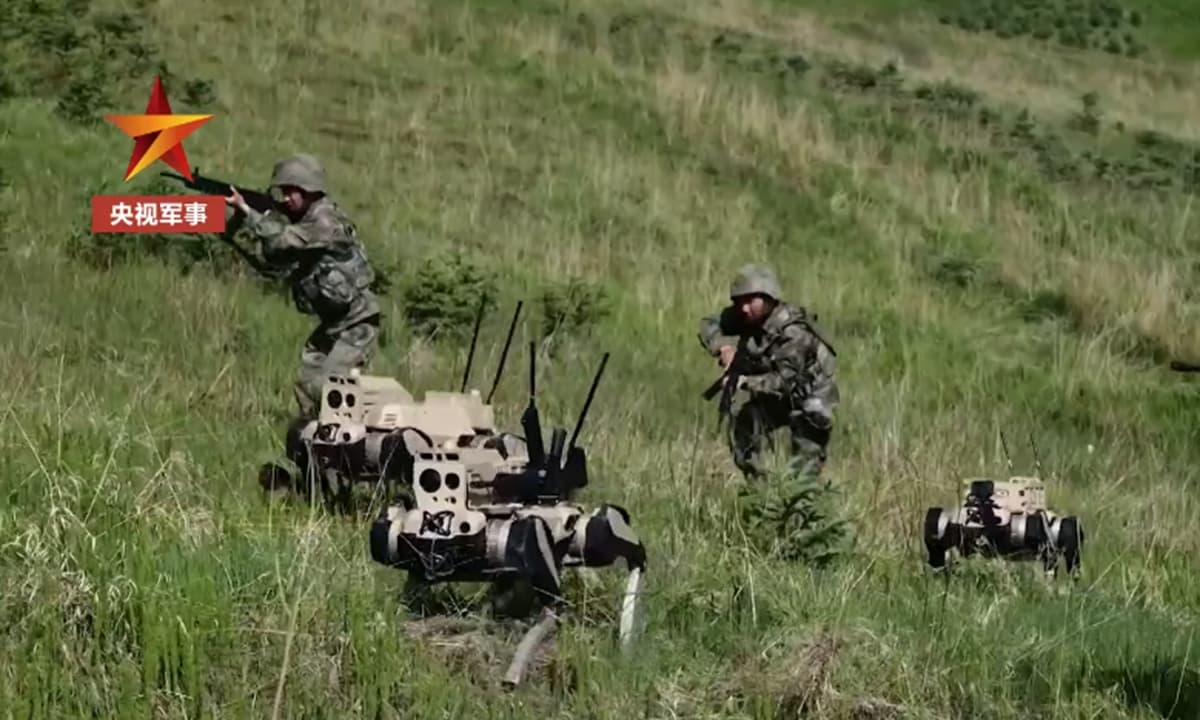

The People’s Liberation Army of Communist China has showcased its robotic technology in a recent human-drone collaborative military exercise, marking the first publicized drill involving the nation’s “robot wolves.”
Official reports from Chinese state-run media have disclosed that the quadrupedal robotics platforms are now part of the military’s push to integrate advanced unmanned systems into traditional combat scenarios.
The latest exercise, conducted by motorized infantry companies of the PLA’s 76th Group Army brigade, featured a confrontational drill that combined human soldiers, drones, and robotic systems.
According to China Central Television, the maneuvers demonstrated the application of drones and robot wolves in various combat settings, including reconnaissance, precision strikes, and providing cover during breakthrough operations.
The drill occurred in a hilly, grassland area, where soldiers carrying weaponry such as assault and sniper rifles, as well as handheld rocket launchers, engaged alongside robot wolves armed with similar weapons or outfitted with reconnaissance payloads. Aerial drone operators, clad in ghillie suits, played a pivotal role in surveillance efforts, using First Person View drones for reconnaissance and “suicide” attack missions.
“This exercise marks the first time I have commanded and operated the robot wolf,” a member of the PLA’s brigade who participated in the drill, Hu Te, said, according to Global Times. “Our primary-level companies aim to use the newly commissioned unmanned equipment well and integrate them with human units effectively.”
The robot wolves, initially unveiled at Airshow China 2024 in Zhuhai, weigh about 150 pounds and are designed as highly versatile platforms. Capable of attack, reconnaissance, transport, and support missions, the machines demonstrate extraordinary mobility, including the ability to traverse rugged terrain, climb ladders, and overcome high obstacles.
According to the developer, the state-owned China South Industries Group Corporation, multiple robot wolves can function in coordinated formations, establishing interconnected networks between human operators, vehicles, and robotic systems. This capability is intended to significantly enhance the combat effectiveness of infantry and special operations forces in treacherous conditions like urban environments and high-altitude areas.
International parallels also highlight the rising prominence of robotics on the battlefield. Ukrainian forces recently claimed to have captured Russian troops without deploying infantry, relying entirely on a combination of drones and ground-based robotic systems.
“With more ground robots being deployed, significant changes are inevitable,” a Chinese military affairs analyst, Fu Qianshao, told the Times. “These technologies have the potential to redefine battlefield dynamics, alter how conflicts unfold, and revolutionize tactical planning altogether.”