Colorblind Justice Will Get Hearing at Supreme Court in Louisiana Voting Case
The Pelican State faces legal scrutiny over whether enough of its congressional districts have a majority of black voters.
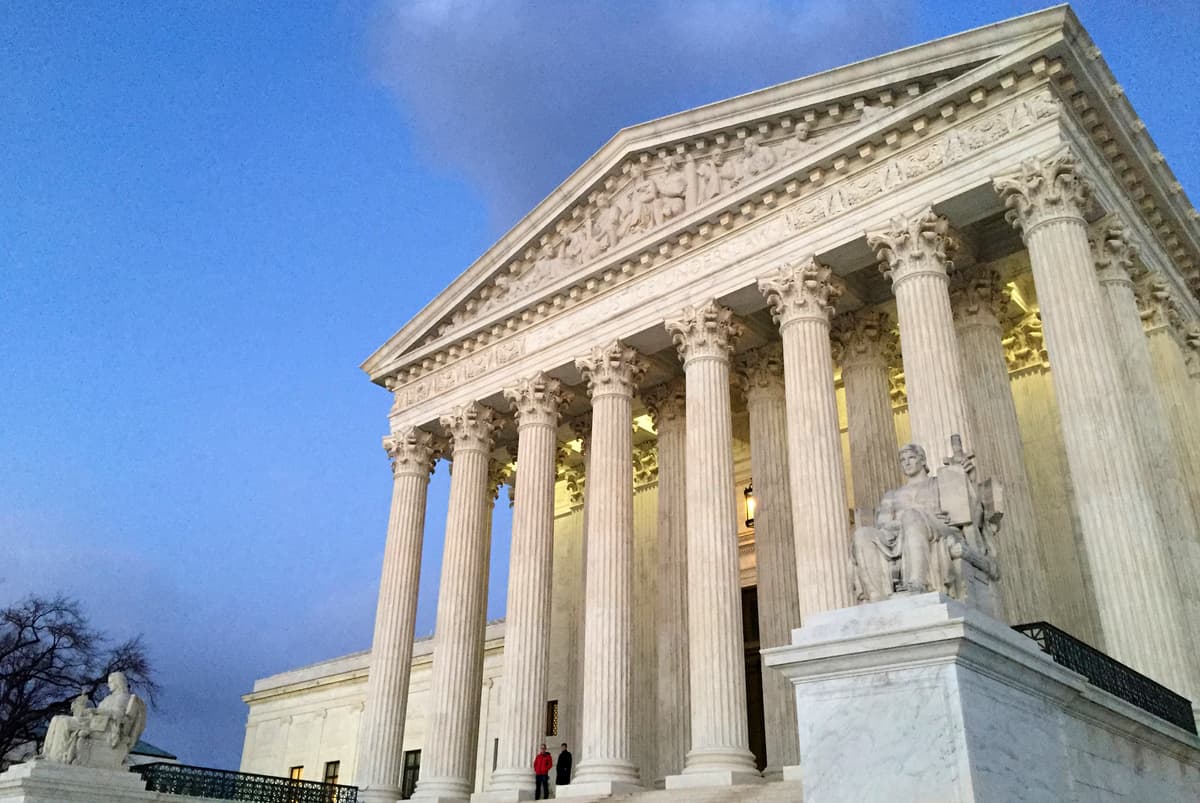

The Supreme Court on Wednesday will have a chance to advance the cause of colorblind justice when it hears arguments regarding Louisianaâs congressional map. The Pelican State has faced legal scrutiny since 2022, when lawmakers drew a voting map in which but one district of six contained a majority of black voters. Because blacks comprise one-third of the stateâs residents, the map drew accusations of racial bias and breaching the Voting Rights Act.
That law, passed in 1965 at the urging of President Lyndon Johnson, is a landmark in American history, helping to vindicate the constitutional promises of racial equality in the 14th and 15th Amendments. The lawâs passage helped to break Jim Crow laws in Southern states that denied black citizens their right to vote. Yet in recent decades the language of the Act has been subject to misinterpretation, distorting the intentions of the law.
Feature, say, the distinction between ensuring blacksâ right to cast ballots in elections and the notion that a stateâs voting districts must reflect the racial breakdown of the stateâs residents. Federal courts pointed to Section 2 of the Voting Rights Act to find that Louisiana lawmakers had erred by drawing a map with only one majority-black district. It seems a stretch to reach that conclusion based on the lawâs text, though.
Section 2 of the Act, after all, states that âNo voting qualification or prerequisite to voting, or standard, practice, or procedure shall be imposed or applied by any Stateâ as a means âto deny or abridge the right of any citizen of the United States to vote on account of race or color.â Poll taxes and literacy or so-called civics tests, to be sure, can be seen to run afoul of this provision. Yet itâs hard to see how a colorblind congressional district map is crosswise with Section 2.
Even so, Louisiana lawmakers duly redrew its voting map to feature two congressional districts with a majority of black voters. The matter did not rest there. A group of voters in the state took exception to the revised map, arguing it was âan unconstitutional racial gerrymander,â as Justice Clarence Thomas put it. The Supreme Court allowed the revised districts to be used for the 2024 election, but now the validity of the map is back before the Nine.
A lively debate can be expected on Wednesday. The high court in 2018 found, in the case of Rucho v. Common Cause, that it lacks jurisdiction to overturn convoluted district maps drawn with political bias in mind. Although âexcessive partisanship in districting leads to results that reasonably seem unjust,â Chief Justice Roberts wrote for the majority, the federal courts are not the appropriate arbiters for such disputes. Congress, though, is, he added.
The question raised in Wednesdayâs case, Louisiana v. Callais, though, is whether gerrymanders animated by racial considerations are kosher under the Constitution. The outlines of the dilemma are sketched by Justice Thomas, who pointed to âthe intractable conflictâ between the high courtâs view of Section 2 of the Voting Rights Act and âthe Equal Protection Clause of the Fourteenth Amendment to the Constitution.â
Liberals like to wield Section 2 of the Voting Rights Act as a cudgel forbidding lawmakers âto dilute the political influence of a minority group,â as the Guardian reports. That interpretive spin on the civil rights law betrays the initial purpose of the Act and ends up creating reverse discrimination. As Justice Thomas explained it, when Section 2 âbreaches the Constitutionâs equal protection guarantee, the Constitution controls.â