Erdoğan’s Most Electable Rival Faces Prison — and the White House Looks the Other Way
The popular mayor of Istanbul faces a potential sentence of more than 2,000 years on charges that independent analysts see as politically motivated.
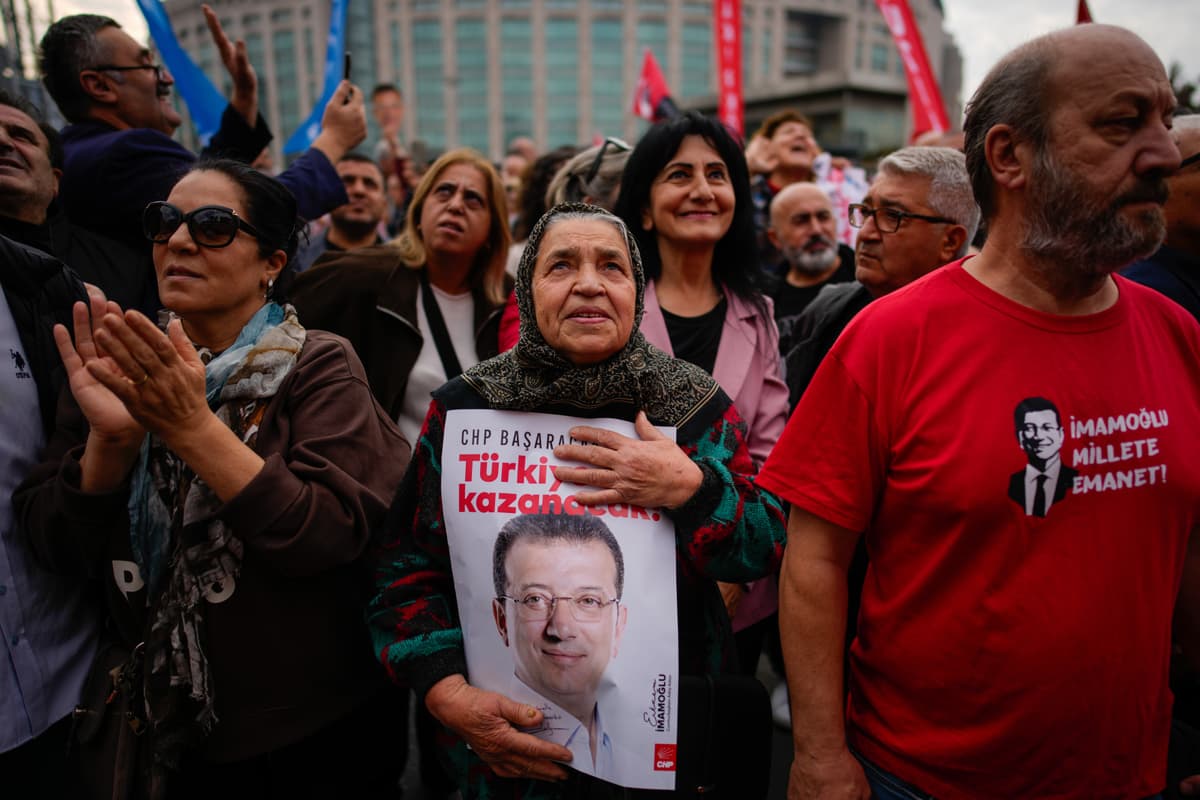

In a stunning escalation of Turkey’s political drama, Mayor Ekrem İmamoğlu of Istanbul was swept from his home in a pre-dawn raid on March 19, 2025, and now faces a potential prison term exceeding a staggering 2,000 years.
Prosecutors released a 3,947-page indictment charging him with 142 counts – including bribery, money laundering, fraud, and leading a criminal organization – demanding sentences ranging from 828 to 2,430 years.
The timing was equally striking: The charges surfaced just one week before Mr. İmamoğlu was set to be formally nominated by the opposition Republican People’s Party, known as the CHP, as their 2028 presidential candidate.
“The charges against him are absurd,” a nonresident senior fellow at the Foundation for Defense of Democracies, Sinan Ciddi, tells The New York Sun. “What they finally put together — espionage and so on — is so weak, so trumped up. It’s the stuff of Soviet-era politics.” Mr. Ciddi is also an adjunct associate professor at Georgetown University.
Mr. İmamoğlu, 55, has been the most dangerous political threat to President Erdoğan since he ended the ruling party’s 25-year grip on Istanbul in 2019 and then crushed Mr. Erdoğan’s hand-picked successor in the 2024 local elections.
The mayor called the case “purely political” in a social-media post hours before his arrest. CHP leader Özgür Özel told parliament the indictment amounted to a “civilian coup” designed to remove Mr. Erdoğan’s strongest rival from the 2028 race.
A Familiar Playbook Against Opposition Leaders
This is not the first time courts have been deployed to sideline Mr. İmamoğlu. In 2022, he received a two-year, eight-month sentence and a political ban for calling election officials “idiots” – a conviction that was later overturned but sufficient to keep him off the 2023 presidential ballot.
The new case dwarfs that episode: Prosecutors allege the mayor ran a criminal syndicate from City Hall, rigging tenders and sharing citizen data with foreign entities. Istanbul University also annulled his diploma the day before the arrest, a move that could bar him from office even if he avoids prison.
Thousands of people poured into the streets of Istanbul, Ankara, and Izmir following the arrest. Police fired tear gas and detained more than 300 people, including several CHP mayors now under separate investigation. Freedom House warned that with Mr. İmamoğlu jailed, Turkey is moving from “competitive authoritarianism” to outright dictatorship.
A senior fellow at the American Enterprise Institute, Michael Rubin, says the purpose of the indictment is unmistakable.
“The charges against İmamoğlu are legally spurious and motivated purely by Erdoğan’s ambitions,” Mr. Rubin tells the Sun, underscoring that legitimizing such prosecutions “just empowers Erdoğan to go after whomever the next challenger to emerge.”
Defenders of Mr. Erdoğan argue that Western critics routinely overlook corruption vulnerabilities in major municipalities and dismiss legitimate national security concerns as political theater.
They contend that the scale of the allegations against Mr. İmamoğlu – involving data handling, procurement, and alleged foreign links – would trigger investigations in any NATO democracy, and that Turkey should not be held to a different standard simply because the accused is a high-profile rival.
Washington Looks the Other Way
The prosecution of Turkey’s most popular opposition leader comes amid a dramatic warming in U.S.-Turkey relations under President Donald Trump. Mr. Erdoğan visited the White House in September – his first trip in six years – and received glowing praise from Mr. Trump, who called him “one of the most powerful in the world” and “a reliable ally.”
Soon after, Turkey played a central role in persuading Hamas to accept the Trump administration’s Gaza ceasefire and hostage-release plan.
That diplomatic win has given Ankara new leverage. Turkey wants back into the F-35 program, relief from sanctions tied to its purchase of Russian S-400 missiles, and U.S. support for its plan to force the Kurdish-led Syrian Democratic Forces into the Syrian army – a long-standing Turkish priority.
“Turkish foreign policy aims to protect Türkiye’s interests in the current turbulent regional and international environment, while also striving to create conditions conducive to sustainable peace and development and working towards the establishment of an effective, inclusive and humane international system,” a Turkish foreign ministry spokesperson tells the Sun.
“Türkiye prioritizes the fight against terrorism and extremism, the prevention of conflicts, their peaceful resolution and mediation, and the strengthening of regional peace and security through a regional ownership approach.”
The State Department has issued no public criticism of the mass arrests or Mr. İmamoğlu’s detention. Senior officials have instead emphasized “strong bilateral ties” and praised Turkey’s contributions in Gaza and earlier Russia-Ukraine talks.
Mr. Rubin, however, argues that silence is a strategic mistake.
“Appeasing Erdoğan, like any bully, only convinces him he can lash out more without consequence,” he observed.
Turkey’s cooperation, he says, “must be taken with a grain of salt,” warning that ignoring ideological motivations is the path to “disaster.”
“Erdoğan wants the legitimacy of elections without competition. Rather than simply congratulate him, we must declare the elections were neither free nor fair,” he continued. “U.S. diplomacy is at its strongest when it is calibrated to reality, not a fantasy dreamed up by access- or investment-seeking think tankers or businessmen-turned-diplomats.”
Europe Keeps Quiet
Europe, while more vocal than America about Turkey’s democratic retreat, has also responded cautiously, signaling a transactional approach that prioritizes strategic interests over a vocal defense of democratic norms.
A European Commission spokesperson urged “due process and fair trial standards” for Mr. İmamoğlu but stopped short of condemning the prosecution. With nearly 4 million Syrian refugees on Turkish soil and migration routes tightly controlled by Ankara, EU states are reluctant to escalate pressure.
“The reason the U.S. and Europe are basically ignoring it is because they think they have more to gain from Turkey transactionally,” said Mr. Ciddi. “They classify it as Turkey’s domestic business.”
He notes that Europe’s silence is more striking than Washington’s.
“It is a major surprise for the European Union – a club of democracies built around values,” Mr. Ciddi continues, highlighting that European leaders now see Turkey as a critical security bulwark against Russia. German and British officials, he says, have openly prioritized defense-industrial cooperation over democratic norms.
Pro-government analysts argue that Mr. Erdoğan has faced intense political resistance for more than two decades and insist that judicial proceedings are often interpreted through a polarized lens, making it easy for outside observers to mistake legal scrutiny for political engineering.
Ultimately, the European Union is reluctant to openly criticize Mr. Erdoğan because it views Turkey through a transactional lens: Its strategic location, control over migration routes, and role in regional security outweigh concerns about democratic backsliding.
“A massive defense industry and industrial base – drones, weapons, land forces – Turkey has more army divisions than the entire European Union combined. Its naval shipbuilding capacity is substantial; more ships are being produced in Turkey than across many EU states combined,” Mr. Ciddi noted.
“European defense industries see Turkey as a major market and partner,” he said. “Implicitly, Turkey is presenting itself as the ‘arsenal of democracy’ against Russian military might. Europe has no alternative: no European Defense Force, no unified military capability beyond NATO, and fears the U.S., especially under Trump, might not uphold Article Five. So, as odious as Erdoğan is – and they know exactly what he is – they’ve decided to ignore it for now.”
What Comes Next
No trial date has been set for Mr. İmamoğlu, fueling expectations that the case will drag well past the 2028 election cycle. Constitutionally barred from running again unless parliament calls early elections, Mr. Erdoğan has shown no sign he intends to relinquish power voluntarily.
The fate of the popular Istanbul mayor, however, is poised to reshape Turkey’s political landscape.
“The charges are a blatant political hit job by Erdoğan’s machine,” the managing director of the strategic policy firm NestPoint Associates, John Thomas, tells the Sun. “I would expect a sham conviction locking him up for decades, unless street protests or U.S. pressure force a backroom deal.”
He also warns that Mr. Erdoğan may have miscalculated the public mood.
“It martyrs İmamoğlu, firing up opposition youth and urban voters, potentially fracturing Erdoğan’s coalition as protests swell and the economy tanks from instability. For Erdoğan, it’s a short-term power grab to neuter the biggest threat, but long-term it poisons the well,” Mr. Thomas added. “He’s calculating he can spin it as anti-corruption patriotism, but if streets erupt, it could backfire into an upset.”
The U.S. Department of State did not respond to the Sun’s request for comment.