
Ethiopia’s Christians Face Mounting Violence and Persecution on Multiple Fronts

Human rights groups say the world must pay more attention to the assault on one of Africa’s oldest Christian communities.
Othodoxy Daily News via X
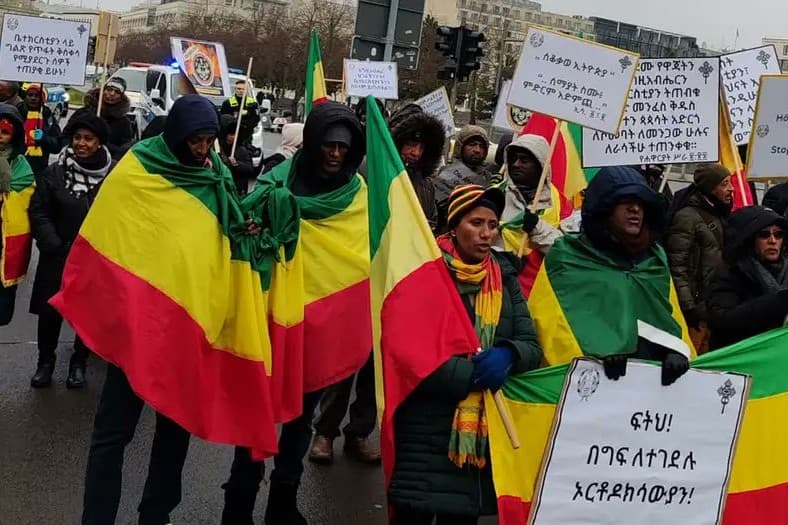
Ethiopians protest the massacre of Orthodox Christians in the Oromia region of Ethiopia at Berlin, Germany, on November 27, 2025. Othodoxy Daily News via X

In a shocking escalation of violence that has reportedly claimed more than 144 lives in just one district since September, Ethiopia’s ancient Christian heartland is under siege. Orthodox believers have been massacred in their homes and churches razed in a surge of ethnic and religious attacks that rights groups warn could unravel the Horn of Africa’s stability.

For centuries, Ethiopia has been a sanctuary of ancient Christianity, a place where faith traditions trace back to the fourth century and the rock-hewn churches of Lalibela stand as testaments to one of the world’s oldest Christian civilizations. 

It is a nation where Christianity has long been intertwined with national identity — surviving invasions, famine, and political upheaval. Today, that legacy faces its most serious threat in generations.

In multiple regions, Christians are being displaced, murdered, and targeted in attacks that cut across denominational lines. Islamic extremist violence, schisms within the Ethiopian Orthodox Church, and simmering regional conflicts have converged into a three-front crisis — one that rights monitors warn is accelerating but overlooked.

Open Doors, an NGO that advocates for persecuted Christians worldwide, ranks Ethiopia in its 2025 World Watch List among the most dangerous countries for Christians due to pressures from extremist groups, political instability, and attacks on churches and clergy. 

While Ethiopia remains a key American ally in the region, analysts say the escalating threats to Christian communities expose a widening human rights emergency and a deeper unraveling of the country’s fragile social fabric.

“Three factors are converging to create an especially dangerous environment for Christians in Ethiopia. First, ethnic nationalism is increasingly weaponizing religious identity,” Open Doors’ CEO in America, Ryan Brown, tells The New York Sun. 

“In eastern regions, ethnic Somali militias target Christians as part of broader ethnic conflicts, while in Oromia, ethnic Oromo militants conflate Christianity with rival ethnic groups. This has resulted in systematic church attacks and forced displacement of entire Christian villages.”

The second factor, Mr. Brown said, is that ultra-conservative factions within the Ethiopian Orthodox Church portray Protestant and evangelical Christians as foreign and unpatriotic. “This stigmatization creates social pressure that can escalate violence, especially against converts from Orthodoxy,” he said.

“Third, converts from Islam face severe hostility in Muslim-majority regions like the Somali state and parts of Oromia. They experience family rejection, mob attacks, church burnings, and systemic discrimination.”

Extremist Violence Targets Converts and Churches

In rural pockets of Ethiopia, particularly in the Oromia and Somali regions, Christians — especially converts from Islam — have been singled out by extremist groups operating largely beyond the control of the central government.

An Ethiopian worker for the America-based human rights group International Christian Concern, who requested their name not be used for security reasons, tells the Sun that the violence is driven by religious and political factors as well as poor governance. 

“In the Somali Region, which is predominantly Muslim, local authorities have directly targeted Christian believers, and many are now imprisoned because of their faith. In Oromia, the regional government has hesitated to protect Christians from armed groups, leaving many believers killed even now,” the insider said. “And in Amhara, where the government system is largely Orthodox, officials routinely oppress those outside the dominant tradition.”

According to Open Doors UK, converts describe being ostracized, threatened, or assaulted by relatives and community members, with entire Protestant and Orthodox congregations facing harassment and raids by militants. One convert, Jemal, told the organization that extremists warned him his “faith is not welcome here,” forcing him and his family to flee their home.

Attacks on churches continue in areas where local authorities struggle to contain armed groups. In October, five people were killed in attacks targeting Orthodox Christians in Arsui Zone amid tensions between ethnic militias and government security forces.

Church leaders have repeatedly urged the federal government to strengthen protections in vulnerable districts. Ethiopia’s Catholic bishops condemned a deadly attack on a parish in the Oromia region earlier this year, calling the violence “an assault on the right to worship” and pleading for authorities to safeguard religious institutions. 

The Department of State’s annual human rights report on Ethiopia documented similar patterns of abuse, citing targeted killings, harassment of religious minorities, and the destruction of churches across several regions. 

For many Christian families, simply gathering for worship has become a risk calculation.

An Orthodox Schism Turns Violent

Alongside extremist attacks, a schism within Ethiopia’s most significant Christian body — the Ethiopian Orthodox Tewahedo Church — has spilled into violence.

According to Mr. Brown, the Ethiopian Orthodox Church is facing an unprecedented split, deeply rooted in Oromo nationalism and political power struggles rather than theology. Both extremists and political actors are exploiting this fracture, severely weakening the entire Christian community in Ethiopia. 

In early 2023, disputes over ecclesiastical authority led to rival synods forming within the church, a rupture that played out along ethnic and regional lines. While efforts were made to resolve the crisis, tensions have lingered, with breakaway groups creating competing structures in parts of Oromia and Amhara. 

When local authorities support one church faction over another based on political calculations, it traps Christian communities in ethnic conflicts and compromises religious freedom principles. 

Historically, the church’s institutional strength offered protection for all Christians; now that it’s divided, every Christian denomination faces increased vulnerability and scrutiny, while the schism itself complicates broader efforts toward national reconciliation.

Attacks against Orthodox Christians spread across Oromia this year, with clergy beaten, churches vandalized, and worshippers threatened amid disputes over who controls local parishes. 

Non-traditional Christian denominations have also come under pressure in districts where local Orthodox leaders and militants accuse them of undermining Ethiopia’s religious traditions. Open Doors US found that Protestant converts and evangelical churches have faced some of the highest levels of hostility, including arson attacks and the confiscation of church property.

The conflict has strained relations between communities that once coexisted peacefully. In areas with contested church leadership, clashes have broken out between local security forces, Orthodox factions, and residents attempting to defend their parishes from takeover.

For younger Christians, the schism has reshaped daily life. Youth groups and choirs have fractured along political and ethnic lines. In some districts, believers say they have stopped attending services altogether for fear of being caught in clashes that are more about identity than theology.

Regional Conflicts That Weaponize Religion

Beyond extremist attacks and denominational conflict, Ethiopia’s broader civil strife continues to fuel religious persecution, especially in the country’s north, where the Tigray conflict has left profound physical and cultural devastation.

Human rights organizations estimate hundreds of thousands were killed in the two-year war between Ethiopian federal forces, Eritrean troops, and the Tigray People’s Liberation Front. Many of the world’s oldest churches, some dating back more than a millennium, were shelled, looted, or burned.

While figures remain difficult to verify due to restricted access, humanitarian monitors agree that the destruction of religious sites was widespread and systematic.

A November 2022 peace deal halted major fighting, but residual clashes, famine conditions, and the presence of irregular militias continue to endanger Christian populations across Tigray, Amhara, and Afar.

In these regions, religion often intersects with ethnicity. Tigrayans — predominantly Orthodox Christians — were targeted not only for political reasons but also for their cultural and religious identity, according to humanitarian groups operating in northern Ethiopia.

Beyond the north, the spread of local conflicts in Oromia, Benishangul-Gumuz, and the Southern Nations region has left Christian minorities exposed as well. Communal militias and insurgent groups frequently target churches as symbols of rival ethnic or political alignment.

Faith-based organizations operating inside the country report ongoing displacement, with thousands of Christian families forced from their homes and many shelters overwhelmed. The Global Prayer Guide, a publication of the non-profit international ministry The Voice of the Martyrs, summarized Ethiopia’s situation as “volatile,” citing repeated church attacks, pressure on converts, and severe restrictions in conflict zones. 

A Forgotten Crisis at a Strategic Crossroads

Despite the scale of the violence, Ethiopia’s Christian persecution crisis rarely commands sustained international attention. Aid groups note that humanitarian access remains limited in parts of the country, complicating assessments and leaving many incidents undocumented.

Bible shortages, destroyed churches, and insecurity have left many rural Christians without basic resources, compounding the impact of violence. 

Analysts warn that Ethiopia’s instability has broader implications. 

“We are seeing a rise in internally displaced people, and humanitarian support is becoming increasingly difficult. All of this is unfolding against the backdrop of a wider geopolitical crisis in the Horn of Africa,” noted the International Christian Concern worker. 

“The Ethiopian government needs to reform and strengthen regional bodies and police forces, guarantee religious freedom, and create stronger mechanisms for inter-religious dialogue. International partners should support these efforts and help the country build lasting inter-religious peace.”

Located near the Red Sea and the Bab al-Mandab Strait, through which a significant share of global trade passes, the country sits at the center of regional power competition. Foreign governments have supplied arms or political backing to various factions, raising concerns that religious persecution may escalate alongside shifting alliances.

“As Africa’s second-most populous nation, what happens in Ethiopia affects the entire region. Continued persecution contributes to displacement, adding to refugee flows in an already strained humanitarian system. When Christians flee persecution in Ethiopia, it creates pressure on neighboring countries already dealing with their own challenges,” Mr. Brown said.

“Additionally, extremist groups operating across borders see successful persecution as encouraging their own tactics. What happens in Ethiopia doesn’t stay in Ethiopia — it influences patterns of violence throughout the Horn.”

For Ethiopia’s Christians, however, the consequences are deeply personal. Generations who once lived side by side across denominations now face an uncertain future marked by displacement, fear, and the destruction of cultural heritage.

As pressure grows on Ethiopia’s government to protect religious communities, faith leaders urge international partners not to overlook a crisis unfolding within one of Africa’s oldest Christian homelands. The belief shared across denominations is simple: Safeguarding Ethiopia’s Christian legacy is not only a matter of human rights but also a matter of preserving a foundational pillar of the country’s identity.

“The Ethiopian government can ensure equal legal protection by investigating and prosecuting attacks on Christian communities with the same vigor applied to other crimes and engage Christian leaders across denominations in national reconciliation efforts they are already trying to make happen,” Mr. Brown said. 

“International partners can be most helpful by supporting locally led initiatives and amplifying voices of Christian leaders already working for peace and reconciliation in their communities.”


The New York Sun

© 2025 The New York Sun Company, LLC. All rights reserved.

Use of this site constitutes acceptance of our Terms of Use and Privacy Policy. The material on this site is protected by copyright law and may not be reproduced, distributed, transmitted, cached or otherwise used.

The New York Sun

Sign in or  create a free account

or
By continuing you agree to our Privacy Policy and Terms of Use