Fracas Over Painting on British Courthouse Wall Could Unmask Art World’s Most Enigmatic Figure
While Banksy has not officially claimed the piece, the protest group Defend Our Juries suggested it was the artist’s work.
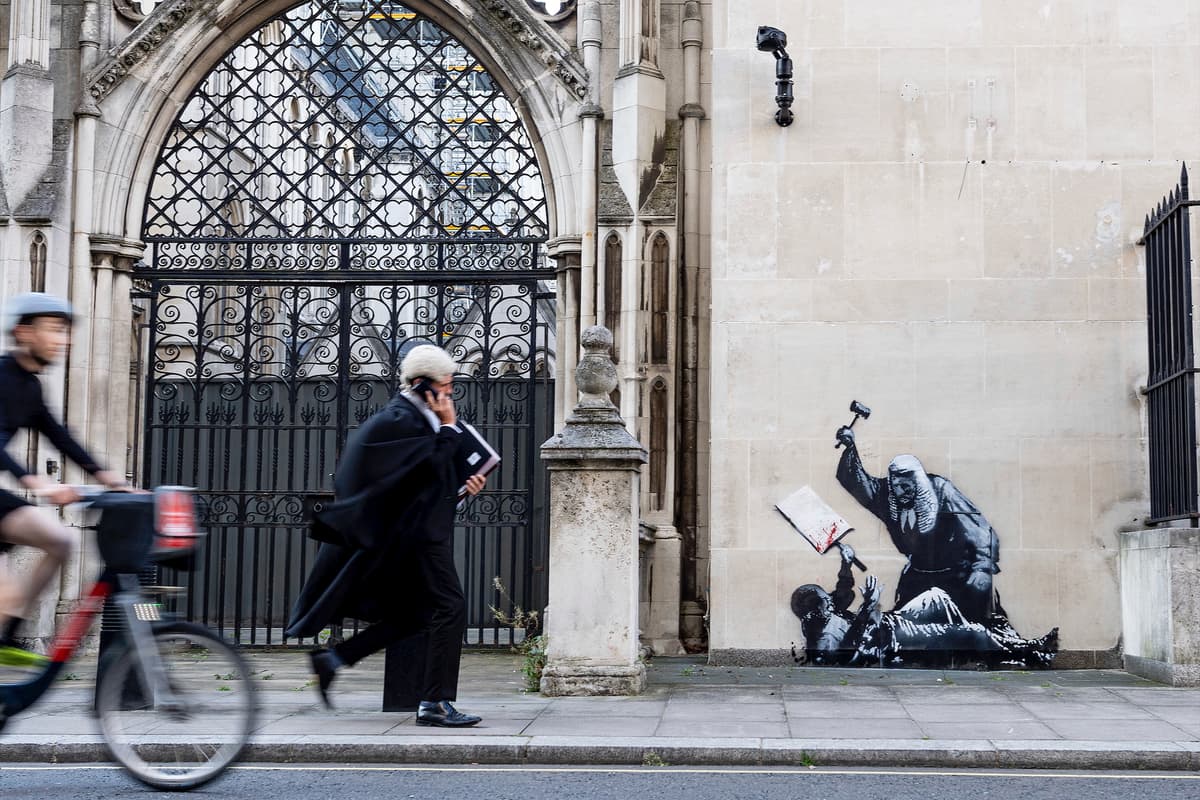

The identity of the world’s most elusive street artist, Banksy, could finally be disclosed after a new artwork attributed to the mysterious creator appeared at the Royal Courts of Justice at London this week.
On Monday, a piece depicting a judge in a wig and gown using a gavel to beat a prostrate protester holding a white, blood-spattered placard was discovered on an external wall of the Queen’s Building at central London.
Metropolitan Police officers promptly covered the artwork — then scrubbed off most of it — and are now investigating the incident as potential “criminal damage” to a historic building.
Such an investigation raises the possibility that Banksy, who has managed to remain anonymous for more than 25 years, could be unmasked. If charged and brought to court, the artist would be required to publicly disclose his or her name.
A Met spokesman confirmed the investigation: “On Monday Sept 8, officers received a report of criminal damage to the side of the Royal Courts of Justice. Inquiries continue,” according to one report.
What’s left of the artwork is now concealed by large black sheets and metal barriers, guarded by security officials. Less than 24 hours after it was found, HM Courts and Tribunals confirmed the piece would be removed. “The Royal Courts of Justice is a listed building and HMCTS is obliged to maintain its original character,” a spokesman told one news site.
The charge of criminal damage carries a maximum sentence of 10 years if the damage exceeds 5,000 British pounds. For damages of less than 5,000 pounds, the maximum penalty is three months in jail or a 2,500-pound fine.
While Banksy has not officially claimed the piece, the protest group Defend Our Juries suggested it was the artist’s work. They believe it depicts the “dystopian” proscription of Palestine Action. Their statement came just two days after 890 demonstrators were arrested on Saturday at a London rally protesting the ban on the group.
A spokesman for the group, which organized Saturday’s rally, described the piece as powerfully depicting “the brutality unleashed by [Foreign Secretary] Yvette Cooper on protesters.”
“When the law is used as a tool to crush civil liberties, it does not extinguish dissent, it strengthens it,” the spokesman said. “As Banksy’s artwork shows, the state can try to strip away our civil liberties, but we are too many in number and our resolve to stand against injustice cannot be beaten — our movement against the ban is unstoppable and growing every day.”