France Pulls Its Soldiers Out of West Africa

Russia is cited as the main threat, as the blue, white, and red tricolore is lowered across the continent.

Ludovic Marin, pool via AP
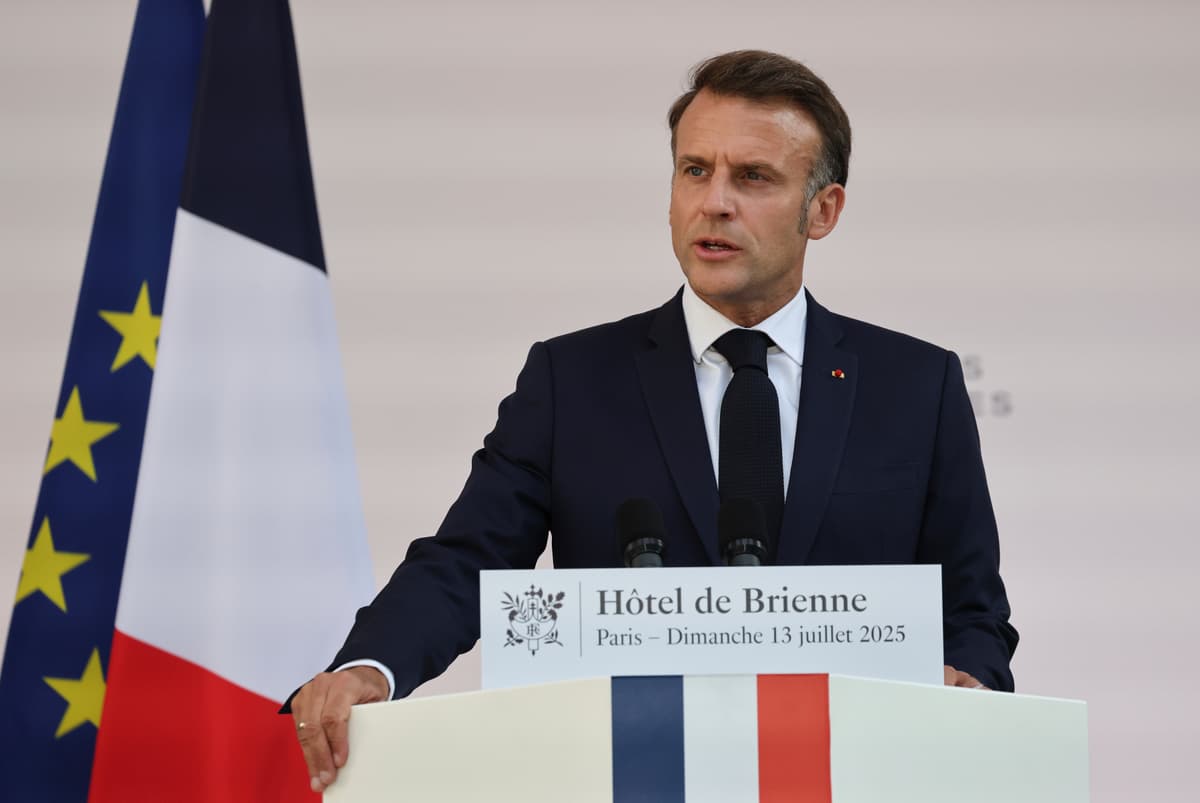
President Macron speaks to army leaders at the Hotel le Brienne, July 13, 2025, ahead of the Bastille Day parade at Paris. Ludovic Marin, pool via AP

As Paris focuses on Russia as its primary threat, France’s blue, white, and red drapeau tricolore is coming down across West Africa. Paris is leaving its former colonies at the mercy of Russian mercenaries and local Islamic terror groups.

In quick succession over the last three years, France has closed bases in Burkina Faso, Chad, Cote d’Ivoire, Gabon Mali, Niger, and, last Thursday, in Senegal. Since the 1960s, when a wave of independence swept across West Africa, the world got used to calling on France, in its role as the gendarme of Africa, to assure Western interests and a modicum of political stability. Until 2000, the French military intervened at the rate of once a year.

Stability and memories of empire were nurtured on the cheap — 10,000 French soldiers stationed across an archipelago of bases in a land as large as Europe. With last week’s closing of three bases in Senegal, though, ending two centuries of French military presence there, France now has only 1,500 soldiers in Africa.

They are all in Djibouti, a former French colony strategically situated 20 miles across the Red Sea from Yemen. There, on the Horn of East Africa, the French rub shoulders with military bases and missions from America, China, Italy, Japan, Saudi Arabia, and South Korea. These foreigners eye Yemen’s Houthi rebels, an Iran-supported group that strangles shipping through the Suez Canal.

France’s pullout from West Africa follows two precepts. By dropping Françafrique, President Macron pulls two popular flags away from France’s most powerful opposition party, the National Rally. Imbued with a nationalist, “France First” ideology, these right-wing voters are tired of Paris’s forever wars in Africa. 

They also want tighter controls on legal immigration and stepped-up deportations of visa overstayers. Immigrants from French-speaking West Africa now account for 3.5 million people, or 5 percent of France’s population of 68 million. This year, for the first time, more people speak French outside of France than inside “L’Hexagone.

Without risking French soldiers falling hostage to the African street, the Macron government can now take a harder line on illegal immigrants from Africa. In France, pre-campaigning is starting for the next presidential election, in April 2027. After two five-year terms, Mr. Macron is term-limited. Yet the 47-year-old politician would like to see his centrist voter base prevail, paving the way for a possible third term bid in 2032.

With Russia rising, Mr. Macron sees Africa in the rearview mirror. He says France’s primary security threat comes from the east. On July 11, the head of France’s army, General Thierry Burkhard, told reporters that Russia has singled out France as its  “main enemy in Europe.” Stressing the point several times, he said, “Putin said it: ‘France is my main adversary in Europe.’” Calling Russia “a lasting, close threat,” he warned: “Russia will continue to rearm, despite the incredible losses it is suffering.” Looking beyond Ukraine, he said Russia “will again constitute a force that will pose a real threat to our borders on Europe’s eastern flank.”

Two days later, Mr. Macron, in his annual pre-Bastille Day speech to the French armed forces, announced a sharp increase in military spending. He promised to increase annual defense spending to $75 billion in 2027. This would represent a doubling of defense spending during the Macron decade, from $37.6 billion in 2017.

“Since 1945, freedom has never been so threatened, and never so seriously,” Mr. Macron, taking on Gaullist tones, said. “You have to be feared in this world. And to be feared you have to be strong.”  Evoking European worries over President Trump’s commitment to NATO, he said “American disengagement” is pushing Europe to defend itself. The speech made no mention of Africa.

Back in Africa, some countries are not doing well without the gendarme. Spreading Islamist insurgencies now control about half of Burkina Faso and Mali. The fighting in Mali has grown so intense that neighboring Mauritania now hosts the largest refugee camp in West Africa, Mbera, home to 250,000 Malians.

After military coups in Burkina, Mali, and Niger, the new military leaders told the French that it was time to go. They may not have understood that they were pushing on an open door at the Élysée Palace. Last year, Washington pulled American troops out of Chad and Niger.

To fill the vacuum, the three Sahel countries brought in Russian “advisors” and mercenaries. Russia is the largest weapons supplier to Africa, according to the Stockholm International Peace Research Institute. However, as insurgencies spread, the Russians are in over their heads.

After recording 850 dead across Mali, Niger, and Burkina Faso in May, an America-based organization, Armed Conflict Location & Event Data, reported that killings hit record levels in June. The lead insurgency group, Jama’at Nusrat ul-Islam wa al-Muslimin, an Al-Qaeda affiliate, is considered the world’s fastest-growing terror group, with 7,000 armed fighters.

In a turning point one year ago, Touareg rebels ambushed a combined Russian-Malian convoy in Tinzaouaten, a Sahara oasis near the Algerian border. The rebels claimed to have killed 47 Malian soldiers and 84 Russian Wagner mercenaries. The dead Russians included Nikita Fedyanin, a well-known  blogger behind the Wagner group’s Telegram channel, Grey Zone. 

Against a desert backdrop, the Touaregs then posed with a Ukrainian flag. This set off a furor. Ukrainian news reports said the Touaregs used drones and satellite intelligence supplied by Ukrainian special forces. Ukraine’s military intelligence spokesman, Andriy Yusov, said on national television the rebels received “all the data they needed, which allowed [them] to carry out their operation against the Russian war criminals.” 

Before the attack, the head of military intelligence, Kyrylo Budanov, had told the Washington Post in an interview: “Our operations are aimed at reducing Russian military potential, anywhere where it’s possible. Why should Africa be an exception?” 

In Moscow, a Russian foreign ministry spokeswoman, Maria Zakharova, told the RIA Novosti news agency that  Ukraine “is pandering to terrorist groups in countries on the continent friendly to Moscow.” She accused Ukraine of opening “a second front in Africa.” Mali and neighboring Niger broke diplomatic relations with Ukraine. A few weeks later, Russia declared its mission accomplished in Mali, withdrew its Wagner combat units, and replaced them with base-bound military advisors from Russia’s newly formed “Africa Corps.”

France’s exit from the three Sahel nations probably prompted Chad’s military ruler to inform Paris that the time had come to end his nation’s 58-year-old military partnership with France. Until six months ago, France had 1,000 troops spread among three bases in this Central African nation. 

France’s air base and the 1.7-mile-long air strip at Ndjamena International Airport served as a French aircraft carrier in the heart of Africa. The loss of the base, which the French air force had occupied since 1939, undoubtedly pushed Paris to close bases this year in three less critical coastal nations — Cote d’Ivoire, Gabon, and Senegal.

Over the last century, France has been the guarantor of West Africa’s coastal Catholic populations. Much like the harmattan dust from the annual wind blowing south from the Sahara, Christians along the Gulf of Guinea have long dreaded Muslim encroachment from the interior. Now, Islamic movements — and sometimes insurgencies — are active in northern Benin, Cote D’Ivoire, and Togo.

Over the last 25 years, Islamist groups in English-speaking Nigeria have killed 62,000 Christians, a slaughter largely ignored on Western university campuses. When West Africa’s next crisis comes, who will answer the whistles blowing for the gendarme?


The New York Sun

© 2025 The New York Sun Company, LLC. All rights reserved.

Use of this site constitutes acceptance of our Terms of Use and Privacy Policy. The material on this site is protected by copyright law and may not be reproduced, distributed, transmitted, cached or otherwise used.

The New York Sun

Sign in or  create a free account

or
By continuing you agree to our Privacy Policy and Terms of Use