France’s Macron Warns Against an American Betrayal in Ukraine
Remember Vietnam, we say.

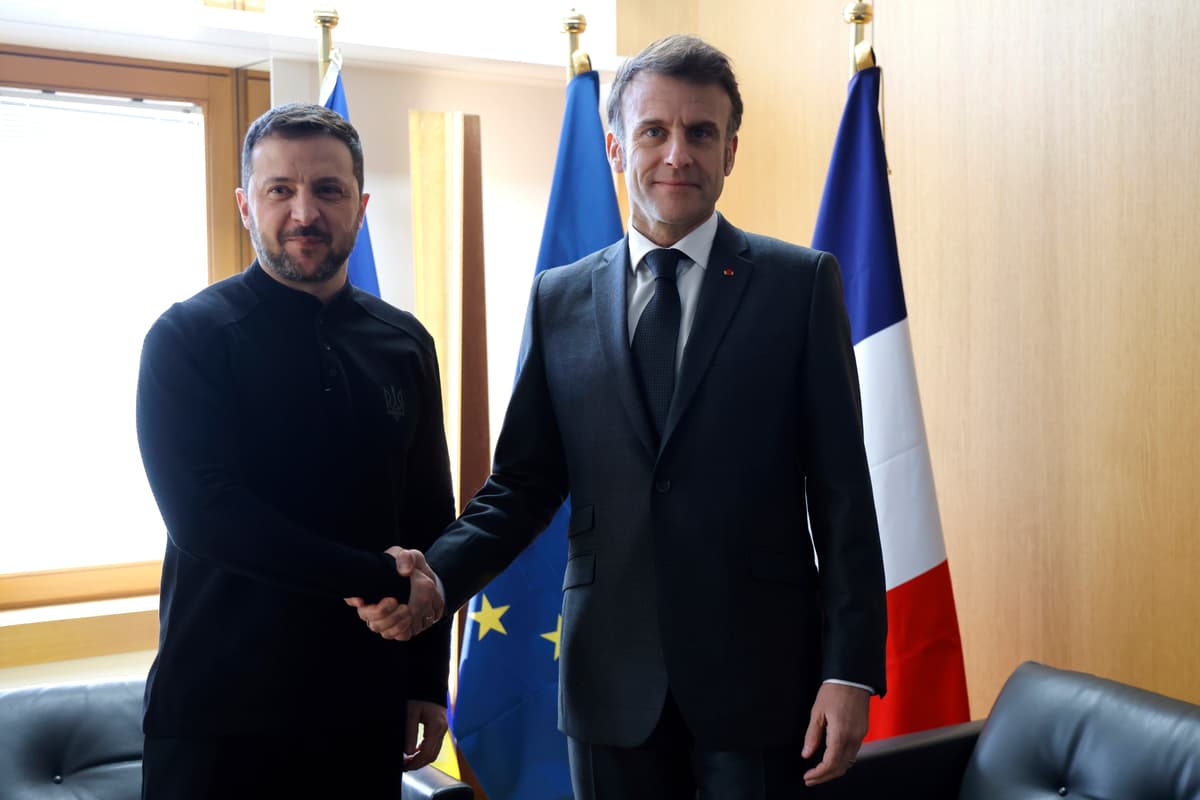
The latest leaks out of Europe quote President Emmanuel Macron of France as warning President Volodymyr Zelensky that “there is a chance that the US will betray Ukraine on territory.” A chance? Nigh a certainty, we’d posit, at least if one peruses the record that began with the Vietnam peace accord that we signed at France’s own capital of Paris. That’s the deal that allowed North Vietnam to base forces in South Vietnam. It led to the communist conquest.
The deal was signed on January 27, 1973. As the date neared, our side still lacked the agreement of the South Vietnamese president, Nguyen van Thieu. He was no dummy. Henry Kissinger, in his memoirs of his White House years, quotes Nixon as telling him to get Thieu’s agreement. “Brutality is nothing,” Nixon said. “You have never seen it if this son-of-a-bitch doesn’t go along, believe me.” What Kissinger called a “scorching” letter followed.
So the deal was signed. From the moment — the nanosecond — it was inked, the communists began breaking it, bringing troops into South Vietnam and continuing to levy the war. The Democratic Congress, in effect, swung to the North Vietnamese side and, in a series of votes, cut off military aid to the free Vietnamese government. That forced the free Vietnamese to retreat from the Central Highlands, and the war ended in our defeat.
We’ve written about this here and here. What sticks with us from the remove of now 50 years is that Vietnam was just the start. During the Obama years, the Democrats abandoned the war in Iraq. Under President Biden they abandoned the war in Afghanistan. In some cases, it wasn’t just the Democrats or the Russians. It pays to be skeptical when negotiators set out to craft a diplomatic deal. If history is a guide, a betrayal is in the making.
We get that Mr. Macron is no De Gaulle. Faced with the largest threat to the continent’s security since World War II, Europe’s leaders seem paralyzed. They talk a big game about the danger of a Russian victory. Yet the Continent’s political divisions seem to be proving a stumbling block to any European action. An EU loan of some $105 billion, based on frozen Russian assets, is shaping up as a test of Europe’s mettle.
In any event, one of the features of the American betrayals of Vietnam, Iraq, and Afghanistan is that none of those wars were declared. Meaning, none was declared by Congress in the constitutional sense. The authorizations to use military force that opened the way to the fighting in those wars were hedged. That’s in sharp contrast to the declaration of war that Congress passed to unleash our forces against Japan in World War II.
That declaration is something to savor in the cold light of history. It was 165 words. Noting Japan’s attacks against us, it resolved that “the state of war” is “hereby formally declared.” It authorized — “and directed” — the president to use our “entire naval and military forces” against Japan. Then the famous words: “to bring the conflict to a successful termination, all the resources of the country are hereby pledged by the Congress of the United States.”
Not even the liberal press could squirm out of that one. So we won the war against Japan. The history since then has been a long retreat, and we’re not inclined to put the gloss on it. Nor mock Monsieur Macron for doubting whether Americans will stick with the war in Ukraine. He’d be smart to address the point to the Congress, which has America’s sole power of declaration. As we’ve noted several times here, America has never lost a war it declared.