
Germany Steps Into Vacuum Created by Trump Turning From Europe

Chancellor Friedrich Merz asserts: Pax Americana is over.
AP/Olivier Hoslet, pool
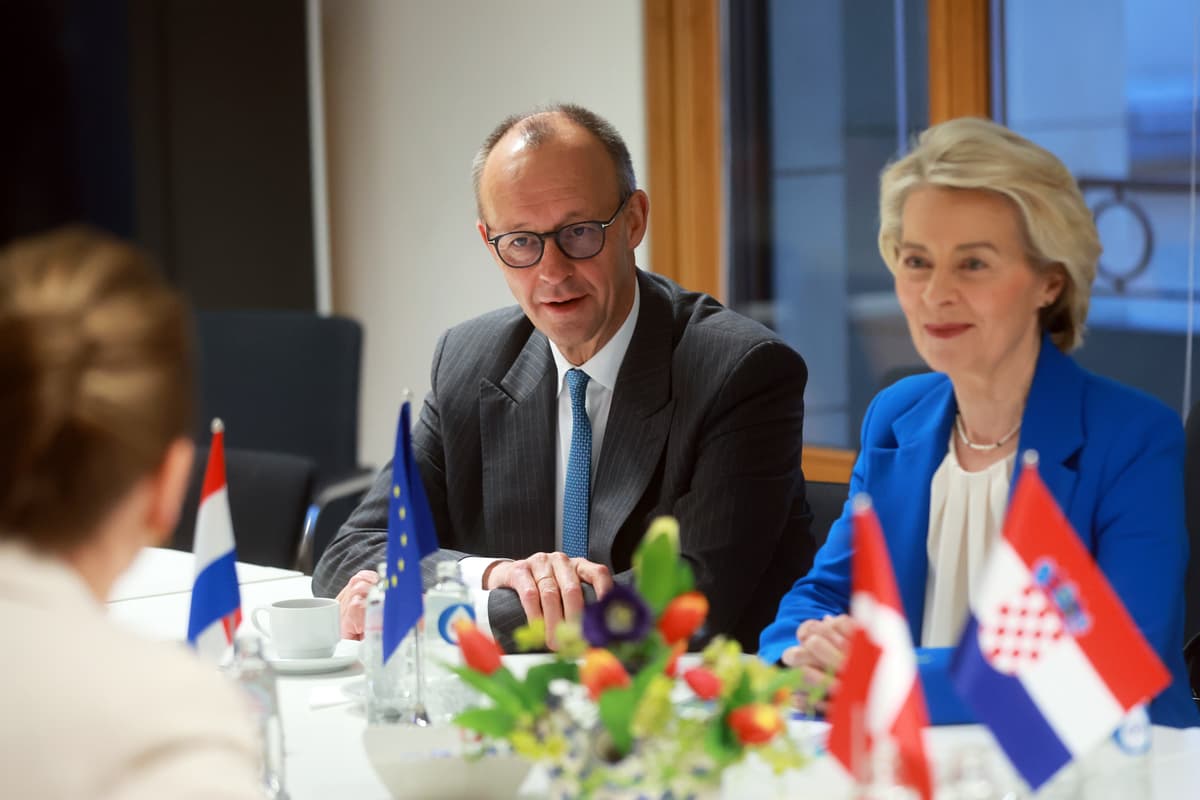
The European Commission president, Ursula von der Leyen, right, and Chancellor Friedrich Merz, left, at the EU Summit, Brussels, December 18, 2025. AP/Olivier Hoslet, pool

As President Trump cuts military support to Europe, Chancellor Friedrich Merz steps up to fill the leadership vacuum. Today, at the European leaders meeting at Brussels, Mr. Merz will stand out for more than his 6-foot 6-inch stature. He is leading the charge to block an American initiative to take control of $250 billion in frozen Russian assets in Europe.

Mr. Merz, a forceful former lawyer for a Chicago law firm, plans to argue today that the 27-nation European Council must brush aside American and Russian objections and seize the money to fund Ukraine for the next two years. Otherwise, Ukraine will run out of money by April. This prospect, Trump Administration officials believe, will force Ukraine to make concessions in peace talks.

“Let us not deceive ourselves. If we do not succeed in this, the European Union’s ability to act will be severely damaged for years,” the German leader on Monday told German TV. “We will show the world that, at such a crucial moment in our history, we are incapable of standing together and acting to defend our own political order on this European continent.”

Mr. Merz has muscled Europe into the Trump Administration’s peace talks, which originally were a Russian-American affair. Now, he and other German voices are saying it is time to stand up to Russia, and, for a change, to America. The German chancellor’s assertion of leadership of Europe comes as many Europeans believe that, for the first time since World War II, America no longer has Europe’s back.

“The decades of Pax Americana have largely ended for us in Europe; it no longer exists in the form in which we once knew it,” the 70-year-old chancellor told a Christian Social Union conference in Bavaria on Saturday. As delegates applauded, he added: “We in Europe, and therefore also in Germany, must become much more independent from the U.S. in terms of security policy.”

Mr. Trump’s father, Frederick, was conceived in Bavaria to a German couple who later immigrated to New York. The elder Trump grew up in a German-speaking household. Yet Mr. Trump shows little affection for the land of his grandparents. 

European nations are “decaying” and “weak,” he told Politico 10 days ago. “Look at Germany. Germany was crime-free, and Angela [Merkel] made two big mistakes: immigration and [abandoning nuclear] energy.” 

Earlier this month, Europe was harshly criticized in the annual White House National Security Strategy. Then, Administration officials leaked a secret appendix: Washington mulls abandoning the Europe-dominated Group of Seven. In its place would be “the Core 5” — America, Russia, China, India, and Japan. Cut out would be Europe, the world’s second-largest economy, after America’s. 

“The U.S. is obviously no longer leader of the free world,” German politician Manfred Weber told reporters at Strasbourg Tuesday.  The leader of the largest party in the European Parliament, the center-right European People’s Party, Mr. Weber complained that the Trump administration is “distancing themselves from us.” 

From the liberal side, editors of Germany’s best-selling news magazine, Der Spiegel, placed on their cover last week a caricature of Mr. Trump and President Vladimir Putin. The title read: “Two villains, one goal: how Trump and Putin are attacking Europe.”

For decades, Western Europeans have been comforted by the knowledge that America’s nuclear arsenal balances that of Russia’s. Now, talk is of a European arsenal. “We need a European Union with a large arsenal of nuclear weapons,” the chairman of Denmark’s parliamentary defense committee, Rasmus Jarlov, posted last week on X. At the same time, Denmark’s Defense Intelligence Service for the first time described America as a potential security risk. Cited as a reason was Mr. Trump’s ambition to take over Greenland, a Danish territory. 

Sympathy for Europe’s new alienation from Washington comes from a Canadian-American political analyst, Diane Francis. Mr. Trump’s “anti-European screed ignored that Europe is not only rich, but it is militarizing,” she objected last week. “To the clear-eyed,” she added, the criticism reflects that Mr. Trump “is biased and badly informed, and that he’s missed the reality that the world order is now ‘tripolar,’ anchored by the U.S., Europe, and then China.”

Last spring, as Mr. Merz prepared to become Chancellor, he engineered a German commitment to spend $1 trillion on its military and its infrastructure over the next decade. Next year, Germany reinstates mandatory registration for the military draft. The goal is to create Europe’s largest army.

“There remains a concern about German military expansion,” a British conservative columnist, Douglas Murray, wrote recently. “But at some stage that is going to have to be a problem that Europe gets over. You will probably never have a secure Europe without a significant German military.”

Russian officials and commentators are not easing European war fears. Yesterday, Mr. Putin told a Defense Ministry gathering that European politicians are “newly weaned pigs” who want to “feast on the collapse of Russia.” Russia’s defense minister, Andrei Belousov, warned the same gathering: “The preparation of NATO forces for an armed confrontation with Russia by 2030 has begun.” 

Last week, the chief Russian negotiator  Kirill Dmitriev, posted on X a photo of President Volodymyr Zelensky with Prime Minister Keir Starmer, President Emmanuel Macron, and Herr Merz. The caption read: “Team ‘War’ is sabotaging Trump’s Peace.” Around the same time, the Kremlin’s top propagandist, state TV host Vladimir Solovyov, called for the murder of a veteran German politician, Ursula von der Leyen. Since 2019, she has served as president of the European Commission.

Under Mr  Trump, American military aid to Ukraine has essentially dwindled to zero. By contrast, under Herr Merz, Germany’s monthly military aid to Ukraine nearly tripled this year, the Kiel Institute’s Ukraine Support Tracker reported last week. In an exception, the United States Senate yesterday passed the 2026 National Defense Authorization Act. Mr. Trump is expected to sign the measure, which mandates a total of $800 million in military aid to Ukraine in 2026 and 2027. By contrast, Germany signed $1.4 billion worth of arms deals yesterday with Ukraine.

Concerned that the Trump Administration is backing away from America’s 80-year-old commitment to Europe’s defense against Russia, the authors of the American bill limit the Defense Department’s ability to cut American forces in Europe to fewer than 76,000 soldiers and bars the American commander in Europe from giving up the title of NATO Supreme Commander.

Last month, at the Berlin Security Conference, the American ambassador to NATO, Matthew Whitaker, said he looks forward to the day when Germany would volunteer to take over the role of Supreme Allied Commander Europe. The senior German speaker, Lieutenant General Wolfgang Wien, was taken aback.


The New York Sun

© 2025 The New York Sun Company, LLC. All rights reserved.

Use of this site constitutes acceptance of our Terms of Use and Privacy Policy. The material on this site is protected by copyright law and may not be reproduced, distributed, transmitted, cached or otherwise used.

The New York Sun

Sign in or  create a free account

or
By continuing you agree to our Privacy Policy and Terms of Use