Hochul vs. New York’s Constitution
The governor and the minority leader in the House, Hakeem Jeffries, seem bent on evading the state’s governing law.
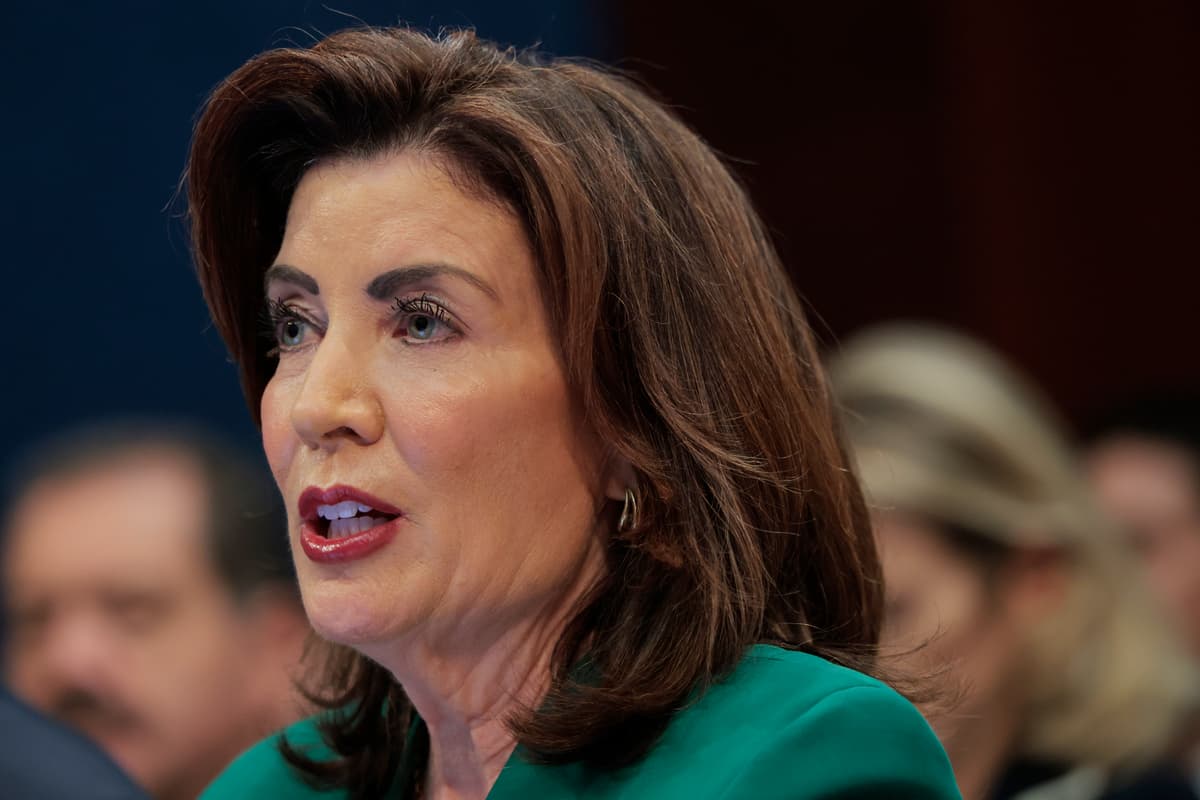

“All’s fair in love and war” — and the fray over control of the United States House. So, it seems, reckons Governor Hochul in a warning that, to help the Democrats, she’s weighing a new attempt at partisan redistricting of New York’s congressional map. Yet the real yardstick of what’s “fair” in New York is the state constitution, which rules out the kind of gerrymander she and the House minority leader, Hakeem Jeffries, would like to instigate.
It’s startling to hear this kind of talk from Mrs. Hochul and Mr. Jeffries after their previous attempt to help their party by rejiggering the state’s district map was rejected by New York’s highest court. The Democrats’ scheme was thwarted by the plain language of the state constitution. In 2014 the voters had approved an amendment that requires voting maps to be drawn every 10 years by an independent, bipartisan panel.
The amendment came amid outrage by New York voters over the use of the gerrymandering tactic, in which irregularly shaped districts are drawn in an effort to favor one party or the other. Yet after the 2020 census, New York Democrats took advantage of a deadlock on the state’s redistricting panel to draw a partisan map. A former chief judge of New York, Janet DiFiore, lamented that Democrats acted as if the amendment had “never been passed.”
Writing for the high court’s majority, Judge DiFiore wrote that the Democrats’ partisan redistricting was “a gross and deliberate violation of the plain intent of the Constitution and a disregard of its spirit.” The ruling, in a rare display of fealty to the law over liberal ideology, struck down the Democrats’ gerrymander. As a result, the maps used in the 2022 and 2024 congressional elections were drawn based on nonpartisan criteria.
So while the map envisioned by the Democrats could have cut the state’s GOP delegation in Congress down to four, the nonpartisan district map led 11 Republicans to be elected in 2022, and seven in 2024. In light of the slender margin of control in the House, it’s possible to see New York’s nonpartisan map as a decisive factor tipping power to the Republicans. That has had dramatic consequences for the fate, say, of President Trump’s budget law.
No wonder that Mr. Jeffries and Mrs. Hochul are looking for any pretext they can find to redraw the maps to the Democrats’ advantage. “We’re following the rules. We do redistricting every 10 years,” Mrs. Hochul seemed to lament today at Buffalo. Yet, she continued, “if there’s other states violating the rules and are trying to give themselves an advantage, all I’ll say is, I’m going to look at it closely with Hakeem Jeffries.”
Mrs. Hochul’s remarks here are a nod to talk among Texas Republicans that they might attempt a gerrymander of their own to boost the Lone Star State’s GOP congressional delegation. The Texas state legislature is even holding a special session to weigh new maps. That prompted Governor Newsom to suggest that California, too, could redraw its maps to help the Democrats gain more seats in the House of Representatives.
No wonder Mrs. Hochul and Mr. Jeffries, representing America’s fourth-largest state, don’t want to sit on their hands. Of the Texas remap, she scolds, “I’m not surprised that they’re trying to break the rules to get an advantage.” Mrs. Hochul adds that it is “undemocratic, and not only are we calling them out, we’re also going to see what our options are.” Say what you will about the Texas effort, it doesn’t run afoul of its state parchment.
Mr. Jeffries’s eagerness to wield the speaker’s gavel is prompting him, too, to weigh a traversal of New York’s state charter to gain a leg up. He’s urging state officials “to explore what, if anything else, can be done to ensure that New York does its part with respect to fair maps across the country.” Curious, isn’t it, that for Mr. Jeffries as well as Mrs. Hochul, New York’s constitution seems to have no bearing on their definition of what’s “fair.”