If Mali Falls to Al Qaeda, the Shock Waves Will Spread to the Coastal States and Beyond
While a government collapse is not considered an immediate worry for the White House, it is one that world leaders cannot ignore.

Mali’s capital, Bamako, is being squeezed as Al Qaeda-linked militants, known as Jama’at Nusrat al-Islam wal-Muslimin, or JNIM, tighten blockades, cut off fuel supplies, and choke the flow of food and medicine — pushing the fragile government to the brink of collapse. So just how close is Mali to falling under terrorist control?
“Mali’s ruling [junta] is facing its greatest security challenge to date,” the director of the Michael J. Morell Center for Intelligence and Security Studies, Karl Kaltenthaler, tells The New York Sun.
JNIM “does not have the capability, at this time, to enter and hold the capital successfully,” Mr. Kaltenthaler said. Instead, “it is likely trying to bide time and let the military junta collapse under its own weight of being unable to secure large parts of the country and to supply the capital with fuel and other goods.”
The Quiet Unraveling
For years, Mali has been sliding. Analysts describe the current moment as the culmination of weakened institutions, repeated coups, divided loyalties, and a jihadist insurgency that has steadily eaten away at state control.
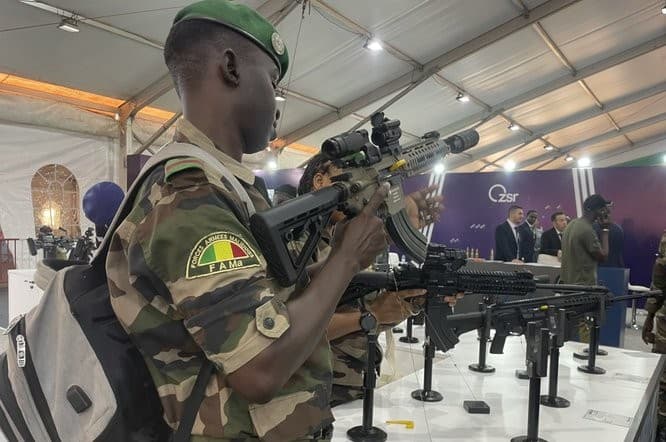
The military junta that seized power in 2020 promising stability instead oversaw a sharp rise in violence as French and other foreign forces were replaced by Russia-aligned mercenaries, now known as Africa Corps but formerly referred to as the Wagner Group. Rather than bolstering state forces, the mercenaries have spent years extracting resources to fund Moscow’s war in Ukraine while the state security apparatus plunges deeper into decay.
“Currently, JNIM was able to cut off Bamako quite effectively and is controlling all energy supplies to the city,” the senior director at the Counter Extremism Project, Hans-Jakob Schindler, tells the Sun.
“This brings the terrorist forces to a very advantageous position as they can simply choke off the capital and wait for the government’s collapse without having to enter the urban area and risk large-scale losses through urban warfare.”
Today, JNIM operates across large swathes of the country. One of its newest tactics is the fuel blockade.
Since early September, the movement has maintained a ban on fuel imports into the country, specifically targeting convoys that bring fuel from Senegal and Côte d’Ivoire into Mali. Hundreds of tanker trucks are stranded at the border and some have been set ablaze. The blockade has triggered school closures, widespread blackouts, and a deep economic shock.
Humanitarian indicators are dire. In its latest situation report, UNICEF found that 88 percent of the population in at-risk regions — nearly 2 million people — were unable to access adequate health services, including more than a million children under 5 and hundreds of thousands of pregnant women.
Conflict deaths across the broader Sahel show no sign of slowing. The state’s apparatus is under strain, its legitimacy eroding, and insurgents now press on the economic and social fronts as well as the military one.
“Mali is experiencing a severe fuel shortage,” says a Senegalese columnist, Hussein Ba, who closely tracks the country’s crisis.
He tells the Sun that “armed groups affiliated with Al Qaeda have managed to blockade several key locations for an extended period, preventing the army from liberating them.” Thus, the jihadists “have succeeded in paralyzing the land corridors that connect Mali to the ports of Côte d’Ivoire, Senegal, and Mauritania.”
The Tipping Point: What’s at Stake and What Comes Next
If Bamako falls — meaning the government can no longer guarantee access, movement, security, or basic services — the country might share the fate of other places in which insurgent groups supplanted the state.
“I don’t think anyone can accurately predict whether or when Mali will outright collapse, as the situation is fluid,” a security and defense consultant, Royce de Melo, tells the Sun.
“But there is a security and humanitarian crisis. JNIM is controlling roads connected to the capital, as terrorists destroy or stop fuel and food convoys, the power outages in the capital, reports of low morale in the armed forces, and rising prices for goods are pushing things to a tipping point.”
That point, he warns, “could manifest as chaos and rioting in the capital’s streets and significant military desertions – or the military turning against President Assimi Goïta.”
Several scenarios present themselves. One is a gradual collapse of state control, with JNIM slowly and methodically filling the vacuum by seizing local authority, levying taxes, controlling roads, and limiting the government’s reach.
A second possibility is the insurgents’ rapid seizure of critical infrastructure in Bamako, triggered by the fuel shortage, protests, or the breakdown of public services. A third is negotiations in which the desperate government might strike local deals with jihadist actors to preserve a semblance of power while conceding territory.
Mr. Schindler said he does not expect a rapid collapse of the government but “the breakdown seems likely.”
“It is not clear if or how the military regime will be able to free itself from this stranglehold without external support, the provision of which does not seem likely,” he said.
Why It Matters for Washington
The unraveling of Mali matters for Western national security, especially for America’s strategy in Africa and the Sahel.
“The benefits of U.S. counterterrorism efforts have been largely undone by the lack of an ongoing military presence in the Sahelian states most affected by the local al-Qaeda and ISIS affiliates,” said Mr. Kaltenthaler. “Governments in Mali, Niger, and Burkina Faso are now increasingly losing control over large swathes of their territory to these groups.”
For Washington, Mali’s fate carries broader implications.
“If or when Mali falls,” Mr. Schindler warns, “it will be of paramount importance for the U.S. and Europe to coordinate their efforts to ensure that at least the coastal states of the Gulf of Guinea do not destabilize as well.”
Containment, he said, “is therefore the only feasible option at this point.”
Mr. Ba agrees that the consequences of an Al Qaeda takeover would ripple far beyond Mali’s borders. “This would be a major blow to its neighbors,” he said. “The fall of Bamako could have incalculable consequences for neighboring coastal countries with stable regimes, such as Senegal, Mauritania, and Côte d’Ivoire.”
Mali’s increasing instability, Mr. de Melo highlighted, also “raises morale for JNIM’s terrorists fighting in Niger, Burkina Faso, and other West African states,” causing “great anxiety for the governments of those same countries.”
Indeed, Mali has reached a moment of truth. It is no longer just grappling with an insurgency — it is a state under siege, assailed on multiple fronts at once. While a government collapse is not considered an immediate worry for the White House, it is one that world leaders cannot ignore.
“JNIM’s ultimate objective is to control all of Mali and to move to control other Sahelian states,” Mr. Kaltenthaler said. “For Al Qaeda, the Sahel is presently the region in the world that offers the movement its greatest opportunity to take and hold territory.”