Khalid Sheikh Mohammad’s Just Deserts
An appeals court allows the government to exit a deal that would have spared the 9/11 mastermind the death penalty.
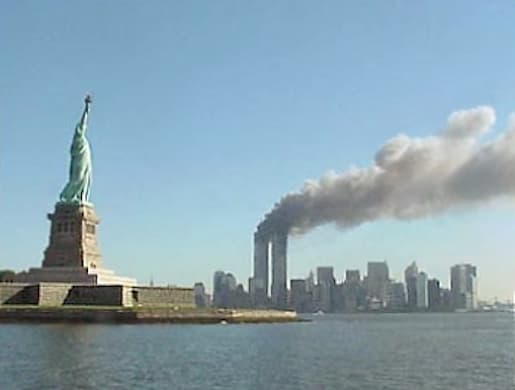

Will the September 11 mastermind Khalid Sheikh Mohammad get his just deserts? The prospect is more likely now that a federal circuit court has agreed to void a deal under which the accused plotter for Al Qaeda would avoid the death penalty in exchange for a guilty plea. The broader problem is yet to be resolved, though: How is it possible that, more than 23 years after 9/11, this case has been dragging on in the federal courts for so long?
What is the matter with our courts? We think back to June 1942, when a group of Nazi saboteurs were landed at Long Island and Florida from enemy U-boats. They were quickly captured. Even before they could carry out an attack against us, they were tried by a military commission that had been convened by FDR. Things dragged on for a few months, but by the end of August, the majority of the saboteurs had been executed.
What a contrast with Mr. Mohammad. Along with two others charged with plotting the 9/11 attacks in which nearly 3,000 died, Mr. Mohammad had hoped to dodge the death penalty under an agreement forged with military prosecutors. The deal, which would have set life sentences for the plotters, sought to bring an end to 20 years of legal wrangling. Yet when word emerged of the prosecutorial pact, the outrage was — understandingly — swift.
President Biden’s defense secretary, Lloyd Austin, then sought to withdraw the deal, only to be thwarted by a military judge who said the attempt raised “the specter of unlawful influence.” A military appeals court subsequently found that Mr. Austin lacked authority to scrap the agreement, prompting the Department of Defense to seek relief from the District of Columbia Circuit of the United States Court of Appeals.
The panel of circuit riders that weighed the government’s appeal included two nominees of President Obama, Patricia Millett and Robert Wilkins, and one nominee of President Trump, Neomi Rao. Judges Rao and Millett today held that while the relief sought by the federal government was “extraordinary,” it was “warranted in this case.” They add that Mr. Austin “indisputably had legal authority to withdraw from the agreements.”
Judges Rao and Millett acknowledged, too, that “the unique and important national security interests” in the case, “as well as the significant public interest in the resolution of these proceedings,” justified the voiding of the lenient plea deal. The matter may yet be appealed to the full bench of the Circuit Court, or to the Supreme Court. “We’re going to weigh our options,” lawyer Matthew Engle, representing one of the defendants, Walid bin Attash, says.
More broadly, though, that the federal government has found itself in such a position — being dictated to, in effect, by the lawyers for Mr. Mohammad et al, including representatives of the American Civil Liberties Union, fer crying out loud — is testament to how awry America’s system of justice has gone. Unlike the World War II-era tribunal that tried the Nazi saboteurs, today’s handling of enemy combatants grants the accused extra protections.
This is partly the result of the Supreme Court’s ruling in the case of Hamdan v. Rumsfeld. That case, in 2006, allowed President George W. Bush’s plan to try 9/11 plotters in military commissions, yet added extra legal protections for defendants. The five-to-three decision held that under the “law of war,” enemy combatants are entitled to “the same procedural safeguards afforded” in a court-martial, a former military lawyer, Scott Silliman, explained.
The Sun had doubts about the high court’s ruling. The Great Scalia, too, warned that granting belligerents extra legal privileges would “keep the courts busy for years to come.” Such caution certainly looks prescient. No wonder prosecutors were tempted to offer Mr. Muhammad and his fellow plotters a deal. Now a chance beckons not only to mete out justice for the plotters but also to reform our laws to keep enemy combatants out of our courts.