Lawrence Summers’s Warning on the Crisis of the Fed

The situation ‘could turn very quickly,’ he reckons.
Mark Wilson / Newsmakers / Liaison Agency
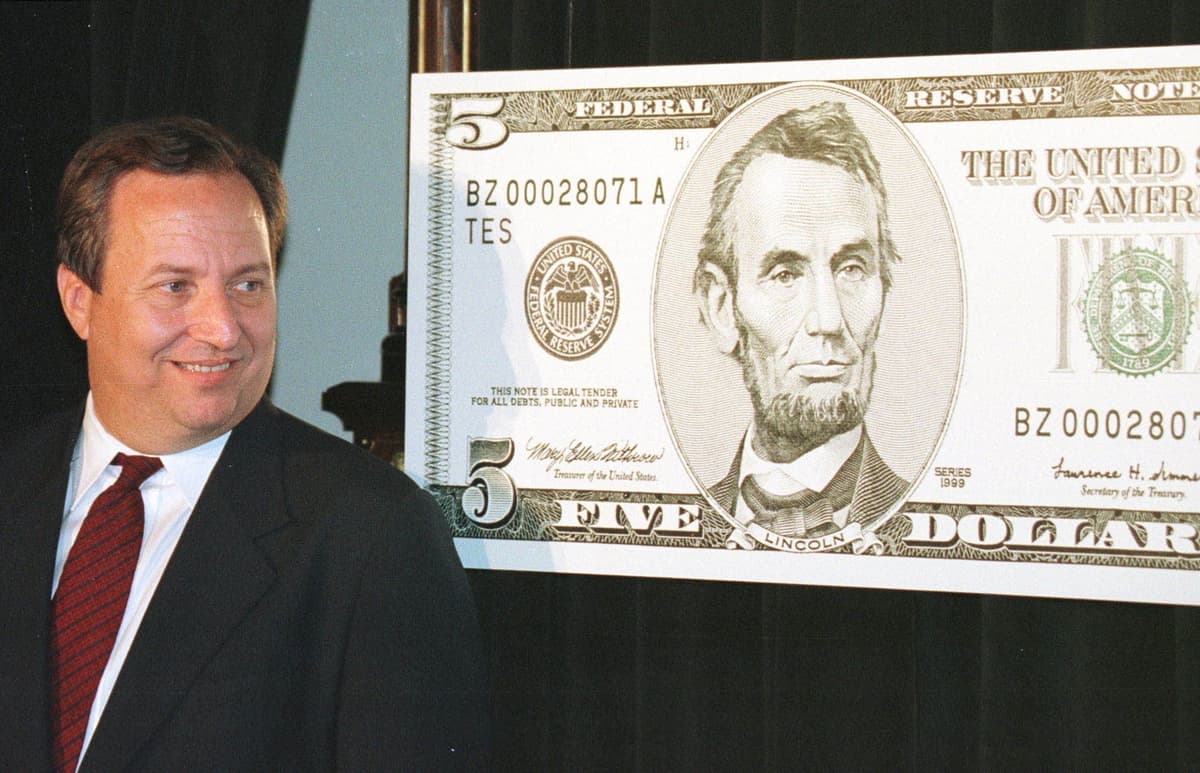
Secretary Lawrence Summers next to a redesigned five dollar bill bearing his signature, November 16, 1999. Mark Wilson / Newsmakers / Liaison Agency

A former treasury secretary, Lawrence Summers, is warning that, as Bloomberg puts it, “while financial markets have so far shown limited concern with regard to the Federal Reserve’s independence, the situation ‘could turn very quickly.’” He goes so far as to say that “we’re on the foothills of a credibility crisis” in respect of the Fed. Mr. Summers made his remarks on Bloomberg Television’s “Wall Street Week,” saying “we are in completely unprecedented territory.”

We’d thought for a moment that Mr. Summers might be talking about the collapse in the value of the dollar. The value of a one dollar Federal Reserve Note plunged this week to a record low of less than a 3,500th of an ounce of gold, after all, and some of the greenbacks still in circulation have Mr. Summers’s own signature on them. Mr. Summers, though, cited, per Bloomberg, President Trump’s campaign for the Fed to cut interest rates.

The Sun hasn’t joined that campaign. We have, though, expressed the view that it’s illogical, at least to us, to argue that a president can’t fire the policy-making governors of the Federal Reserve, since he in effect hires them by nominating them — with the advice of the Senate. The president, after all, is the sole repository of the Article II executive powers of the federal government, and authority over personnel is key to his ability to faithfully execute the laws.

Yet Mr. Summers depicts Mr. Trump’s efforts to, say, oust from the Fed’s board Governor Lisa Cook as “an attack on the governance of the institution.” He scores Republicans for their supposed silence amid “the wholesale politicization of the Fed.” Mr. Summers draws a contrast with “a long tradition of distinguished Republican leaders who have stood up for the importance of inflation credibility” at the central bank. 

One wonders, though, what is this “inflation credibility” of which Mr. Summers speaks? The question nags after the Fed in 2021 dropped the ball by writing off as “transitory” the worst wave of price increases in some 40 years. The bungle was all the more embarrassing for the Fed since its former chairman, Ben Bernanke, dismissed warnings that his Quantitative Easing would trigger inflation and insisted the Fed could nip it “in 15 minutes.”

Some four years later, the failure to quell the Biden inflation stands as a blot on the central bank’s escutcheon, especially since the pace of price increases has yet to return to the Fed’s own 2 percent target. This is not news to Mr. Summers, who in 2021 warned that President Biden and Democrats were “overdoing it” on stimulus. He cautioned “economic policymakers,” too, that their sense “that this is all something that can easily be managed, is misplaced.”

Where, then, was Mr. Summers’s talk of Fed credibility? He seems to have griped more in sorrow than anger. This speaks to a point made well by a Wall Street Journal editorial board member, Allysia Finley, the other day. “It’s hard not to gag over the dirges in the press for the Federal Reserve’s ‘independence,’” Ms. Finley reckons. Ms. Cook, she finds, “has become a martyr for a cause Democrats didn’t much care about when they were in charge.”

Feature, say, the Dodd-Frank Act in 2010, which required the Fed to “assess the diversity policies and practices of entities” they supervise. Ms. Finley calls it an order “to examine banks to ensure they were sufficiently woke.” Mark, too, Ms. Finley writes, Mr. Biden’s call to broaden the Fed’s dual mandate to encompass “racial ‘equity.’” That idea was used by the bank “as a reason not to raise interest rates,” as Democrats urged “the Fed to keep money easy.”

Which brings us back to Mr. Summers’s fears for the Fed’s integrity. He frets that Mr. Trump’s “highly irresponsible” behavior is “being normalized.” The concerns were echoed at today’s confirmation hearing for Mr. Trump’s nominee for the Fed, Stephen Miran. The gripes would have more credibility if they were part of a consistent concern for the president’s prerogatives, as opposed to viewing the central bank as the financial policy wing of the Democratic Party.


The New York Sun

© 2025 The New York Sun Company, LLC. All rights reserved.

Use of this site constitutes acceptance of our Terms of Use and Privacy Policy. The material on this site is protected by copyright law and may not be reproduced, distributed, transmitted, cached or otherwise used.

The New York Sun

Sign in or  create a free account

or
By continuing you agree to our Privacy Policy and Terms of Use