

Liz Truss Is Just Getting Started
England’s 56th prime minister, in office for only 50 days, is hardly a spent force.
When Margaret Thatcher was at the end of her premiership and we were at Brussels for the Wall Street Journal, we sent an editorial writer to London for a cocktail party in her honor. At the right moment, the editorial writer, Peter Keresztes, approached the Great Lady and identified himself as from the Journal. Thatcher, without missing a beat, shook a finger in his face. “Don’t use the phrase ‘supply side,’” she exclaimed. “People don’t like it.”
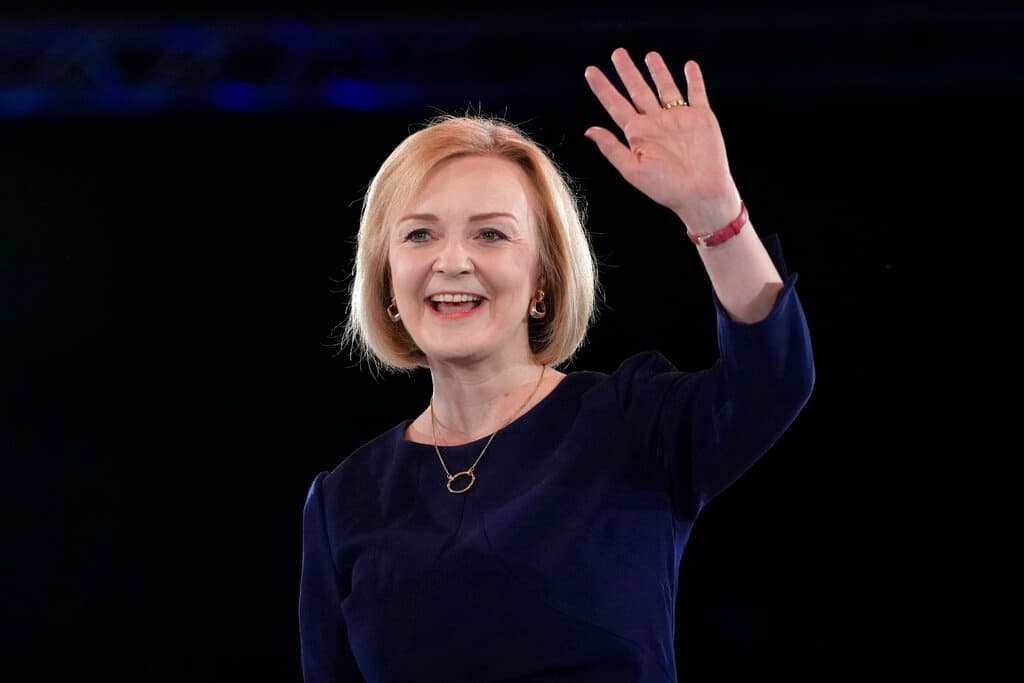
Well, meet Prime Minister Liz Truss. The former premier, whose tenure was the shortest in British history, was at New York and we met her at a live taping of the Sun’s podcast, “Sanity.” She toasted the 50th anniversary of the supply-side revolution with Arthur Laffer at the Treasury Department. She made clear that there will be no shyness about the war of ideas on the right. She is taking the long view toward a trans-Atlantic conservative renaissance.
Ms. Truss seemed to us to grasp why the supply side ideal has such an enduring hold in a country where it’s been tried. She is a champion of low taxes, deregulation, and sound money — the supply-side formula — and is intent on carrying that standard. Spending her formative years at Leeds — a leftist post-industrial redoubt — sharpened her appreciation for the revolution wrought by Thatcher.
Ms. Truss’s “mini-budget” codified those ideals and cost her her job. Ms. Truss, interviewed by our A.R Hoffman and Rebecca Sugar, was asked about surging antisemitism in England. She recalled that the prime minister, Sir Keir Starmer, once served in the leftist Jeremy Corbyn’s shadow cabinet. Quoth she: “Many members of his Cabinet have been spending their time appeasing Islamist interests. The Labor Party has done it systematically to buy votes.”
The 56th prime minister was also alert to the retreat of free speech in the land of Magna Carta and the Glorious Revolution. Now Ms. Truss argues that “the politically correct views around London and New York dinner tables” are uniformly left-wing. Even the Iron Lady, Ms. Truss, contends, “did not take on the Deep State.” She references Sir Humphrey Appleby, the archetypal obfuscating civil servant from the English television show “Yes, Minister.”
Ms. Truss views dislodging that “risk-averse, patronizing bureaucracy” as the key to saving the British ship of state from what she takes to be its ruinous course. One of Ms. Truss’s villains is Prime Minister Tony Blair, on whose ledger she lays such baleful innovations as a “pseudo-Supreme Court,” and an “unaccountable” Bank of England. She calls Mr. Starmer “the last gasp of the Blair era” and a “follower and not a leader.”
Ms. Truss predicts a “counter-revolution” and reckons that the model for such an insurgency against what she calls the “dinner party set” is President Trump. She proclaims that she is unequivocally “pro-Israel” and that London’s recognition of a state for the Palestinian Arabs was “ludicrous.” One imagines, though, that it is in respect of her vision for a prosperous Britain that Ms. Truss will be heard from in the years ahead.