Lured to Russia With the Promise of Work, Many African Nationals Unknowingly Sign Contracts To Fight in Ukraine

After nearly four years of war, Russia is attempting to bolster its number of soldiers by using covert tactics to coerce foreign recruits.

Via X
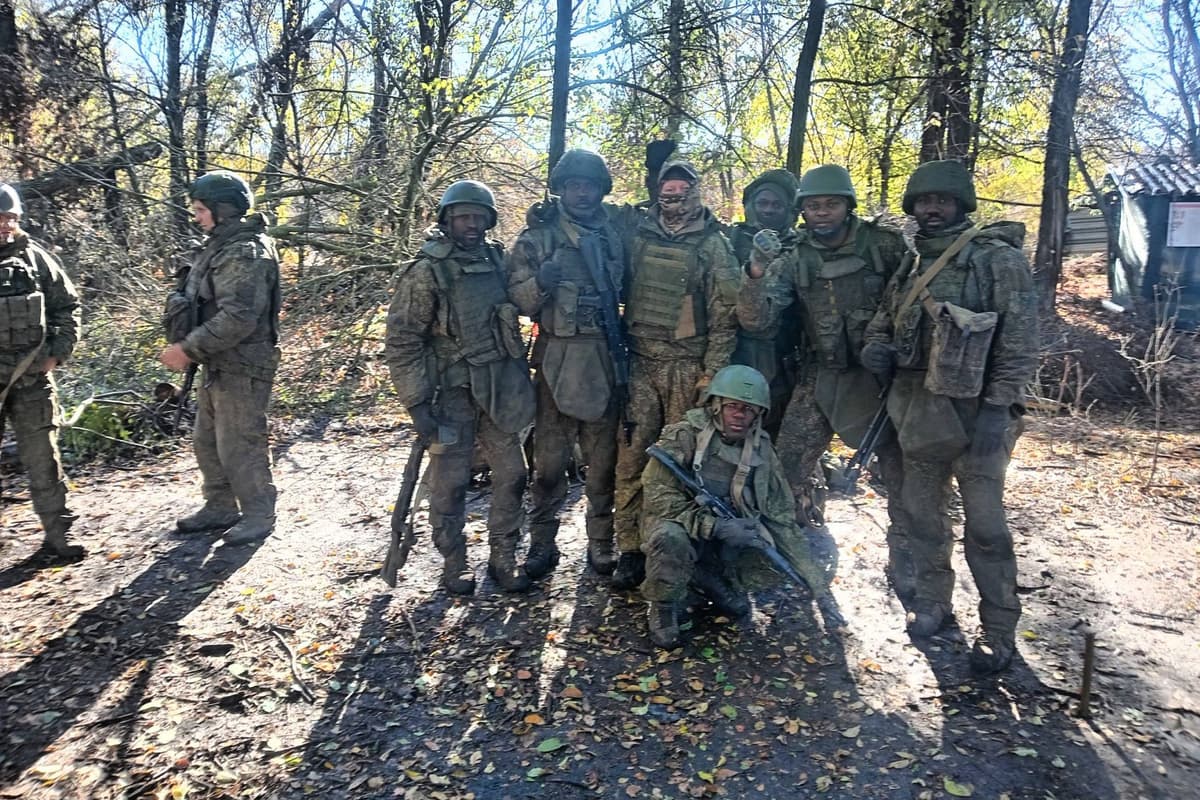
Reports reveal that Africans on work visas have been detained and forced to choose between deportation or the front line. Via X

Russia is quietly expanding its war machine with thousands of foreign recruits, many of them African nationals who claim that they were lured to the country with promises of work, only to discover too late that they had unknowingly signed military enlistment contracts and were being sent to the front in Ukraine.

On November 7, Ukraine’s Foreign Minister, Andriy Sybiha released a statement on X stating that at least 1,436 citizens from 36 African countries have been duped into participating in Russia’s invasion of Ukraine. 

Hailing from impoverished circumstances in their home countries in Africa, many young men look at Russia as an accessible country to secure economic opportunity. Some arrive to study in Russian universities. Others scour for employment that will allow them to work without documents, but mostly all are convinced that signing a contract in Russian will award them a comfortable salary that can be used to support their families back home. Signing a contract, Mr. Sybiha warns, is equivalent to signing a death sentence.

According to reports in the LA Times, recruits are promised a monthly pay ranging between $2,500 to $3,500, nearly ten times the average in a country like Cameroon. But when these men go missing or are killed, Russian authorities hardly share any information with the bereaved families, including the bodies of the fallen or their earnings.

The process after signing moves fast. Men report only a few weeks of training before they are immediately sent to the worst of the fighting, the so-called “meat assaults,” as Mr. Sybiha explains, adding that the recruits are “treated as second-rate expendable human material.” Most mercenaries, Mr. Sybiha concludes, “do not survive more than a month.” 

Researchers believe that Russia’s use of non-ethnic personnel is intentional, placing the heaviest frontline burdens on units from Buryatia and Tuva, along with migrant recruits from Central Asia. Analysts argue that these communities from economically disadvantaged areas in Siberia and the Russian Far East bear disproportionate risk and higher mortality than soldiers from the cosmopolitan centers of Moscow and St. Petersburg. 

While some African men volunteer as foreign mercenaries in Africa Corps, formerly known as the infamous Wagner Group, reports reveal that even Africans on work visas have been detained and forced to choose between deportation or the front line. 

Last week, President Cyril Ramaphosa of South Africa ordered the investigation of 17 recruited South Africans who are suspected to be trapped in the Donbas. In a statement, President Ramaphosa says that the government “received distress calls for assistance to return home.” The statement also says that the men were “lured to join mercenary forces” adding that these decisions were made under the “pretext of lucrative employment contracts.” According to South African law, it is illegal to participate in another country’s military. 

Sometime in late spring, long distance runner Evans Kibet, 36, from Kenya, was anticipating a race in St. Petersburg when his visa expired. His host promised him a job, where Kibet signed a series of papers. Unbeknownst to him, he was signing a military contract. According to the BBC, the man then took Kibet’s phone and passport. He was given a week of military training and a gun. By late July, after wandering the woods in Ukraine’s north-eastern Kharkiv region, he was captured by Ukrainian soldiers. He is now a prisoner of war in a Soviet prison in western Ukraine.

By capitalizing on a misinformed and an economically destituted populace, Russia has expanded its war time economy to include female migrant workers in its drone production. According to a study, since 2022 women from the ages of 18-22 have been targets of Russia’s Alabuga Start program. Masquerading as a work-study initiative, the Alabuga Start program is located in the Special Economic Zone, a large industrial complex in the Tartastan region. Though the program appears to have initially targeted recruits from African countries, the program’s reach has increased, including marketing campaigns in Latin America, South Asia and former Soviet countries. Lured through expansive social media campaigns, the Alabuga Start program’s global reach includes prospective applicants in 84 countries

The Alabuga Special Economic Zone is a production site for drones used by the Russian military in its war in Ukraine. Since 2024, there have been repeated instances of Ukrainian drone strikes on the facility, aimed at severing Russia’s drone production. In April 2024, a Ukrainian strike wounded several African workers, hitting a dormitory where Alabuga Start participants were housed. The Global Initiative Against Transnational Organized Crime argues that the Alabuga SEZ program constitutes an exploitative use of juvenile and migrant labour that tricks women into supporting the Russian war economy.

Beverly Ochieng, senior analyst at the Control Risks’ Global Risk Analysis service told the NY Sun that while the allegations against Russia’s coercive recruitment strategies has increased the visibility of the dangers, there has not been much outcry. Ms. Ochieng says the flurry of government statements in recent days comes as officials are understanding the scope of their nationals fighting for Russia in Ukraine. 

When individuals find themselves trapped in poor working conditions, existing in a language that is not their own with very limited diplomatic contact, these barriers, Ms.Ochieng asserts, often trap the most susceptible into “feeding into another cycle of violence.”

“As long as governments are not being proactive in providing people information around the possibility that they may end up in the Russian and Ukrainian front line in one way or another,” continues Ms. Ochieng, “then it’s going to remain a persistent problem”


The New York Sun

© 2025 The New York Sun Company, LLC. All rights reserved.

Use of this site constitutes acceptance of our Terms of Use and Privacy Policy. The material on this site is protected by copyright law and may not be reproduced, distributed, transmitted, cached or otherwise used.

The New York Sun

Sign in or  create a free account

or
By continuing you agree to our Privacy Policy and Terms of Use