

Mahmoud Khalil’s Alternative Facts

While fighting deportation, the ex-student at Columbia gives an interview to the Times.
AP/Yuki Iwamura
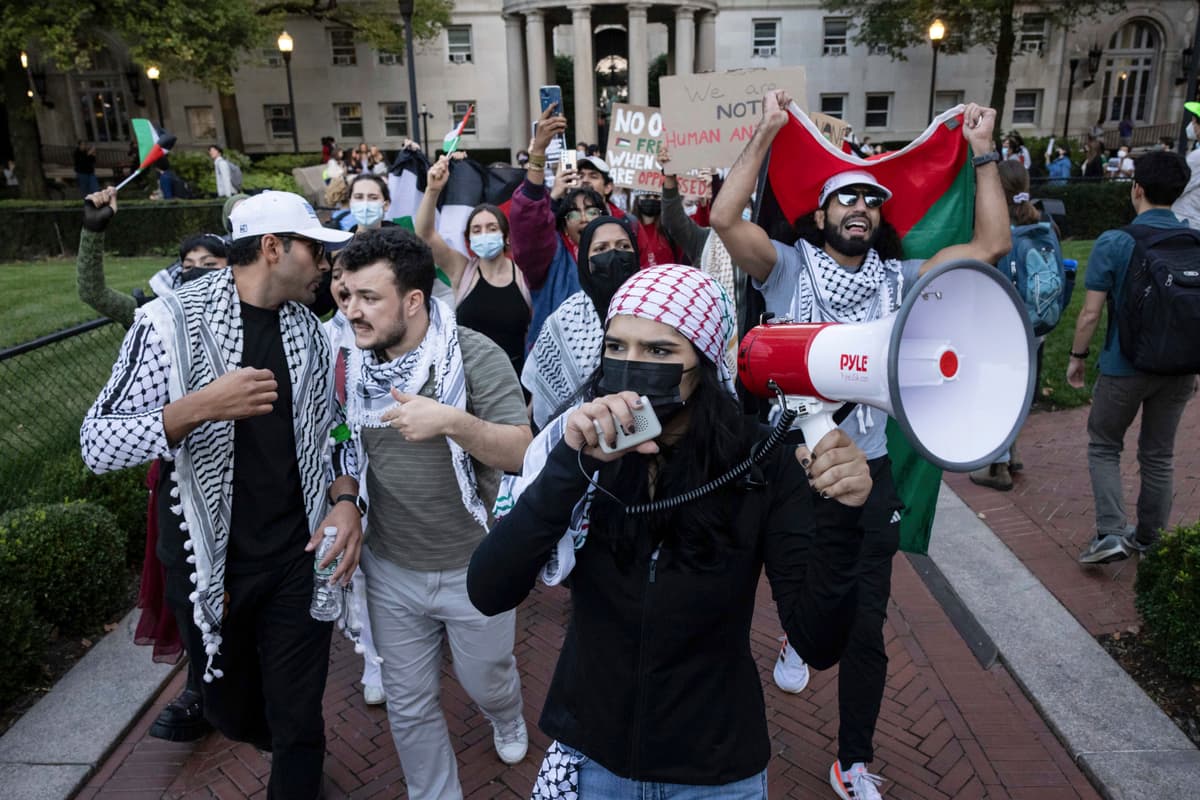
Mahmoud Khalil, second from left, demonstrates during a protest at Columbia University in 2023. AP/Yuki Iwamura

Mahmoud Khalil’s recent sit-down with the New York Times’s Ezra Klein reinforces perceptions that the anti-Israel activist represents extremism rather than legitimate pro-Palestinian advocacy. The interview, which took place as Mr. Khalil faces ongoing deporting proceedings, lays bare Mr. Khalil’s willingness to revise history and distort the truth to inspire hostility toward the Jewish state and sympathy for Hamas. 

Consider Mr. Khalil’s recounting of his initial response to Hamas’s invasion of Israel on October 7: “To me, it felt frightening that we had to reach this moment in the Palestinian struggle,” Mr. Khalil says. When asked by Mr. Klein to elaborate, Mr. Khalil describes the situation in Gaza as “not sustainable” and cites Israel’s deal with Saudi Arabia as proof of the country’s disregard for Palestinians. As a result, “we couldn’t avoid such a moment,” he argues. 

Mr. Khalil again justifies October 7 when asked by Mr. Klein whether he viewed the attack as a strategic move by Hamas to pull Israel into a war or “as something that needed to happen to break the equilibrium.” Mr. Khalil, stating that his position more closely aligns with the latter, reasons that the attack marked “a desperate attempt to tell the world that Palestinians are here, that Palestinians are part of the equation.” 

Sound familiar? Consider Hamas’s own defense of the attack as “a necessary step and a normal response to confront all Israeli conspiracies against the Palestinian people.” That’s what the terror group wrote in a report published in January 2024. Hamas claimed in the same document that any “case of targeting civilians” happened “accidentally and in the course of the confrontation with the occupation forces.” 

Mr. Khalil employs similar sleight of hand on the issue. Although he states that “targeting civilians is wrong,” he insists that “we cannot ask Palestinians to be perfect victims after 75 years of dispossession, of killing people in Gaza, being under siege.” In the case of the second intifada — during which Palestinians killed some 1,000 Israelis via suicide bombings and mass shootings — Mr. Khalil mislabels the uprising as “overwhelmingly” peaceful.  

Such prevarications are straight out of the Hamas playbook. Perhaps Mr. Khalil absorbed these techniques during his internship with the United Nations Relief and Works Agency, a position he occupied during Hamas’s October 7 assault. Evidence now documents Unrwa’s ties to Hamas and other terrorist organizations, with several agency employees confirmed as direct participants in the October 7 massacre.

Mr. Khalil’s antipathy toward the Jewish state may run deeper. When Mr. Klein inquires about his relationships with Jewish students, Mr. Khalil offers a telling account of his early impression of Jewish people: “Having lived in the Middle East most of my life, unfortunately, the only Jew you hear about is the one who’s trying to kill you.” Which Jews were trying to kill him in his native Syria, which drove out its Jewish population in 1948?

Such comments belie Mr. Khalil’s claims that the administration’s allegations of  antisemitism are “baseless.” Mr. Khalil, though, also protests when Mr. Klein suggests that antisemitism had reared its ugly head at Columbia. He downplays complaints of the hatred on campus — complaints that are documented in a report from Columbia’s own task force — as “manufactured hysteria.” Call them Mahmoud Khalil’s alternative facts.


The New York Sun

© 2025 The New York Sun Company, LLC. All rights reserved.

Use of this site constitutes acceptance of our Terms of Use and Privacy Policy. The material on this site is protected by copyright law and may not be reproduced, distributed, transmitted, cached or otherwise used.

The New York Sun

Sign in or  create a free account

or
By continuing you agree to our Privacy Policy and Terms of Use