
Meloni — and Trump — vs. the Courts on Illegal Migration

Both leaders face pushback from unelected judges as they exercise the mandates voters gave them to address illegal migration.

Prime Minister Meloni/X
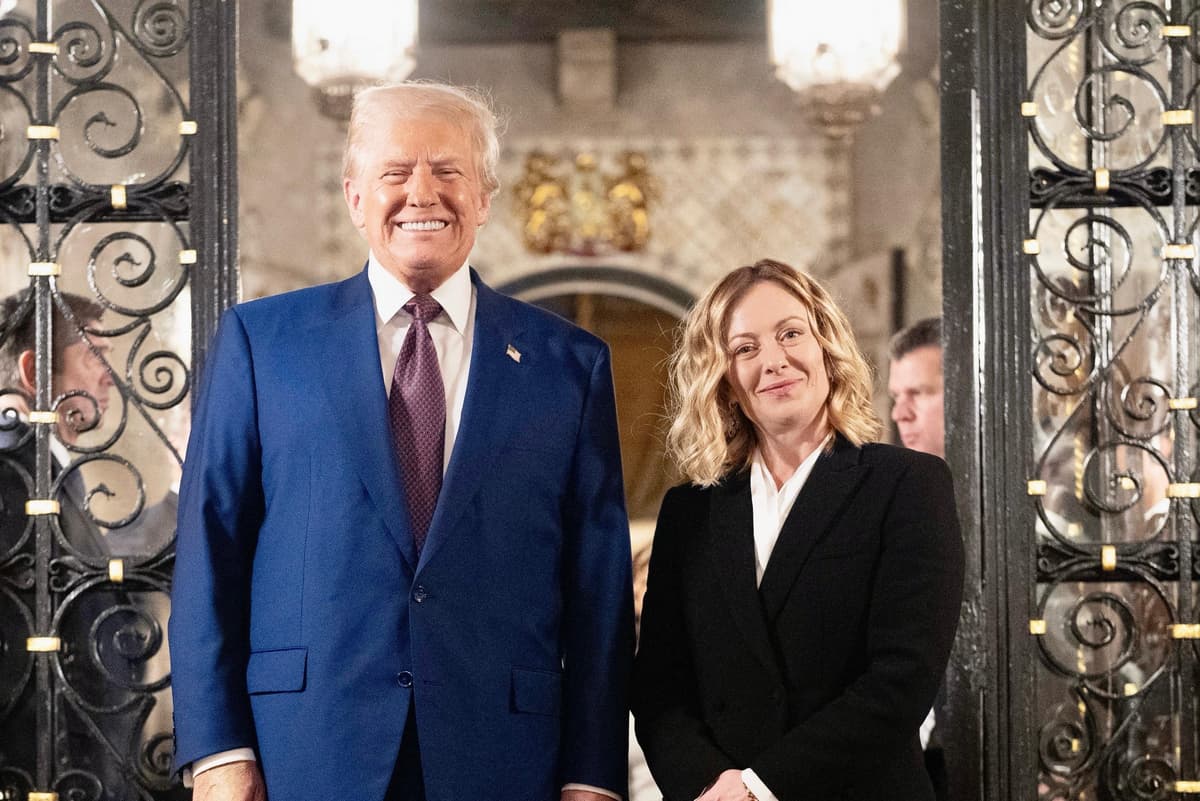
President-elect Trump and Prime Minister Meloni at Mar-a-Lago on January 4, 2025. Prime Minister Meloni/X

Coraggio: That’s our exhortation to Prime Minister Meloni as she  contends against courts that are thwarting her efforts to tackle Italy’s migration crisis. As in America, where President Trump won at the polls a mandate to address immigration, a politically slanted judiciary in Italy seems bent on obstructing the country’s attempt to deal with the wave of migrants arriving in Europe. In both cases, unelected judges run the risk of defying the voters.

Italy, in part because of its extensive coastline, has borne the brunt of the migrant influx that is roiling Europe more broadly. The continent’s migrant population surged to some 63 million in 2024 from 41 million in 2010, EUNews reports. Some 6.7 million migrants are living in Italy, a nation of less than 60 million residents, raising concerns of cultural disruption that helped Signora Meloni in 2022 cruise to victory with a rightist coalition.

Since then, the premier and her governing partners have sought to stem the tide of migration in part by addressing a problem that has become all too familiar on America’s southern border — phony asylum claims. While no one wishes to deny the rights of legitimate asylum seekers, these claims are often abused by individuals seeking to short-circuit the legal immigration process and gain entry to Western nations.

To help prevent such abuse of asylum, Signora Meloni made a pact with nearby Albania to divert some incoming migrants to the Balkan nation. “Italian-run processing centres there,” the Financial Times reports, can provide “a fast-track evaluation of asylum claims deemed unlikely to succeed.” Migrants whose asylum claims were denied would then be returned to countries deemed by the Italian government to be safe.

No sooner was the Albanian pact struck than Italian courts said shortly not so fast. The courts raised doubts about how Signora Meloni’s government “had established that countries, including Bangladesh and Egypt, were ‘safe’” for the returned migrants. Now the European Union’s Court of Justice has weighed in, the BBC reports, claiming that Italy’s way of deciding if a country is “safe” traverses EU law.

Under Signora Meloni’s plan, “anyone from a ‘safe country’ who was refused asylum was supposed to be deported within a week,” the BBC explains. Yet the EU tribunal says “a nation can only be included on the government’s list if the entire population there is safe,” per the BBC. That means Italy would have to go back to the drawing board and revamp the policy, even as the flow of illegal migrants continues largely unabated. 

“The court’s decision weakens policies to combat mass illegal immigration and defend national borders,” Signora Meloni’s office said after the ruling. The court decision, she lamented, lets the views of unelected jurists “prevail over the results of complex investigations conducted by the relevant ministries and evaluated by the sovereign Parliament.” It is, she concluded, “a ruling that should concern everyone.”

Signora Meloni’s coalition partner, the deputy premier, Matteo Salvini, denounced the ruling as “scandalous.” Mr. Salvini, who heads the rightist League party, said the court decision “erases national sovereignty” and “is yet another demonstration of a Europe that doesn’t work.” It stirs echoes, too, of how left-leaning jurists in America’s federal courts are imposing roadblocks to Mr. Trump’s efforts to get control of the border.

Feature the panel of circuit court judges that on Friday curbed Mr. Trump’s attempt to limit abuse of asylum on the Mexican border. They caviled that Mr. Trump’s policy could lead to “deporting migrants to places where they would face persecution or torture,” CBS News says. The case could reach the Supreme Court, which, unlike Europe’s top tribunal, could have a clearer-eyed view of the role of judges vis-à-vis elected officials — not to mention, voters.


The New York Sun

© 2025 The New York Sun Company, LLC. All rights reserved.

Use of this site constitutes acceptance of our Terms of Use and Privacy Policy. The material on this site is protected by copyright law and may not be reproduced, distributed, transmitted, cached or otherwise used.

The New York Sun

Sign in or  create a free account

or
By continuing you agree to our Privacy Policy and Terms of Use