Merz’s Stunning Defeat in First Bid To Become Germany’s Chancellor Suggests Challenges Ahead for Left-Right Coalition
Because the vote is held by secret ballot, it is not immediately clear — and might never be known — who defected from Merz’s camp.
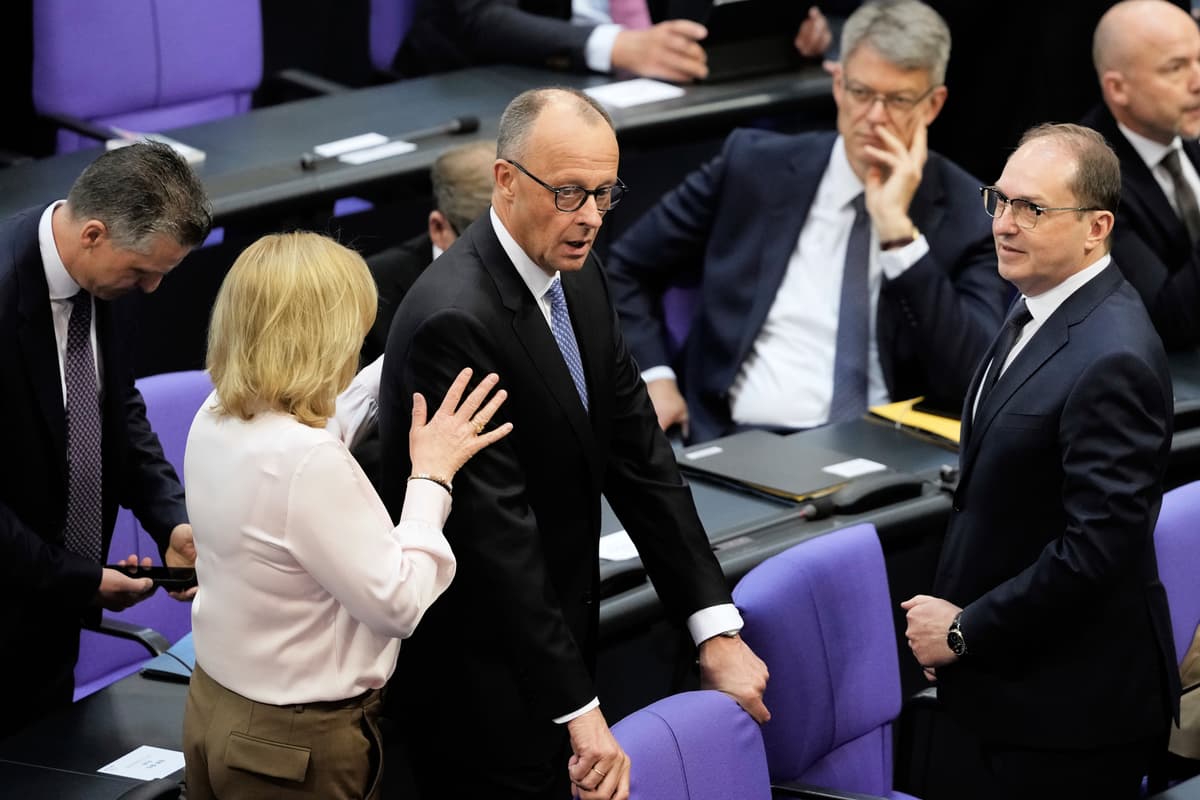

BERLIN — Conservative leader Friedrich Merz’s failure to win a majority in parliament in his first bid to become Germany’s 10th post-World War II chancellor suggests challenges ahead for the attempt to forge a left-right governing coalition at Berlin.
Mr. Merz’s defeat by six votes in what had been expected to be a smooth victory marks a historic first for Germany’s modern republic. He did succeed in becoming chancellor in a second vote.
A candidate for chancellor had never failed to win on the first ballot since the end of the war. The loss triggered a stock market slide: The DAX, the index of major German companies, was down 1.8 percent following the vote.
Mr. Merz needed a majority of 316 out of 630 votes. He only received 310 votes — well short of the 328 seats held by his coalition, which is also one of the slimmest postwar majorities.
Because the vote was held by secret ballot, it was not immediately clear — and might never be known — who defected from Mr. Merz’s camp.
In parliamentary elections in February, German voters gave a majority of seats to conservative parties, including Mr. Merz’s Christian Democratic Union; its Bavarian wing, the Christian Social Union; and the rightist Alternative for Germany, or AfD.
Yet because of the AfD’s associations with extremism, Mr. Merz’s party has refused to collaborate with the rightist party, instead choosing to partner with the leftist Social Democrats, the party of the outgoing chancellor, Olaf Scholz.
The co-leader of the AfD, Alice Weidel, called Mr. Merz’s failure proof that his coalition has a “weak foundation.”
AfD is the biggest opposition party in Germany’s new parliament after it placed second in national elections in February. Despite its historic gains, it was shut out of coalition talks due to the “firewall” that mainstream German political parties have upheld against cooperating with parties on the far-right of the political spectrum since the end of the war.
There is even talk in Germany of banning the AfD as an extremist organization. This prompted pushback over the weekend in America from Vice President Vance and Secretary Rubio, who questioned the legitimacy of such a move by German authorities.
The coalition parties were now to regroup to discuss the next step but it was also unclear how long the process could take. The failure of Mr. Merz’s bid could also raise doubts about the viability of the left-right coalition that had been cobbled together in the aftermath of the February election.
Mr. Merz was seeking to take the helm of the 27-nation European Union’s most populous member after Mr. Scholz’s government collapsed last year and a national election was held in February. Mr. Scholz, despite his official farewell on Monday, remains in a caretaker role until a new chancellor takes over.
Germany has the continent’s biggest economy and serves as a diplomatic heavyweight. The new chancellor’s portfolio would include the war in Ukraine and the Trump administration’s trade policy on top of domestic issues, such as Germany’s stagnant economy and the rise of the AfD.
“The world is in turmoil. Europe needs a strong Germany,” the secretary-general of the Christian Democrats, Carsten Linnemann, told reporters after Mr. Merz’s loss.
The designated next foreign minister, Johann Wadepuhl, said he was confident Mr. Merz would ultimately prevail, as he did.
“It is an annoying process, but in a parliamentary democracy, in a liberal country, this is unfortunately one of the scenarios that you have to be prepared for,” he told reporters.
The author Volker Resing, who wrote the recent biography “Friedrich Merz: His Path to Power,” expressed surprise at the turn of events.
“It shows how fragile the coalition’s situation is and that some lawmakers are prepared to spread uncertainty — that’s a warning signal,” Mr. Resing said.
Mr. Resing said that if Mr. Merz were to get elected in the second round, then everything would be fine and people may soon forget about this hiccup.