
Mystery Over Dublin: Did Russian Drones Try to Take Out Zelensky?

Incident exposes weakness of Irish military and naval forces amid Moscow’s testing of European resolve.
AP/Peter Morrison
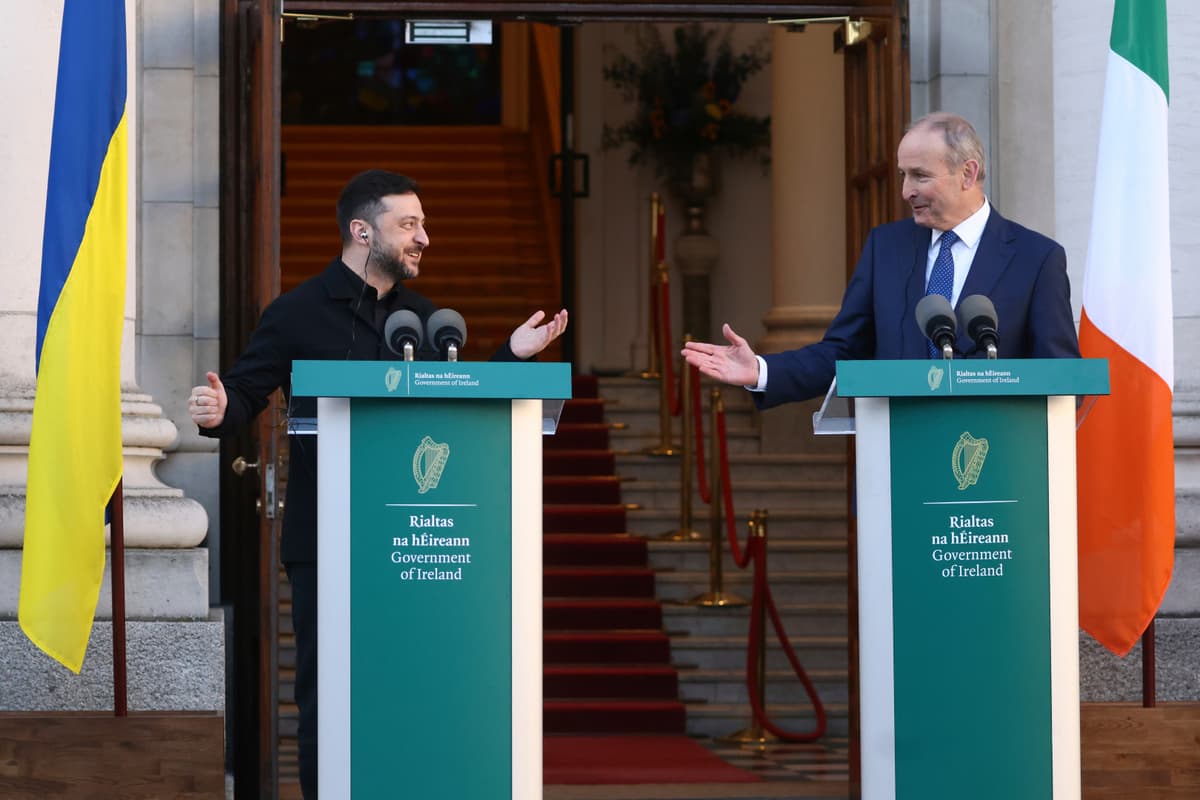
President Volodymyr Zelensky, left, and the Irish taoiseach, Micheal Martin, at Dublin, December 2, 2025. AP/Peter Morrison

As President Volodymyr Zelensky arrives at London today to meet with European leaders, investigators in Ireland are seeking to determine if his last foreign trip, to Dublin, was a near-miss for a Russian drone assassination team. 

One week ago, on December 1, Ukraine’s presidential plane touched down at Dublin Airport at 11 p.m. local time, a few minutes before its scheduled arrival time from Paris. Although greater Dublin had been declared a “no drone zone” for the night, four “military-style” drones flew straight toward the President’s flight path, reports an Irish news site, the Journal.

“The drones reached the location where Zelensky’s plane was expected to be at the exact moment it had been due to pass,” the Journal reports, giving details that later were confirmed by other Irish news outlets. “The drones then orbited above an Irish Navy vessel that had secretly been deployed in the Irish Sea for the Zelensky visit.”

Sailors aboard an Irish offshore patrol vessel spotted the drones hovering over their ship, the William Butler Yeats. They were not flying in formation, an indication that they were controlled by four remote pilots and not by artificial intelligence. The drones, all quadcopters, had their lights on. Investigators believe this indicates  intent to intimidate and not to bring down the presidential jet, an Airbus 319. No drone was tracked down and recovered.

Zelensky
President Volodymyr Zelensky at Dublin, December 2, 2025. AP/Peter Morrison

The buzzing of Dublin Airport comes after unidentified drones have disrupted air traffic in Europe in incidents that started September 22. Since then, drones have forced temporary closures of airports in Lithuania, Poland, Germany, Belgium, Norway, and Sweden. Although some drones may have been launched from land, some analysts speculate that many were launched from Russian mother ships in the Baltic.

Similarly this fall, mystery drones surveyed NATO air bases in Belgium, Britain, Denmark, Germany, and Norway. On Thursday night, French marines opened fire on five drones flying over France’s Île Longue naval base. The is the Atlantic home port for France’s four nuclear ballistic missile submarines. No drones were hit.

“If these violations continue…we will have to use stronger measures, including potentially shooting down a Russian airplane or drones,” the Czech president, Petr Pavel, told the Sunday Times of London in an interview posted yesterday.  Russia wouldn’t allow repeated violations of their airspace. And we have to do the same.”

A former chairman of  NATO’s Military Committee, Mr. Pavel said Russia’s drone incursions are “deliberate, well-planned and focused on several objectives,” including demonstrating that Russia “can do it,” testing Western air defense systems, and “testing our resolve to act in self-defense.”

In the Irish case, sailors and air traffic controllers said the four drones came from the east. Ten miles east of Dublin Airport is the Irish Sea. Over the last four years, several well known Russian spy ships — notably the Yantar and the Viktor Leonov have been identified and escorted out of Irish waters, often with the help of Britain’s Royal Navy. Frequently crossing Irish waters are Russian “shadow fleet” tankers carrying loads of oil in violation of Western sanctions.

Ireland is widely seen as a weak link in NATO defenses. Roughly the size of South Carolina, Ireland has a total marine territory of 343,750 square miles, 5 percent larger than the state of California. To patrol this area, Ireland has a navy of eight ships. Of these, only four are operable. Ireland’s Air Corps has no fighter jets and only two maritime patrol aircraft.

Normally, no one would care. However, as Maeve Drury and Jason C. Moyer note in a recent Atlantic Council essay: “Approximately 75 percent of data cables in the Northern Hemisphere pass through or near Irish waters; combined, they represent 95 percent of international data traffic.”

Ireland’s current economic boom is fueled in part by data centers that depend on these undersea cables. However, since winning independence from Britain in 1921, Ireland has pursued a neutral foreign policy. The country is not a member of the North Atlantic Treaty. The nation’s new president, Catherine Connolly, opposes joining this transatlantic military alliance. 

Inside the 27-country European Union, Ireland pays the least for defense — one quarter of 1 percent of its gross domestic product. Last summer, President Trump urged NATO member nations to spend 5 percent of their GDP on defense.

Ireland’s low levels of defense were on display when the four drones flew toward Mr. Zelensky’s flight path. The Yeats has no air radar, antiquated machine guns, and no secure way of communicating classified information with nearby NATO militaries, namely Britain’s.

Before the November 11 inauguration of Ms. Connolly, the Irish government was discussing significant investments in defense. Up to $2 billion would be spent to buy up to 14 fighter jets. The Irish Naval Service would be rebranded as the Irish Navy, and the working patrol fleet would be expanded to 12 ships. 

As for Mr. Zelensky, he lands at London to meet the leaders of Britain, France, and Germany to formulate a European response to the latest Trump peace plan.“I think that it would be very foolish for the Russians to try to take out Zelensky,” futurist blogger Michael Snyder writes about the zone intrusion. “Any attempt to assassinate Zelensky would create great outrage in Europe, and it would have the potential to be the sort of event which causes at least some of our European allies to feel compelled to enter the war.”


The New York Sun

© 2025 The New York Sun Company, LLC. All rights reserved.

Use of this site constitutes acceptance of our Terms of Use and Privacy Policy. The material on this site is protected by copyright law and may not be reproduced, distributed, transmitted, cached or otherwise used.

The New York Sun

Sign in or  create a free account

or
By continuing you agree to our Privacy Policy and Terms of Use