
Norman Podhoretz
The neoconservative sage, 95, leaves an indelible intellectual, political, and journalistic legacy.
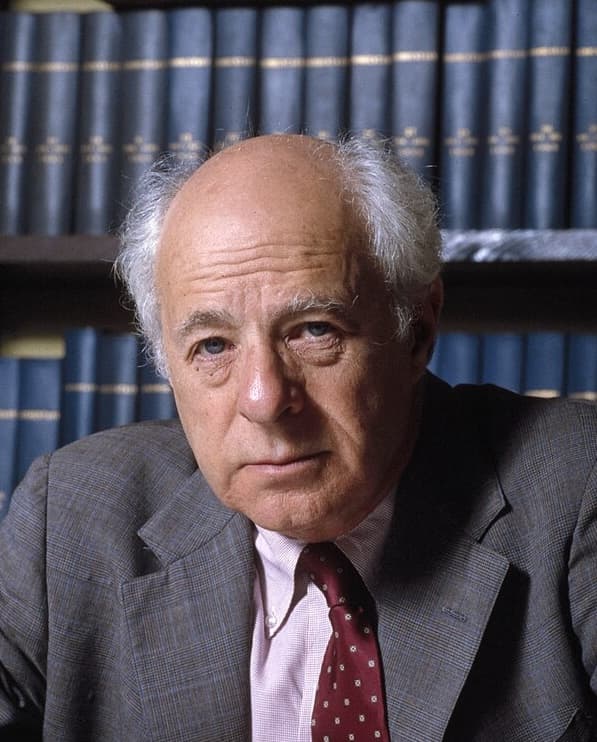
With the death of Norman Podhoretz at the age of 95 America loses a conservative lion and one of its greatest intellectuals. The longtime editor of Commentary magazine traced a journey from left to right that saw him become a founding father of neoconservatism and, in 2004, be awarded the Presidential Medal of Freedom by President George W. Bush. His wife, the Cold War hero Midge Decter, was no less a luminary.
Podhoretz was a son of Brownsville and a grandson of Galicia. His most explosive book was “Making It,” an account of the raw desire of his intellectual demimonde for power and influence — an ambition that burned no dimmer because the means were words and ideas. Podhoretz wrote that the yearning for success “seems to be replacing erotic lust as the prime dirty little secret of the well-educated American soul.”
Podhoretz’s son John, who now edits Commentary, writes that his father “passed peacefully and without pain, with a new translation of ‘The Odyssey’ on his desk that had been sent to him by his friend Roger Hertog.”* Nearly 70 years earlier he reviewed Bernard Malamud’s “The Natural,” writing that “Bad art has been allowed to monopolize the thunderbolts which once belonged as a matter of course to writers who knew better what to do with them.”
Podhoretz knew what to do with his thunderbolts. After an exchange about the Kurds — who they were — between Podhoretz and another journalist at a banquet, we wrote that “basic questions are what one might call the Podhoretz Method, and we predict that generations from now, journalists will study his knack for — his insistence on — pressing the simplest seeming, most basic questions as if each were fresh and open to new implications.”
Podhoretz “bound himself,” as his son writes, “fast to his people, his heritage, and his history.” Hardly any less to America. He could be scathing, as when he wrote that “in abandoning these people at the end, the United States demonstrated that saving South Vietnam from Communism was not only beyond its reasonable military, political, and intellectual capabilities but that it was ultimately beyond its moral capabilities as well.”
Though he was a student of the literary sages Lionel Trilling and F.R. Leavis — and himself a critic of distinction — Podhoretz’s vision imprinted itself on American foreign policy. Two ambassadors to the United Nations, Daniel Patrick Moynihan and Jeane Kirkpatrick, burnished their resumes prior to their appointment by writing in Commentary’s pages. President Reagan was said to be a reader of the magazine.
Podhoretz threw his entire weight behind the war in Iraq, coining the phrase “World War IV” to describe the stakes of the civilizational clash that came into focus in the wake of 9/11. He also, as far back as 2007, backed the bombing of Iran’s nuclear facilities. That was eventually accomplished, at least in part, this past summer when President Trump dispatched B-2 bombers to Nantaz and Fordow in support of Israel’s war against Iran.
The scholar Ruth Wisse once celebrated Podhoretz as a “careful writer; clarity for him is not simply the basis of good prose but the test of moral integrity.” She reckons that she has only “felt this way once before — about Samuel Johnson, for whom honesty was also the supreme virtue.” John Podhoretz agreed that his father, of the first rank of the New York Intellectuals, never committed “a sin against honesty.” How our country and craft need him. May his memory be for a blessing.
________
* Founding chairman of The New York Sun.
This editorial has been edited and expanded slightly from the bulldog.