Not So Fast on Contempt for Team Trump, the D.C. Circuit Says

The court sometimes called the second most powerful in the land throws a brushback pitch at Judge James Boasberg.

Zach Gibson/Getty Images
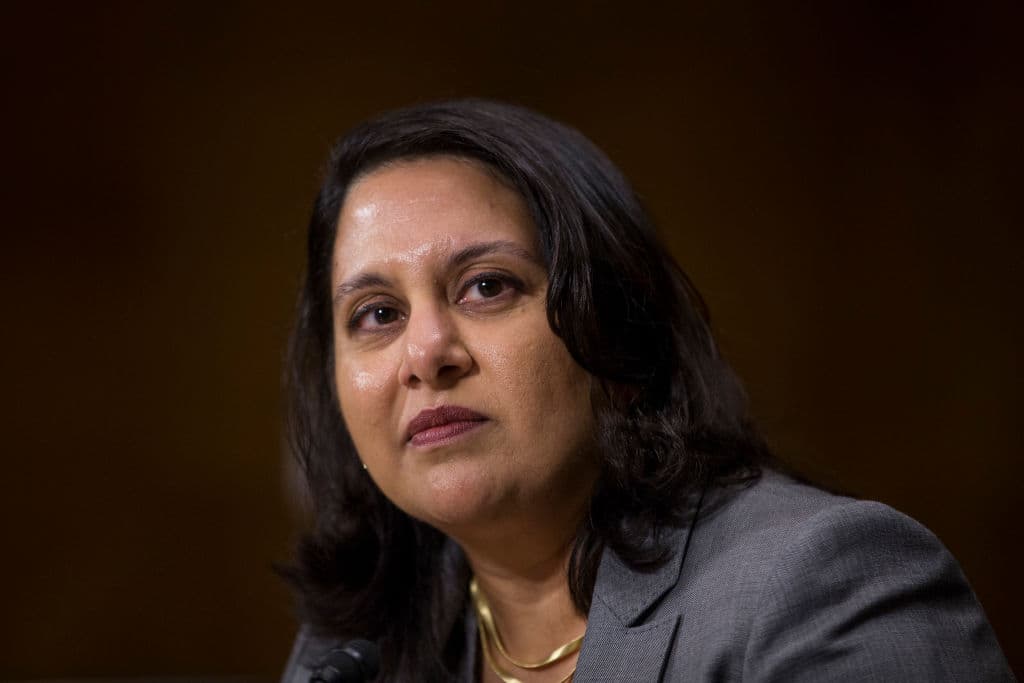
Judge Neomi Rao, President Trump's then-nominee for the District of Columbia Circuit, testifies during a Senate Judiciary confirmation hearing on Capitol Hill on February 5, 2019. Zach Gibson/Getty Images

The writ of mandamus issued by the District of Columbia Circuit of the United States Court of Appeals freezes, for now, Judge James Boasberg’s notion to initiate contempt proceedings against the Trump administration. At issue is whether the federales ignored the judge’s orders to turn around two airborne planes full of illegal migrants speeding for El Salvador. The 1798 Alien Enemies Act was the wind beneath the wings of those flights.

The D.C. Circuit — or at least a three-rider panel of its full complement — was wise to put a stop to the contempt charade. The vote was two to one, along partisan lines. Judges Gregory Katsas and Neomi Rao, appointees of President Trump, found for the government. The dissenter was Judge Cornelia Pillard, named to the federal bench by President Obama. If the case is appealed to an en banc hearing, the court’s larger leftward tilt could show.

For now, though, Judge Boasberg is rebuked. The trial judge’s push to hold the government in contempt was especially puzzling to us given that on the merits — whether the government’s use of the AEA was valid — Judge Boasberg has already been reversed by the Supreme Court. The Nine unfroze, albeit temporarily, Judge Boasberg’s block on the use of the act, and transferred the case to Texas, where the migrants were being held, from his jurisdiction. 

Judge Boasberg, then, was readying to hold contempt proceedings connected to a case over which he no longer presided. We get that courts have held that contempt can still be pursued in such an instance. Still, the judge’s declaration that “the Constitution does not tolerate willful disobedience of judicial orders — especially by officers of a coordinate branch who have sworn an oath to uphold it” came after he had been reversed from on high.

Judge Katsas took what to us appears to be the sober-minded stance that Judge Boasberg’s contempt contretemps posed “troubling questions about judicial control over core executive functions like the conduct of foreign policy and the prosecution of criminal offenses.” It threatened to exacerbate an “extraordinary, ongoing confrontation between the Executive and Judicial Branches.” For the moment, that showdown is settled.  

Judge Rao put it simply and sharply — “this case is highly unusual, and I have found no other like it, perhaps because no district court has threatened criminal contempt against Executive Branch officials as a backdoor to coercing compliance with an order that has been vacated by the Supreme Court.” The doughty jurist dilates on how Judge Boasberg’s precedent could have heightened the “potential for abuse in future cases.” She reckons he made an “error.”

Judge Rao found that “the district court used the threat of criminal contempt to coerce the Executive Branch to comply with an order it had no authority to enforce. And it directed that coercion toward the Executive’s exercise of its foreign affairs power.” As our A.R. Hoffman reports, Justice Amy Coney Barrett elsewhere called this the behavior of an “Imperial Judiciary,” and opposing an imperial judiciary requires carrying no brief for executive malfeasance.

Judge Pillard’s dissent is largely a reprise of Judge Boasberg’s initial finding of “probable cause” for contempt. She writes that “willful disobedience of a court order is punishable as criminal contempt.” Her colleagues, though, found that Judge Boasberg’s order, written in a chaotic moment of the deportation drama, was ambiguous. Ambiguity in the law always redounds to the defendant’s benefit. In this case, that’s Uncle Sam.


The New York Sun

© 2025 The New York Sun Company, LLC. All rights reserved.

Use of this site constitutes acceptance of our Terms of Use and Privacy Policy. The material on this site is protected by copyright law and may not be reproduced, distributed, transmitted, cached or otherwise used.

The New York Sun

Sign in or  create a free account

or
By continuing you agree to our Privacy Policy and Terms of Use