


Party Time: Is Elon Musk Out of His Depth?

The record suggests that it takes a generation or more to establish a new political party with a chance to win an election.
AP/Evan Vucci
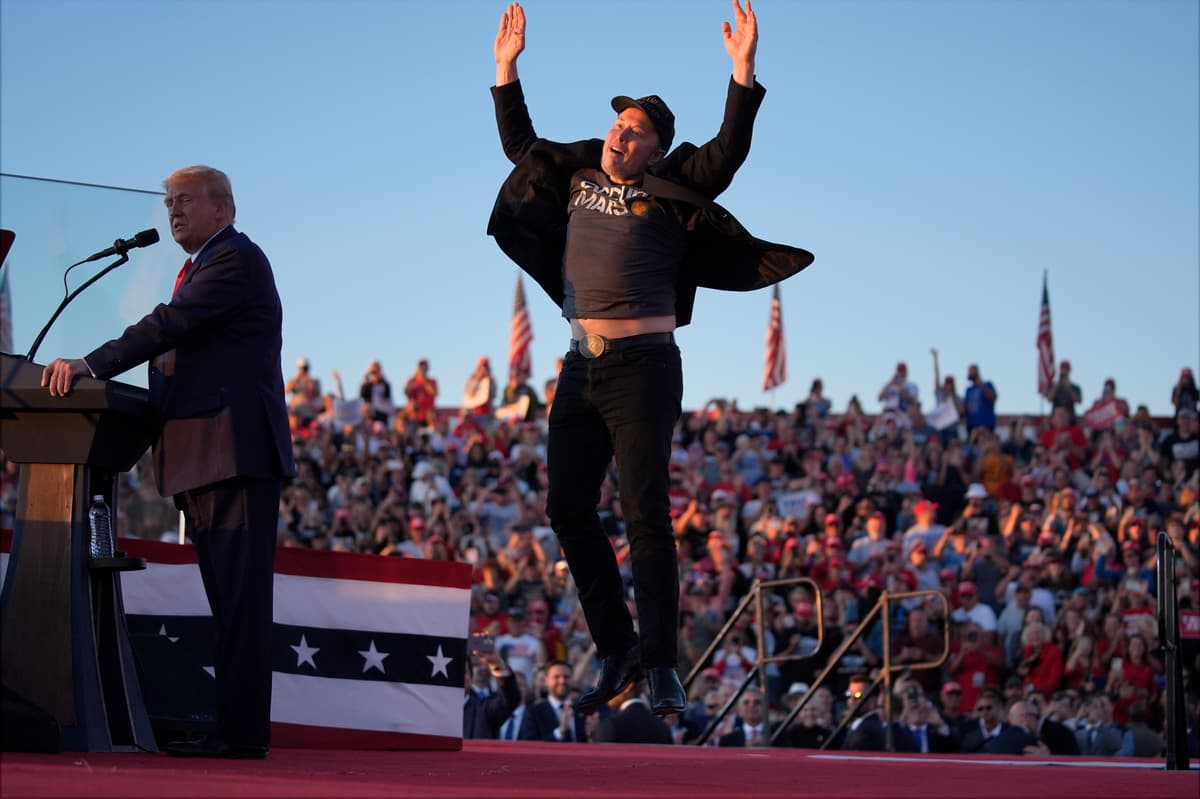
Elon Musk jumps on the stage as President Trump speaks at a campaign rally at Butler, Pennsylvania. AP/Evan Vucci

Elon Musk’s new “America Party” faces criticism out of the gate as a likely spoiler for the two-party system. Yet this overlooks how every major party begins as an insurgency, unless and until the new bloc catches on with voters. The last time this happened in America, an upstart anti-slavery, pro-infrastructure, pro-Second Amendment faction overtook the Whigs and captured the White House within six years. That was the Republican Party.

The GOP was formed in 1854, though, underscoring the longevity of the two major parties despite efforts, like Mr. Musk’s, to break up the duopoly. Across the pond, in Britain, a similar dynamic prevails, due in part to first-past-the-post elections. It took the Labor Party some 24 years from its founding to achieve, in 1924, a majority coalition in parliament. That knelled for the demise of the Liberals, Britain’s main opposition party for nearly a century.

Will Mr. Musk have the patience, and devote the resources, to set his America Party on a trajectory like that traced by the GOP and Labor? Will Mr. Musk’s ideas serve to forge a platform around which a majority of voters could coalesce? So far, the mogul calls for the party to back the right to keep and bear arms. He criticizes America’s monetary system. “Fiat is hopeless,” he avers. This suggests awareness of the need for — hallelujah — honest money.

Yet Mr. Musk is already limiting the party’s ambitions, which could prove counterproductive. “Backing a candidate for president is not out of the question, but the focus for the next 12 months is on the House and the Senate,” he says. By contrast, the early Republicans were quick to plunge into the presidential fray. In 1856 the GOP put up General John C. Fremont, hailed as the “Pathfinder” for his Western explorations, as its candidate for the White House.

The GOP platform in 1856 was succinct and set out an alternative to the Democrats with two big themes: opposition to slavery and promotion of national improvements, like a “railroad to the Pacific Ocean.” These themes led the party to capture 11 states in the election, but only 33 percent of the popular vote. The Democrats under James Buchanan won the White House, capturing 19 states and 45.5 percent of the popular vote.

The Whigs, who had earned 44 percent of votes four years before, won but one state and 21.5 percent of the popular vote. “It’s remarkable how fast it all fell apart for the Whigs,” historian Phillip Wallach reports. The GOP in 1856 was less a spoiler than a party on the rise. That point was underlined by the election four years later, when the GOP under Lincoln won the presidency by carrying 18 states and nearly 40 percent of the popular vote in a four-way race. 

That election, and the North’s victory in the ensuing Civil War, cemented — within an astonishingly brief time from its founding — the GOP’s role as one of the two major parties. In Britain Labor’s rise was slower. The party won but two seats in parliament in 1900 in its first general election, rising to 42 seats by December 1910, and 57 seats in 1918. Yet by 1924 the party was strong enough to form, with the waning Liberals, a government. 

That coalition was short-lived, and Labor waited until 1929 to form a majority in parliament on its own, with 287 seats. Yet it signaled the death of the Liberals as the chief leftist bloc. The Liberal party, a champion of free trade and expanded voting rights, was “a various and valuable collection of gold, stocks, bibles, progressive thoughts, and decent inhibitions,” historian George Dangerfield lamented. Even Keynes sniffed at Labor as merely “a class party.”

Labor, though young, had captured the electoral mantle of the left, and assured its place in Britain’s two-party schema. It now looks like the venerable Tories are vulnerable to being overtaken by an upstart party, Nigel Farage’s Reform UK. Yet the fall of the Liberals came within a few years of their landslide win in 1906. That marks a cautionary lesson for any “major” party — that political winds tend to shift unexpectedly and could easily as not blow aside Mr. Musk.


The New York Sun

© 2025 The New York Sun Company, LLC. All rights reserved.

Use of this site constitutes acceptance of our Terms of Use and Privacy Policy. The material on this site is protected by copyright law and may not be reproduced, distributed, transmitted, cached or otherwise used.

The New York Sun

Sign in or  create a free account

or
By continuing you agree to our Privacy Policy and Terms of Use