President Putin’s Primrose Path
Russia pledges to end its invasion against nebulous guarantees of the sort we’ve heard before.
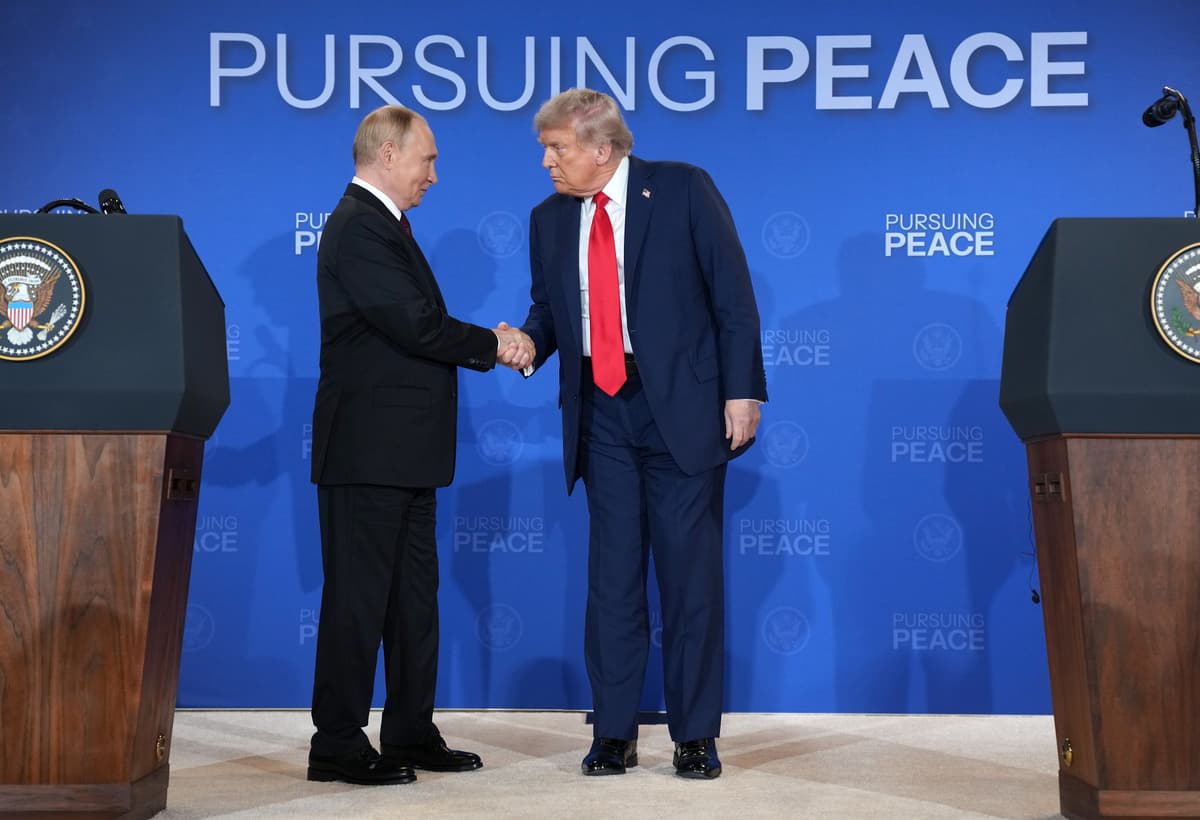
Call it President Putin’s Primrose Path. The Russian tyrant seems to be inveigling President Trump with pledges to end its invasion and to respect Ukraine’s independence in the event that Kyiv cedes land to Moscow. The peace would be enforced by what are, for now, nebulous security guarantees, softened further by Mr. Trump’s “assurance” that no American ground troops will enforce the pact. Russia’s track record offers grounds for caution.
The parallels are inexact, yet not since 1938 at Munich, it would seem, has behavior so bad as Mr. Putin’s been so richly rewarded. There are echoes, too, of Ukraine’s cession of its nuclear weapons in exchange for, you guessed it, security guarantees. That was in 1994, after the collapse of the Soviet Union. It could be described as the most misguided deal of the century, another lesson of history that apparently got learned too late.
Under that agreement, Kyiv undertook to cede its arsenal of nuclear weapons, then the world’s third-largest, in exchange for promises from Russia, America, and Britain. The parties of the pact, Harvard’s Matthew Bunn reports, “pledged to respect Ukraine’s territorial integrity and inviolability of its borders.” Plus, too, the signing nations — including Russia — pledged “to refrain from the use or threat of military force,” Mr. Bunn adds.
“Today we herald the arrival of a new and safer era,” President Clinton crowed at the signing ceremony, claiming “perseverance, courage, and common sense have triumphed.” Yet the pact had no teeth. It was never ratified by the Senate, as would be required for a treaty. Mr. Clinton later reported that Mr. Putin told him in 2011 that his predecessor, Boris Yeltsin, “never got it through the Duma.” Mr. Putin added: “I don’t agree with it” and “I’m not bound by it.”
Sure enough, Mr. Putin breached the deal in 2014 when he seized Crimea. America, then under President Obama, and the West failed to act. The Minsk cease-fire agreements signed after the capture of Crimea were meant to conciliate Russia with the handover of the Ukrainian territory. Yet the Minsk deal meant that “Putin has paid no price,” Senator Bob Corker griped, noting that European leaders were dismayed by Mr. Putin seeing “no push back” from America.
In both cases, these columns have lamented, “Russia has proven a perfidious partner in seeking peace.” That could reflect the lack of respect among Mr. Putin and his camarilla for the notion of a sovereign Ukrainian nation. Mr. Putin avers that Ukraine never enjoyed “real statehood,” though one might add it wasn’t for lack of trying. In Mr. Putin’s telling the Ukrainian lands are inseparable from Russia’s “own history, culture, spiritual space.”
Criticism of this strain of Russian parochialism, though, dates back to the Cold War, when diplomat Charles E. Bohlen summed up Moscow’s view as: “What’s ours is ours, what’s yours is negotiable.” Bohlen’s quip was marked in 1968 by the Times’s C.L. Sulzberger, who was struck, after a tour of the Soviet Bloc, by Moscow’s “hard line” in Eastern Europe and its “brutal attitudes in safeguarding” what it saw as “the domain of its territorial imperative.”
Sulzberger reckoned that the Kremlin’s foreign policy “may sometimes derive from remote instincts first noted among wolves, horned owls or lions patrolling their preserves for sustenance.” If the Kremlin viewed the lands of the Warsaw Pact with a proprietary air, as Sulzberger’s account suggests, one can only imagine how Moscow’s loss of Ukraine has rankled Russians since the breakup of the Soviet Union.
This context helps explain, without excusing, Russia’s failure to honor its past vows to respect Ukraine’s borders. Like concerns fester over Moscow’s broken pledges with neighbors like Moldova, Georgia, and the autonomous republic of Chechnya. There’s talk of a “trilateral” parley at, of all places, Budapest. Where else to ink a pact between Moscow and Kyiv that underscores the need to be wary of hazarding Ukraine’s safety on Russia’s promises?