Putin Emerges on the Back Foot as Trump Moves for Advantage

Age, war, and economic stagnation take toll after quarter-century of rule.
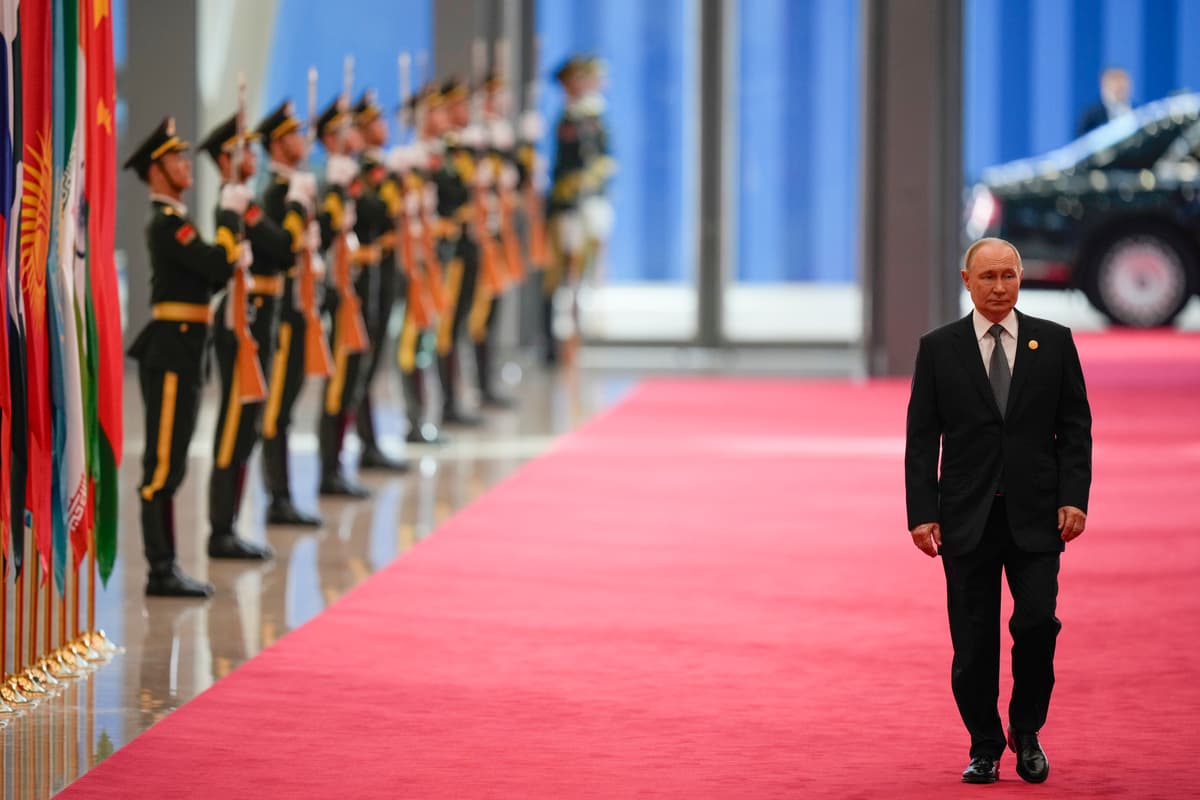
Suo Takekuma - pool/Getty Images
President Vladimir Putin arrives for the Shanghai Cooperation Organization Summit on September 1, 2025 at Tianjin, China. Suo Takekuma - pool/Getty Images

‘When the tsar dies, we’ll dance again. 
The old man still clings to his throne, afraid to let go.’

The teenagers were not singing at a “No Kings” rally at St. Petersburg, Florida. They were busking in front of a subway station at St. Petersburg, Russia, the country’s second-largest city and the home town of Vladimir Putin.

Punishment for such blasphemy was immediate. Each band member won 12 days in jail for obstructing pedestrians. The leader, 18-year-old Diana Loginova, who performs under the name Naoko, faces additional charges of “discrediting” Russia’s military. 

By definition, a strong man does not tremble at the sight of teenage girls singing in the streets. Yet as President Trump increasingly realizes, Mr. Putin is not as strong as he looks. After a quarter century in power, his grip on that power shows cracks.

Starting with Stalin, all of Russia’s dictators exited the Kremlin between the ages of 70 and 80. On October 7, Mr. Putin turned 73. One week after his birthday, Russia’s Federal Security Service opened a criminal case against 22 of Russia’s most prominent exiles and accused them of plotting to violently seize power. Led by businessman Mikhail Khodorkovsky, the exiles were all members of Russia’s Anti-War Committee, a group that had recently won recognition as dialogue partner with the Parliamentary Assembly of the Council of Europe.

Kremlin hard-liners want to avoid this group winning legitimacy as a democratic force in a post-Putin transition period, Mr. Khordokovsky, once Russia’s richest man, reasons in Telegram posts. Last week, the Trump administration sanctioned Russia’s two largest oil companies. It seems to realize that Russia’s leader is on the back foot. Washington’s goal is to push Mr. Putin to agree to a cease-fire and a peace deal with Ukraine.

“Russia is going to feel the pain immediately,” Secretary Scott Bessent said yesterday on Face the Nation. “The Russian economy is a wartime economy. Growth is virtually zero. Inflation, I believe, is over 20 percent and everything we do is going to bring Putin to the table. It’s oil that funds the Russian war machine, and I think we can make a substantial dent in his profits.”

While the Kremlin has budgeted a 54 percent increase in its federal propaganda spending for next year, Mr. Putin rules less on PR and more through tightening controls. Naoko’s band sang a sarcastic challenge directed at Vladimir Putin: “Uncle Volodya, tighten up our screws.” 

After launching the full-fledged war against Ukraine in 2022, Mr. Putin immediately banned Facebook and Instagram. More recently, he interferes with YouTube, WhatsApp, and Telegram. The goal is to move the population to Max, a government-created and -controlled messaging service. At last count, Russia blocks 417,000 websites. The government penalizes users of VPNs, the workarounds that allow users to surf the internet freely.

For dissidents like Naoko who do not get the message, 60 new politically motivated criminal cases are opened monthly against Russians, according to a United Nations report last month. A Russian human rights group, OVD.Info, estimates that there are at least 1,700 political prisoners in Russia today — more than the number in the Soviet Union in the mid-1980s. The Soviet Union, with 377 million people in 1985, had almost double the population of Russia today.

“Old man in the bunker, still thinks it’s 1985,” sang Naoko, with a flip of her golden locks. Within days of her arrest, Telegram followers of her band, Stoptime, zoomed to 45,000, from hundreds.

Perhaps sensing a generational revolt, Russia’s Duma last week drafted legislation that would impose mandatory life sentences on people who induce children 14 and under to commit acts of sabotage.

Mr. Putin’s insecurity stems from two liabilities — his war against Ukraine and his country’s anemic economy. For two years, Russia’s military has been stalled in Ukraine. This year, Russia’s army conquered less than one percent of Ukrainian territory. At this rate, the Economist calculates, it would take Russia one century to conquer Ukraine.

For such pitiful progress, Russia pays an appalling price. This year is shaping up as the bloodiest yet, with 343,820 Russian soldiers killed and wounded through Saturday, according to the running tally kept by Ukraine’s military high command. Widely accepted by Western military analysts, this number means that in 10 months Russia has lost five times the number of killed and wounded as the Soviet Union did in Afghanistan in 10 years.

To shield the politically sensitive cities of Moscow and St. Petersburg, Mr. Putin focuses on recruiting soldiers from marginal communities — Buddhists, Muslims, prison inmates, and residents of regions far from power centers. Exile media publication Mediazona compiles lists of names of dead Russian soldiers. Moscow city accounts for 9 percent of  Russia’s population, but only 1 percent of known war dead. Last summer, half of Moscow respondents to a Levada Center poll said they did not know anyone fighting in the war. 

While censorship shields many Russians from a real understanding of the war, the economic squeeze is felt by everyone — and discussed on state-controlled TV. With  Russia’s prime interest rate at 16.5 percent, more and more companies are closing their doors. After ginning up the war effort with huge loans between 2022 and 2024, banks now face mountains of non-performing loans. Economic growth is to end this year running at less than 1 percent. 

Russians are famous for tightening their belts and putting up with tough times. However, unlike during the Soviet era, Russia’s middle class cherish memories of their European vacations. They stew over their own country’s lost opportunities.

Since the collapse of communism in 1990, the former Soviet satellites that joined the European Union have seen their economies increase almost 10-fold, calculates American financier Michael Tory. The star pupil is Poland with a nearly 14-fold GDP explosion.

By contrast, the economies of Russia, Ukraine, Moldova, and Georgia expanded only four-fold over 35 years. 

In 1990, Russia had twice the GDP of its Eastern European satellites. In a humiliating exercise of trading places, the new EU nations of Eastern Europe now have a combined GDP of $2.4 trillion — larger than Russia’s $2.2 trillion.

“Putin fears only his own society,” President Volodymyr Zelensky said last week on NBC’s “Meet the Press,” adding, “He wants to remain president until death.”


The New York Sun

© 2025 The New York Sun Company, LLC. All rights reserved.

Use of this site constitutes acceptance of our Terms of Use and Privacy Policy. The material on this site is protected by copyright law and may not be reproduced, distributed, transmitted, cached or otherwise used.

The New York Sun

Sign in or  create a free account

or
By continuing you agree to our Privacy Policy and Terms of Use