Rattled by Russian Aggression, Germany Moves Toward Bringing Back Military Draft

Analysts say Moscow could attack a NATO country by the end of the decade if its forces are no longer tied up in Ukraine at that time.
Hesham Elsherif/Getty Images
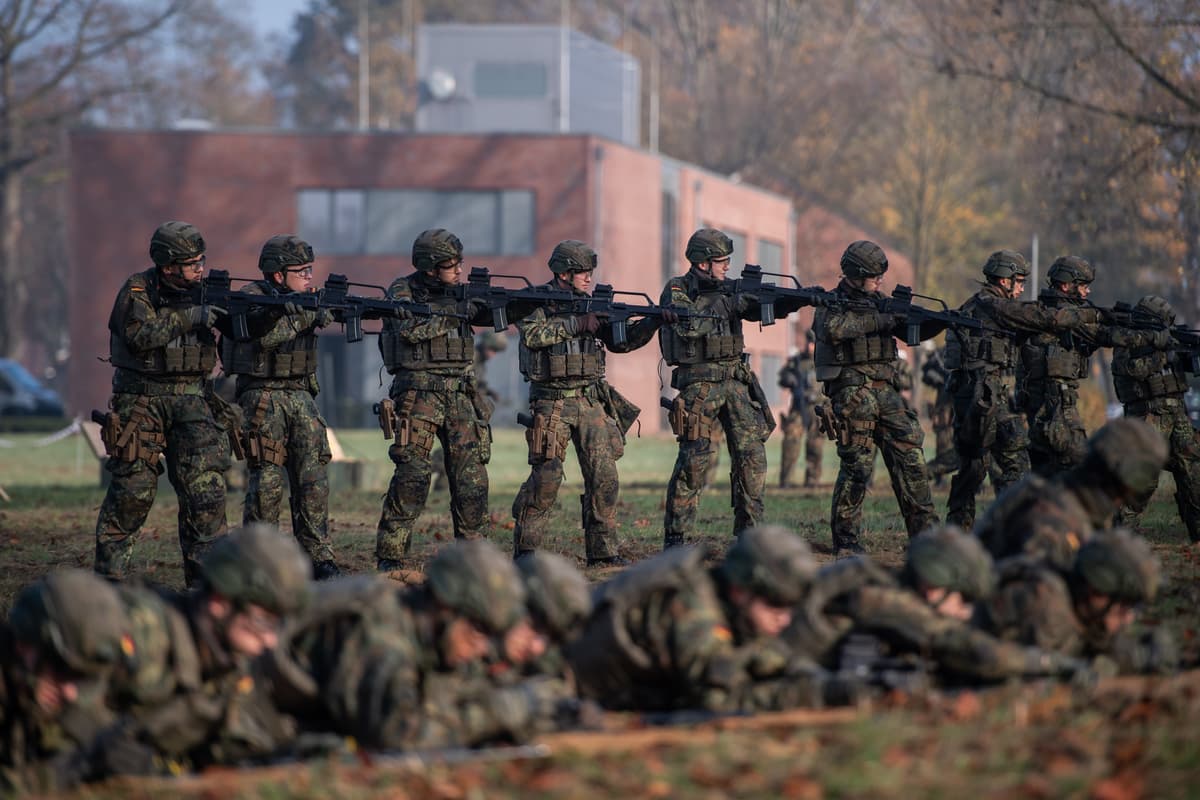
Recruits of the Bundeswehr's 2nd Homeland Security Regiment take part in training at Muenster, Germany, on November 10, 2025. Hesham Elsherif/Getty Images

Germany is inching closer to bringing back a military draft as it works to boost troop numbers.

Lawmakers are expected to vote on a new military service plan by the end of the year that would require all 18-year-old men to fill out a questionnaire on their ability to serve. Beginning in 2027, all men 18 and over would be required to undergo medical screening.

Germany is trying to create Europe’s largest conventional army as it faces a growing threat from Russia, which conducts hybrid warfare activities against Germany and has repeatedly sent drones and aircraft into NATO airspace.

The German military, the Bundeswehr, currently has around 182,000 troops – far fewer than the nearly half million during the Cold War. The government hopes to grow it to as many as 260,000 in the next decade backed by another 200,000 reservists, the BBC reports.

“We must strengthen our ability to deter and defend, now and decidedly, without hesitation because no one else will do it for us,” Defense Minister Boris Pistorius said on Thursday.

If Germany can not meet its enlistment targets though volunteers, Mr. Pistorius says, the parliament may be asked to approve compulsory enlistment. Germany ended its required military service in 2011 but the law was suspended and not repealed, making it easier to reverse.

Under the plan agreed to by the ruling parties, women will not be required to take part in the process but are being encouraged to volunteer to serve.

President Trump has pressured Germany and other European allies to play a greater role in their own defense.

Germany’s chancellor, Friedrich Merz, acknowledged in an interview this summer that Europe has been “free-riding” on the United States for its security.

He also issued a stark warning about Russia.

“We are seeing a big threat, and the threat is Russia. And this threat is not only on Ukraine. It’s on our peace, on our freedom, on the political order of Europe,” Mr. Merz said.

The German parliament agreed on Friday to send 11.5 billion euros – equal to $13.56 billion – in military support to Ukraine next year. Mr. Pistorius said in an Instagram post that this is an increase of 3 billion euros – equal to $3.5 billion – over the current year’s support.
Analysts have warned that Moscow could attack a NATO country by the end of the decade if its forces are no longer tied up in Ukraine at that time.


The New York Sun

© 2025 The New York Sun Company, LLC. All rights reserved.

Use of this site constitutes acceptance of our Terms of Use and Privacy Policy. The material on this site is protected by copyright law and may not be reproduced, distributed, transmitted, cached or otherwise used.

The New York Sun

Sign in or  create a free account

or
By continuing you agree to our Privacy Policy and Terms of Use