Russ Fighter Aircraft Probe Estonia

Lenin himself came up with an aphorism on what to do when one uses arms to test a neighboring country.

Sergei Bobylev/RIA Novosti via AP
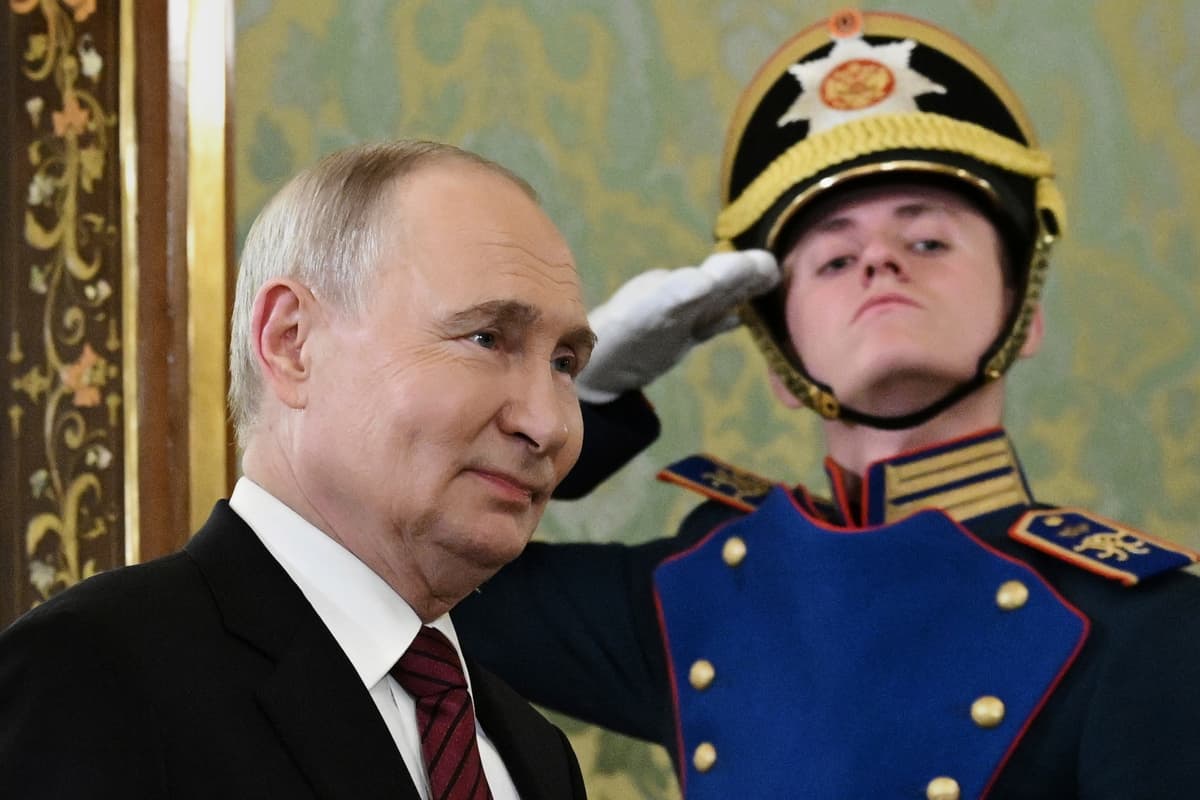
President Putin at the Grand Palace at the Kremlin, May 10, 2025. Sergei Bobylev/RIA Novosti via AP

News of an incursion by Russian fighter jets into Estonian airspace, following an earlier incident of the Kremlin’s drones meandering over Poland, calls to mind an old Soviet aphorism. “Probe with bayonets,” says the aphorism laid to Lenin. “If you encounter mush, proceed; if you encounter steel, withdraw.” This was later popularized by President Nixon, who was well versed in Soviet subterfuge. Are President Trump and our allies as astute?

So far, at least, the 12-minute flight by three Russian jets is being met mainly with verbal flak. Estonia’s foreign minister denounced an “unprecedented and brazen intrusion.” The European Union’s foreign policy chief, Kaja Kallas, a quondam premier of Estonia, scored the Kremlin for an “extremely dangerous provocation,” saying the incident “further escalates tensions in the region.” In other words — mush.

A spokesman for the North Atlantic Treaty says that the alliance’s aircraft had “responded immediately and intercepted the Russian aircraft,” decrying the Kremlin demarche as “yet another example of reckless Russian behavior.” It could be a telling detail, though, that the specific NATO jets were Italian F-35 fighters. That’s in part because of the position being taken by the prime minister at Rome, Giorgia Meloni, vis-a-vis Russian aggression. 

“A Kennedyesque tone of defiance” is how our Rosario Iaconis describes Signora Meloni’s response following Russia’s “unprecedented breach of Polish airspace” on September 9. The Italian premier was quick to pledge Rome’s “full solidarity with Poland over Russia’s serious and unacceptable violation of Polish and NATO airspace.” It’s good to hear that kind of talk from a European leader, but is there “steel” to match the rhetoric? 

It was more than three decades ago, in the aftermath of America’s liberation of Kuwait from Saddam Hussein, that the Belgian foreign minister, Mark Eyskens, quipped that the war had exposed the atrophy of the continent’s defense capabilities. The war had shown Europe to be “an economic giant, a political pygmy, and a military larva,” he told the Washington Post. Europe is in the midst of a rearmament drive, but this will take some time to take root. 

To that end, it’s good to see that, at the prodding of Mr. Trump, our North Atlantic allies have pledged to bring up their defense spending to some 5 percent of national output. Germany is planning to double its defense outlays. Yet France is finding its efforts to boost its military expenditures are running afoul of the nation’s debt crisis, making it difficult to borrow the needed funds. Doubtless these developments are being monitored at Moscow.

As for Mr. Trump, his recent decision to cut spending on military aid programs for nations that border Russia likely does little to curb President Vladimir Putin’s ambitions to restore the Kremlin’s orbit of influence in what was Russia’s Eastern Bloc. “The Russians genuinely only care about American dollars, American troops and the American flag,” one European official warns. If Russia is testing the West, the display of a little more steel would surely be salutary.


The New York Sun

© 2025 The New York Sun Company, LLC. All rights reserved.

Use of this site constitutes acceptance of our Terms of Use and Privacy Policy. The material on this site is protected by copyright law and may not be reproduced, distributed, transmitted, cached or otherwise used.

The New York Sun

Sign in or  create a free account

or
By continuing you agree to our Privacy Policy and Terms of Use