
Seven Years After Trump, Europe Brings Down the Curtain on the Iran Nuclear Deal

With the passing of a 12:01 am Sunday deadline, a ‘snapback’ mechanism restores sanctions that were in place before the signing of the 2015 deal.
Angelina Katsanis/AP
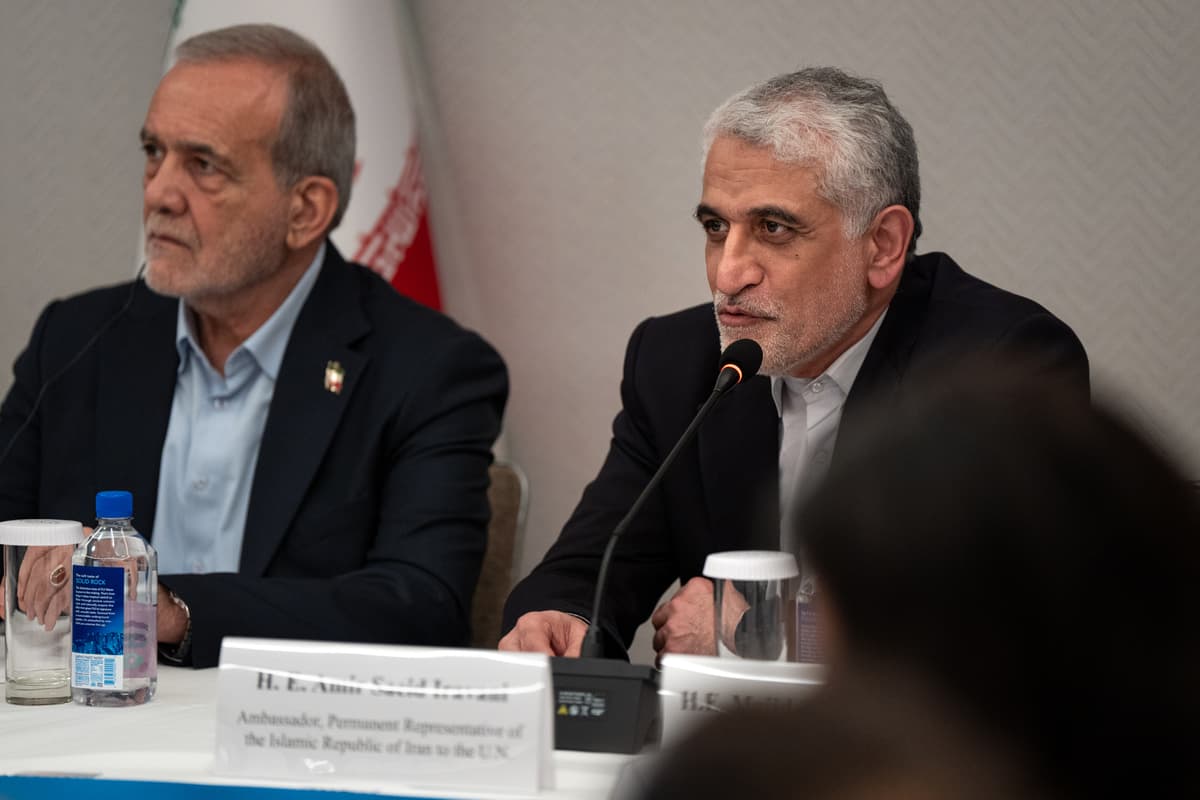
Iran’s U.N. ambassador, Amir-Saeid Iravani, starts a press briefing with President Masoud Pezeshkian of Iran at New York on September 26, 2025. Angelina Katsanis/AP

Seven years after President Trump withdrew America from the international agreement aimed at constraining Iran’s nuclear ambitions, its European allies are following suit.

With the imposition of “snapback sanctions” as of 12:01 am Sunday, the so-called Joint Comprehensive Plan of Action is effectively a dead letter, likely to be honored among the original signatories only by China and Russia.

The agreement, negotiated on behalf of America by the Obama administration in 2015, lifted a number of international sanctions on Iran in exchange for that country’s agreement to grant U.N. inspectors access to its nuclear program and limit its enrichment of uranium, among other concessions.

But the European participants – including Britain, France, and Germany – say Tehran has violated “the near entirety of its JCPOA commitments.” They notified the United Nations in late August that they planned to trigger a snapback mechanism in the agreement after 30 days if Iran did not honor its commitments.

With the expiry of that deadline on Saturday, the European powers follow the example set by Mr. Trump in 2018 by effectively tearing up the deal.

The renewed sanctions include a U.N. conventional arms embargo; restrictions on activities related to ballistic missiles capable of delivering nuclear weapons; a ban on enriching and reprocessing uranium; and a global asset freeze and travel bans on Iranian individuals and entities, according to Radio Free Europe/Radio Liberty.

Analysts say these renewed measures are likely to have a limited impact on Tehran’s nuclear program, given that Iran has long ignored most of its obligations and found ways to advance its nuclear program regardless.

But it also faces new economic constraints aimed at its oil industry as well as its shipping, financial, and banking sectors. China, its main customer for petroleum, is likely to continue its oil purchases but will be able to demand lower prices, the analysts say.

“The impact of snapback sanctions is already being felt in Iran, with the rial continuing to weaken against the dollar amid worsening pessimism in the business community,” a senior analyst at the New York-based Eurasia Group, Gregory Brew, told RFE/RL.

“With U.N. sanctions reimposed, Chinese refiners will be able to demand a steeper discount on Iranian oil, which will hit Iran’s oil revenues,” Mr. Brew said.

Some experts worry that Iran could retaliate by withdrawing from the Nuclear Non-Proliferation Treaty, under which countries that do not currently possess nuclear weapons pledge not to acquire them.

But Iran’s president, Masoud Pezeshkian, told a group of journalists and analysts on Wednesday that Iran has no intention of leaving the NPT as a result of the snapback sanctions, Reuters reported.

Iran has long insisted its nuclear program is intended only for peaceful purposes. But America and Israel, among others, question the oil-rich country’s need for nuclear power and point to its enrichment of uranium to within one step of weapons grade.

Tehran’s progress toward achieving a nuclear weapon is believed to have been set back by months or years by coordinated Israeli and American airstrikes on three key facilities in June.

However the Washington Post reported this week on satellite imagery showing work on a mysterious underground site near one of the damaged sites at Natanz, suggesting Iran may be cautiously working to reconstitute the nuclear program.


The New York Sun

© 2025 The New York Sun Company, LLC. All rights reserved.

Use of this site constitutes acceptance of our Terms of Use and Privacy Policy. The material on this site is protected by copyright law and may not be reproduced, distributed, transmitted, cached or otherwise used.

The New York Sun

Sign in or  create a free account

or
By continuing you agree to our Privacy Policy and Terms of Use