Syria Says Security Agreement Based on 1974 Armistice Line With Israel Is Close as Lebanon Moves To Disarm Hezbollah by Year’s End

The agreement would return IDF forces behind the buffer zone that separated the Israeli-controlled Golan Heights and Syrian territory before Assad’s ouster last December.

AP/Matias Delacroix
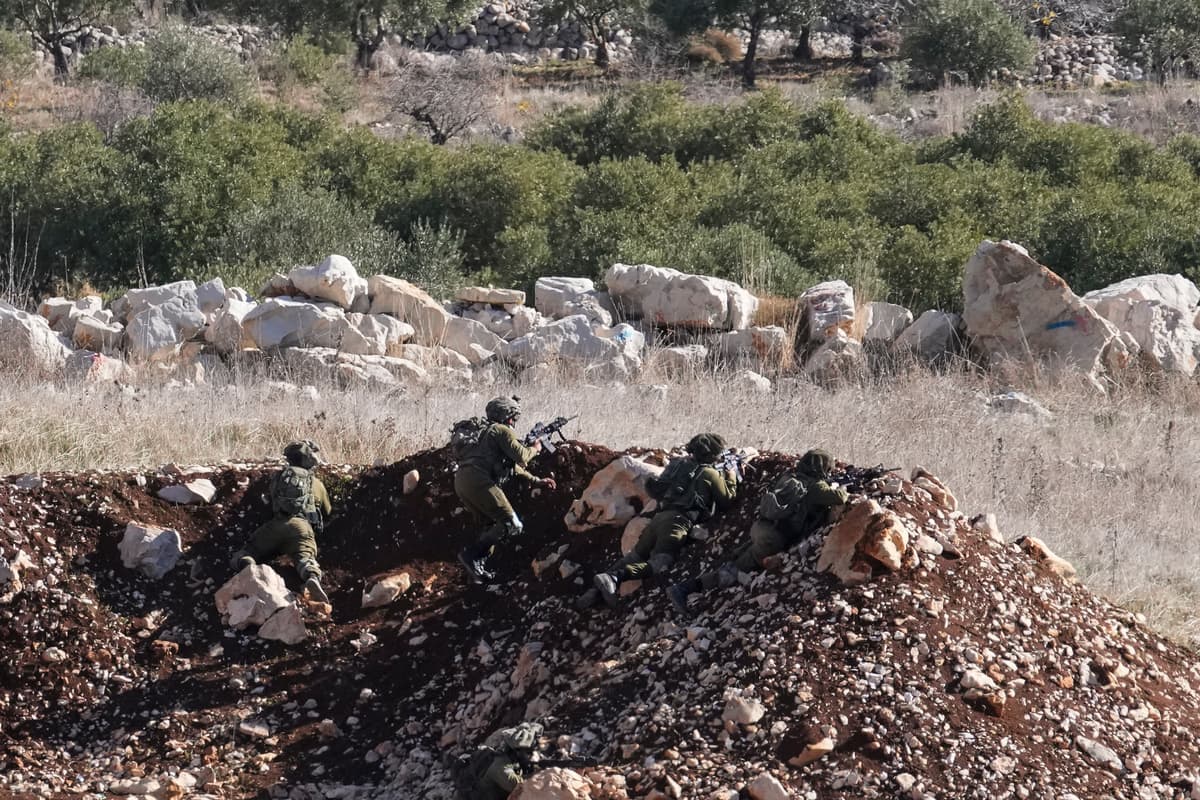
Israeli soldiers take position near the so-called Alpha Line that separates the Israeli-annexed Golan Heights from Syria. AP/Matias Delacroix

Syria is in “advanced” talks to reach a security agreement with Israel that would return Israeli forces back behind the 1974 armistice line that separates Syrian territory from the Israel-controlled Golan Heights.

Syria’s president, Ahmed Al Sharaa, hosted a media delegation at Damascus on Sunday that included heads of media institutions, editors-in-chief of Arab newspapers, and former ministers of information. According to Sky News Arabia, Mr. Sharaa told the delegation that the chances of reaching a security agreement with Israel are high. 

If the two countries reach a deal — still uncertain as the Israeli government reportedly insists on certain control points in the southern region of Syria and a security corridor for the Druze minority — it would “preserve” Syria’s sovereignty and pave the way for “confidence-building measures and possibly reaching a peace agreement,” Sky News Arabia’s CEO, Nadim Qatish, who was present at the meeting, said. 

While Mr. Sharaa doesn’t see the current circumstances leading to a peace deal, he won’t hesitate to reach such an agreement if it “serves Syria and the region,” Mr. Qatish added. 

The announcement comes as the heads of Israel’s other neighbor, Lebanon, said Monday that they would accept an American plan that calls for complete disarmament of Hezbollah by the end of the year. The statements by Lebanon’s president, Joseph Aoun, and Prime Minister Nawaz Salam earned praise from Prime Minister Benjamin Netanyahu of Israel, who offered to conditionally reciprocate by implementing a phased withdrawal of Israeli Defense Forces from southern Lebanon, where troops have been stationed to ensure a cease-fire with Hezbollah. 

The Lebanese and Syrian statements followed a Sunday meeting between Mr. Netanyahu and an American envoy, Thomas Barrack, on Syria and Lebanon, according to Israeli media. Last week, Israel’s strategic affairs minister, Ron Dermer, met with Syria’s foreign minister, Asaad al-Shibani, at Paris for discussions on a security agreement. 

Following the toppling of President Bashar al-Assad in December of last year, Israel took control of the border region, fortifying the 1974 buffer zone as well as the Syrian-controlled Mount Hermon. At the time, Mr. Netanyahu said that Israel would not allow jihadists to threaten its borders by letting Mr. Sharaa’s forces fill the vacuum left by Mr. Assad’s forces. 

“This deployment is temporary until a force that is committed to the 1974 agreement can be established and security on our border can be guaranteed,” Mr. Netanyahu’s office said at the time. 

Israeli forces entered Syrian territory as recently as Saturday overnight to clear the area of weapons. The IDF said that during simultaneous searches at various locations in southern Syria, Israeli troops “located several weapons storage facilities where RPG missiles, explosive devices, AK-47 rifles, and large amounts of ammunition were hidden. All of the findings were confiscated by the troops.”

The Israeli army has also launched hundreds of airstrikes against military bases and equipment left by Mr. Assad, including chemical weapons, helicopters, and missile depots. 

In July, the Israeli army attacked Mr. Sharaa’s forces near the Druze city of Sweida as the minority was facing violent crackdowns following a dispute with nearby Bedouin tribes. The Israeli air force also hit the Syrian defense ministry headquarters at Damascus as well as an area near the presidential palace. 

Israeli ministers at the time advocated for an assassination of Mr. Sharaa, whose forces committed massacres against the Druze minority, including summary executions. 

“We must not stand idly by in the face of the Islamo-Nazi terrorist regime run by Al Qaeda elements in suits. Sharaa is a terrorist. It’s better to eliminate him now,” the diaspora affairs minister, Amichai Chikli, said at the time. 

The national security minister, Itamar Ben-Gvir, also called on Mr. Sharaa to be assassinated: “We need to do one more thing: Eliminate al-Julani,” he said, referencing Mr. Sharaa’s nom de guerre. “Get rid of him. He’s a jihadist. Why are we letting him live?”


The New York Sun

© 2025 The New York Sun Company, LLC. All rights reserved.

Use of this site constitutes acceptance of our Terms of Use and Privacy Policy. The material on this site is protected by copyright law and may not be reproduced, distributed, transmitted, cached or otherwise used.

The New York Sun

Sign in or  create a free account

or
By continuing you agree to our Privacy Policy and Terms of Use