
The Art of Appeasement

It’s going to be hard to reach a deal with President Putin that excludes the participation of President Zelensky.
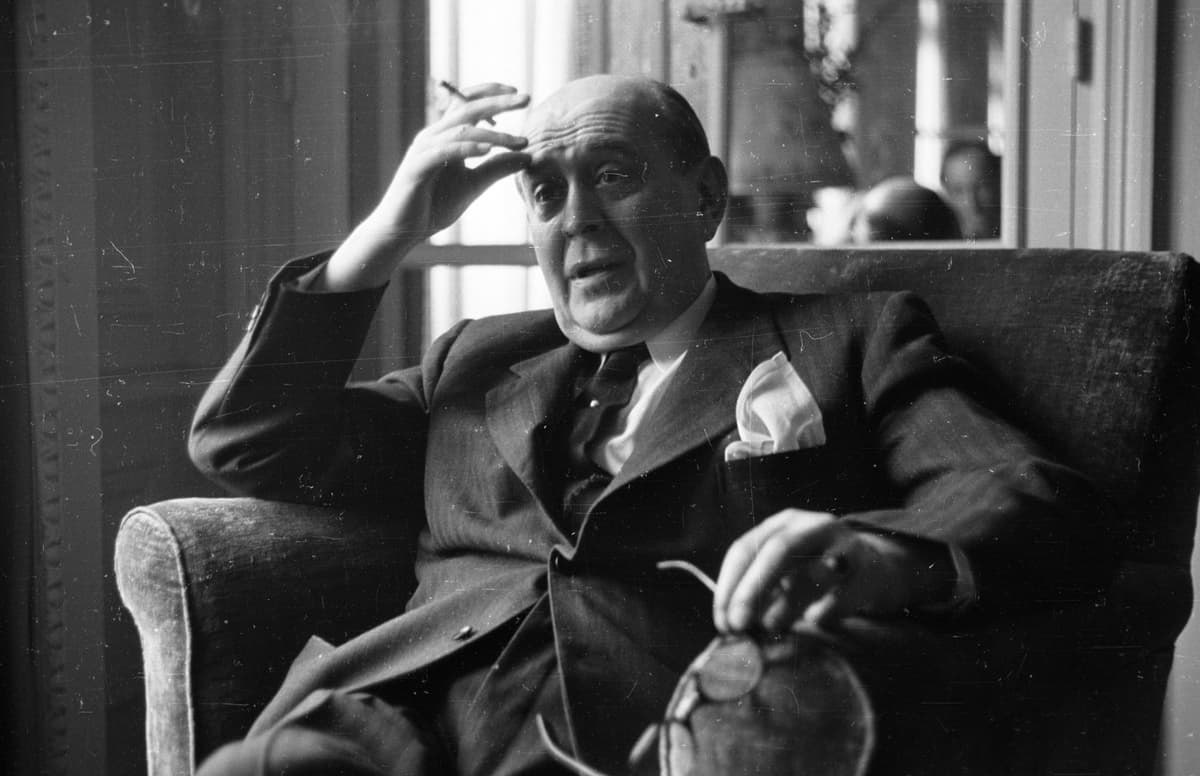
Haywood Magee/Picture Post/Hulton Archive/Getty Images
The Czechoslovakian diplomat Jan Masaryk at a peace conference at Paris, October 5, 1946. Haywood Magee/Picture Post/Hulton Archive/Getty Images

The main thing President Trump has going for him as he seeks a deal in respect of Ukraine is that he’s standing on the platform on which he ran for a second term. He told the American voters that he would try to end the war in Ukraine — in one day,* he boasted — and it was certainly one of the platform planks on which the American voters, who in their millions know what they’re doing, gave the 47th president a mandate.

It’s no small thing. If there’s one point we’ve pressed throughout this long debate it is not to take the American people for granted. Here at the Sun we still see the world through the prism of Vietnam. Congress sent two and a half million GIs halfway around the world and into a war without having gained a proper war declaration binding Congress. Some 58,000 of them fell for their country in a war that ended in an American debacle.

Mr. Trump is being chided for asserting, in his phone conversation with President Putin Wednesday, that no American boots — meaning GIs — are going to be sent to Ukraine. It’s hard to imagine Mr. Trump would get ten votes for doing so. World War II was in its third year before America entered the lists. It was prompted to do so only by the Japanese who sank our fleet at Pearl Harbor. It would take something like that to bring America into Ukraine.

When we went into World War II it was with a declaration of war saying that not only did a state of war exist with Japan but that the president was “authorized” and also “directed” to employ “the entire naval and military forces of the United States” to carry the war against Japan. “To bring the conflict to a successful termination,” it declared, “all the resources of the country are hereby pledged by the Congress of the United States.”

That’s what one calls a commitment, and it’s the last hot war we won. The abandonment of Vietnam was forced by the Democrats in Congress in one of the darkest deeds in the history of America. It happened again in Iraq, when President Obama prematurely withdrew our forces. It happened again in Afghanistan, with the particularly supine surrender by President Biden to the Taliban. It all is the prism through which we’re watching President Trump.

We’ve cautioned against striking a pact on the Ukraine war without consulting the Ukrainians — as Britain and France failed to include the Czechs at Munich. President Zelensky said today that “We, as a sovereign country, simply will not be able to accept any agreements without us.” He echoes Jan Masaryk: “If you have sacrificed my nation to preserve the peace of the world, I will be the first to applaud you. But if not, gentlemen, God help your souls.”

Munich, indeed, stands as a cautionary tale, especially with talk of peace pacts in the air as the Western powers meet there again for a security conference. “Coincidences are puns of destiny,” Arthur Koestler once quipped. The long-ago peace deal achieved there was based in part on Hitler’s vow to be satisfied with the seizure of some Czech borderlands, and that he would make no more territorial demands in Europe. Within months he breached that promise.

In the cold light of history, some have argued that Munich had a hidden merit — it bought the UK the time it needed to modernize its outmoded military, particularly the Royal Air Force that was able, but two years later, to fend off the Nazis in the Battle of Britain. There are hints of that silver lining in today’s remark by Britain’s defense secretary, John Healey, that a peace deal will not change the fact that “Russia remains a threat well beyond Ukraine.” 

For Europe to meet the challenge of defending Ukraine — and its own security — Bloomberg estimates a cost of “$3.1 trillion over the next 10 years,” which will “push the bloc to its limits.” Mr. Trump’s calculus seems to be that the cost is better borne by them than us. Even if Secretary Rubio is committing America to Ukraine’s independence, the Art of Appeasement could prove to be a dangerous gamble. 

________

* The boast reminds of the line in “Inherit the Wind,” where Clarence Darrow asks William Jennings Bryan: “That first day, what do you think it was? Twenty-four hours long?”


The New York Sun

© 2025 The New York Sun Company, LLC. All rights reserved.

Use of this site constitutes acceptance of our Terms of Use and Privacy Policy. The material on this site is protected by copyright law and may not be reproduced, distributed, transmitted, cached or otherwise used.

The New York Sun

Sign in or  create a free account

or
By continuing you agree to our Privacy Policy and Terms of Use