The Best Defense: Trump’s Pentagon Rebrand Could Be More Than Cosmetic

Presidential renaming invites a turn away from entrenched bureaucracy and perpetual conflicts.
AP/Alex Brandon
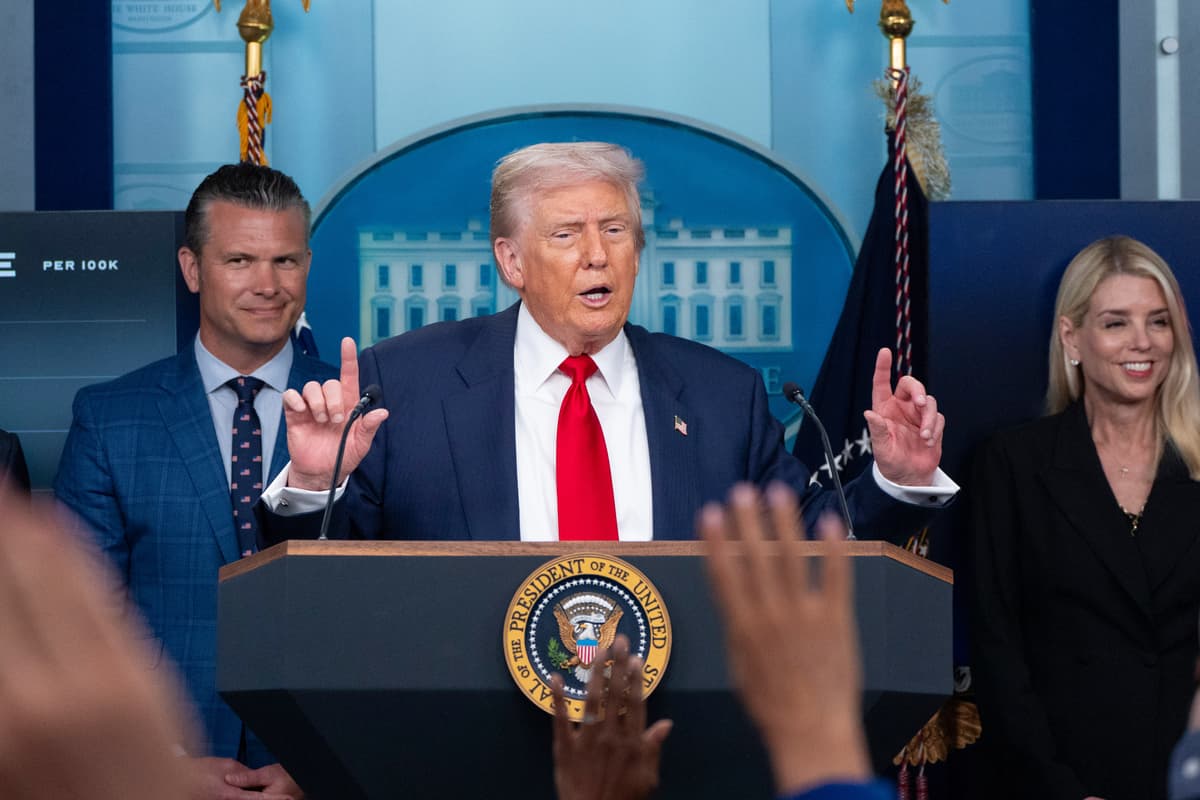
President Trump at the White House, August 11, 2025, as the defense secretary, Pete Hegseth, and Attorney General Pam Bondi look on. AP/Alex Brandon

President Trump’s restoration of the Department of War to designate America’s defense establishment could prove to be more than a cosmetic reversion to the name jettisoned in 1949. The rise of the Defense Department was a feature of the Cold War and America’s military expansion to become a global superpower. Along with that came the rise of a vast security bureaucracy, typified by the labyrinthine Pentagon.

Mr. Trump’s preference for a Department of War, though a law would be needed to finalize the change, invites a turn away from this entrenched bureaucracy. It suggests a return to the days when America saw wars as rare events to be won with overwhelming force as opposed to perpetual conflicts with inconclusive outcomes. Hence Mr. Trump’s point that “everybody likes that we had an unbelievable history of victory when it was Department of War.”

Our instinct is that there’s something to be said, too, for the clarity of purpose embodied in the original name for the department. Dropping “War” amounted at best to euphemism, or at worst a deception on a par with the moniker “Ministry of Peace” for the military agency in Orwell’s dystopian “1984.” Britain made a similar mistake when it changed its War Office, led by the Secretary of State for War, into a continental-sounding Ministry of Defense.

The renaming of the War Department — and the subsuming into it of the Navy Department — came at a time when the size and powers of the federal government were waxing in the face of the Soviet threat. As the twilight struggle of the Cold War came into focus, William F. Buckley Jr. foresaw in 1952 that “we have got to accept Big Government for the duration.” Without it, Buckley cautioned, “neither an offensive nor a defensive war can be waged.”

The danger of global communism, Buckley averred, justified the creation of a “totalitarian bureaucracy within our shores.” Since “Soviet power” was “a menace to our freedom,” even conservatives would “have to support large armies and air forces, atomic energy, central intelligence, war production boards, and the attendant centralization of power in Washington.” Buckley joked that this was needed, “even with Truman at the reins of it all.”

After World War II “the military institutions and the imperial responsibilities of the United States grew to monstrous proportions,” historian John Lukacs reported. By peacetime 1960, military spending was triple the level in 1950, during the hostilities in Korea. Military research and development soared to $1.5 billion a year in 1956 from less than $250 million during World War II. Under Eisenhower, the White House’s full-time staff tripled, too.

The platform of the GOP, a party once criticized for isolationist tendencies, called in 1956 for “American bases all around the world.” By 1958, America had forged “alliances and military arrangements with nearly sixty countries,” Lukacs reported. These bonds with nations across the globe would impose costs that America could afford some 70 years ago, but today make less sense as the national debt is soaring past $37 trillion.

The 1960s and the administrations of JFK and LBJ would prove a turning point for the escalation of security infrastructure under the aegis of the Defense Department as America incrementally joined the conflict in Vietnam without a proper war declaration or clear purpose. “The Kennedy era,” Lukacs wrote, marked a “decline of real American power,” even as it was “obscured” by “the enormous increase of military bureaucracy and technology.”

Lukacs lamented that “during the 1950s most of the American people went along with this development without thinking much about it.” Yet America’s transformation into a globe-straddling hegemon was never an ideal fit with our constitutional character. Viewed in that lens, Mr. Trump’s push to rename the Defense Department could be seen as a return to historic form, guided by his vow: “I’m not going to start wars, I’m going to stop wars.”


The New York Sun

© 2025 The New York Sun Company, LLC. All rights reserved.

Use of this site constitutes acceptance of our Terms of Use and Privacy Policy. The material on this site is protected by copyright law and may not be reproduced, distributed, transmitted, cached or otherwise used.

The New York Sun

Sign in or  create a free account

or
By continuing you agree to our Privacy Policy and Terms of Use