The Case Against Trump in Georgia Is Dropped
The dismissal of District Attorney Fani Willis’s racketeering charges could help draw to a close an era of political prosecutions.
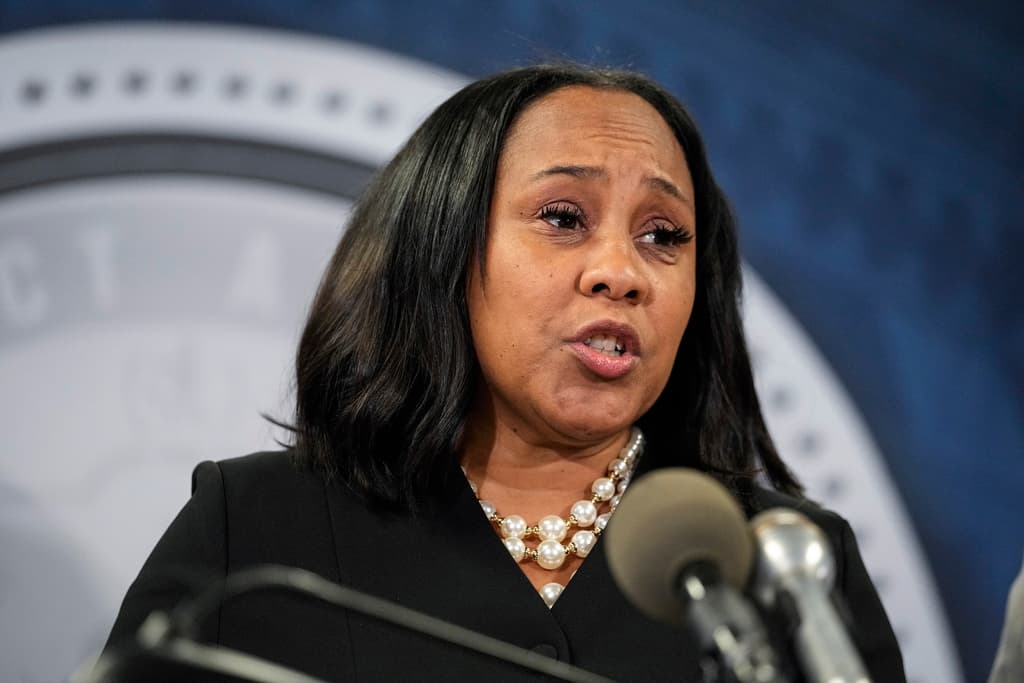
The demise of the criminal racketeering case brought by the district attorney of Fulton County, Fani Willis, against President Trump and 18 others is a remarkable moment in American legal and political history. Never before had a state prosecutor charged a former president — let alone for allegedly acting to reverse the results of an election. The decisive moment was the disqualification of Ms. Willis from her own case for an affair with a subordinate.
By Georgia law, Ms. Willis’s departure handed the baton to the discretion of a veteran prosecutor, Peter Skandalakis. He first selected himself to handle it — he couldn’t recruit anyone else — before filing for its dismissal on Tuesday. The presiding judge, Scott McAfee, quickly agreed. The case is now abandoned for all of its defendants. Among those who are cleared here are Mayor Rudolph Giuliani, Chief of Staff Mark Meadows, and John Eastman.
Mr. Skandalakis begins his filing by acknowledging that “unlike family members who must make the emotional decision to withdraw loved ones from life-sustaining treatment, I have no emotional connection to this case.” That distance enabled him to grasp that the prosecution was on “life support.” In a twist, he also opines that the court didn’t belong in Georgia at all — endorsing the view taken by none other than Ms. Willis’s defendants.
“The criminal conduct alleged in the Atlanta Judicial Circuit’s prosecution,” Mr. Skandalakis writes, “was conceived in Washington, D.C., not the State of Georgia. The federal government is the appropriate venue for this prosecution.” He reckons that the “strongest and most prosecutable case … was the one investigated and indicted by Special Counsel Jack Smith.” That one was dismissed after Mr. Trump’s reelection.
Mr. Smith’s all-fired rush to convict Mr. Trump was confounded by a constitutional barrier — presidential immunity. Sitting presidents, the Department of Justice acknowledges, possess “categorical” protection. Former presidents, the Supreme Court ruled in Trump v. United States, are presumptively immune for their official acts. Georgia’s indictment, handed up before Trump, would have required revision in any event.
Mr. Skandalakis candidly admits that “there is no realistic prospect that a sitting President will be compelled to appear in Georgia to stand trial on the allegations in this indictment … bringing this case before a jury in 2029, 2030, or even 2031 would be nothing short of a remarkable feat.” He declares that the “citizens of Georgia are not served by pursuing this case in full for another five to ten years.” What a dose of old-fashioned common sense.
The end of Ms. Willis’s case marks the third prosecution of the president that has ended in defeat for prosecutors. The fourth prosecution, the hush money verdicts secured by Manhattan’s district attorney, Alvin Bragg, could yet be reversed on appeal. Meanwhile, Mr. Trump is smack in the middle of a second term delivered by the verdict of voters after they had learned the particulars of all four criminal indictments of Mr. Trump.
None of this is to gainsay the seriousness of the allegations against Mr. Trump, or of the harm done in the aftermath of the 2020 election. Yet pursuing a conviction in the courts — by a special counsel appointed by the Biden administration and by elected Democratic officials like Ms. Willis and Mr. Bragg — hardly appears to have been an efficacious course. Thanks are owed Mr. Skandalakis for doing his part to help close the book on lawfare.
More broadly, and apart from the constitutional questions above, the whole pursuit of Mr. Trump after the 2020 election is a reminder of the dangers of politically motivated prosecutions. That is how millions of Americans will see what Ms. Willis was doing in Georgia. It is what they saw in Attorney General Merrick Garland’s appointment of Mr. Smith promptly after Mr. Trump announced for the presidency. It is what Mr. Trump faced at New York.
With the disposal of these cases — and lawfare cases just dropped against New York’s attorney general, Letitia James, and the former FBI director, James Comey — there is an opportunity to undo some of the damage wrought by political prosecutions. One could do worse than adopt Mr. Skandalakis’s valedictory sentence in his memorandum, asserting that his “assessment of this case has been guided solely by the evidence, the law, and the principles of justice.”