
The Lisa Cook Case

Should the Fed really be independent of the one person with the duty to make sure our laws are faithfully executed?

AP/Mark Schiefelbein
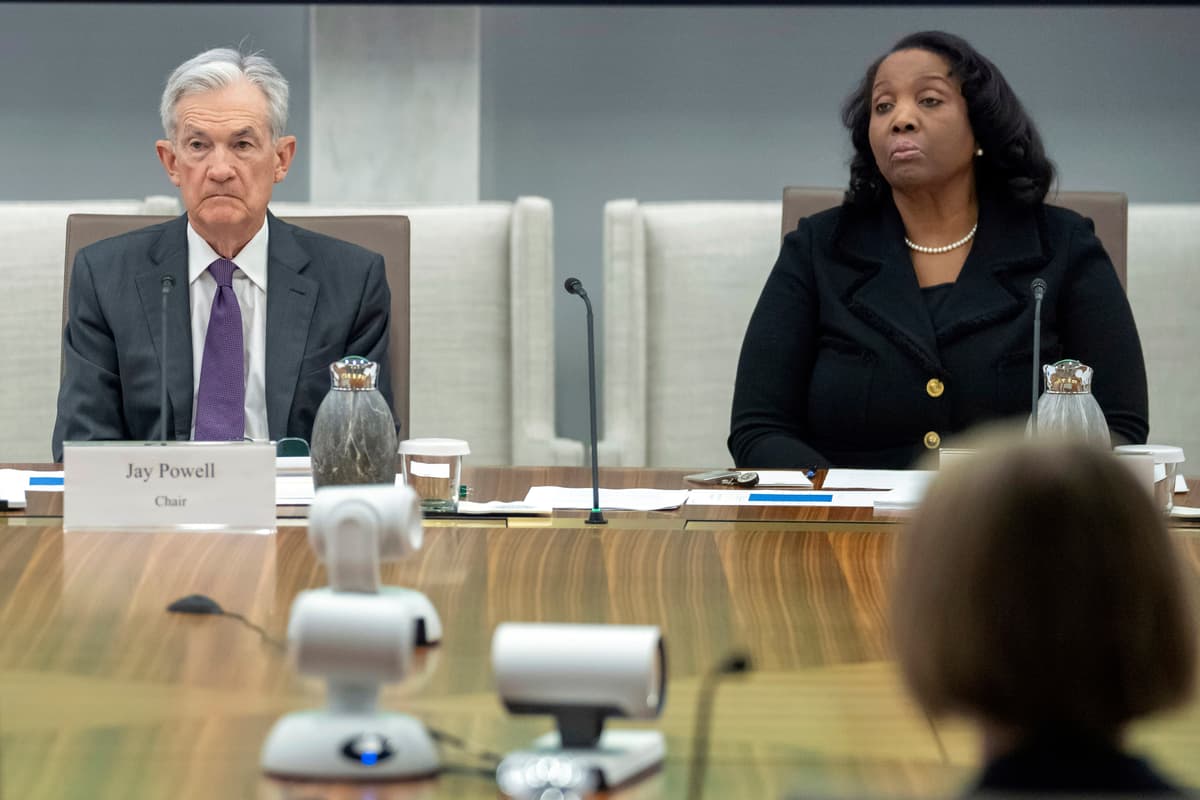
The Fed chairman, Jerome Powell, left, and board member Lisa Cook, right, at the Federal Reserve, June 25, 2025. AP/Mark Schiefelbein

Will the Supreme Court allow President Trump to fire a governor of the Federal Reserve, Lisa Cook? The answer appears to be far from clear in light of the high court’s recent ruling in a case involving the president’s power to fire two members of the boards of two other federal agencies, the National Labor Relations Board and the Merit Systems Protection Board. In that ruling, the Nine suggest limits to Mr. Trump’s power to fire Fed board members.

In May, the Supreme Court issued a preliminary ruling in Trump v. Wilcox allowing Mr. Trump’s summary termination of the labor relations and merit protection board members, Gwynne Wilcox and Cathy Harris, to proceed even as litigation was pending in lower courts. Yet the court’s ruling in Wilcox offers, too, a defense of the Federal Reserve’s independence in the federal constitutional scheme, insinuating limits to presidential authority on this head.

The high court’s holding about Mr. Trump’s power over the central bank came in response to the arguments advanced by Ms. Wilcox and Ms. Harris. They claimed that the precedent set by their terminations would “necessarily implicate the constitutionality of for-cause removal protections for members of the Federal Reserve’s Board of Governors or other members of the Federal Open Market Committee,” a financial policy-making panel at the central bank.

This suggestion cut no ice with a majority of the justices, if the Wilcox ruling is any guide. “We disagree,” the justices said in the unsigned order. “The Federal Reserve is a uniquely structured, quasi-private entity that follows in the distinct historical tradition of the First and Second Banks of the United States.” At the time of that ruling, these columns raised questions about the constitutional consistency of the high court’s position.

By suggesting that the president could terminate members of the two federal agency boards but not the Federal Reserve, we argued, the high court risked the impression that it “is more interested in mollifying financial markets than in a clear reading of the Constitution.” Also, too, the mention of the 19th century banks of the United States — private institutions chartered by Uncle Sam — raises complex historical echoes.

It was, after all, an earlier populist commander in chief — Andrew Jackson — who had in effect staked the success of his presidency on limiting the influence of the Second Bank of the United States, which he decried as “corrupt” and “monstrous.” Jackson was opposed to its support for paper money, since Old Hickory viewed gold and silver to be the only legal currency under the Constitution — a position in line with the Framers’ view.

As Jackson put it when he vetoed the renewal of the charter of the Second Bank, a central bank would never be “compatible with justice, with sound policy, or with the Constitution of our country.” Yet some eight decades later Congress ignored that insight when it opted to cede its constitutionally granted powers over federal monetary policy to the reincarnation of the Jackson-era central bank, the Federal Reserve System.

Which brings us back to Mr. Trump’s attempt to fire Ms. Cook, amid a broader attempt to bring Fed policy into his ambit. In the Federal Reserve Act, Congress stated that Fed governors can be fired only for “cause.” Mr. Trump isn’t firing Ms. Wilcox or Ms. Harris for cause, and the Nine suggested that the president’s ability to fire them was a function of his authority, as the sole repository of executive branch power, to manage policy-making federal staffers.

In Ms. Cook’s case, though, Mr. Trump alleges that she committed mortgage fraud, pointing to her “deceitful and potentially criminal conduct in a financial matter.” He adds that his duty of “faithfully executing the law requires your immediate removal.” To us Ms. Cook refusing to resign is shocking. Could the issue of “cause” lead the high court to take a new look at whether it makes sense for the Federal Reserve to be independent of the nation’s executive?


The New York Sun

© 2025 The New York Sun Company, LLC. All rights reserved.

Use of this site constitutes acceptance of our Terms of Use and Privacy Policy. The material on this site is protected by copyright law and may not be reproduced, distributed, transmitted, cached or otherwise used.

The New York Sun

Sign in or  create a free account

or
By continuing you agree to our Privacy Policy and Terms of Use