
The Oxford Union Loses the Debate on Israel
Famed university debating society concludes that Israel is a ‘greater threat to regional stability than Iran.’
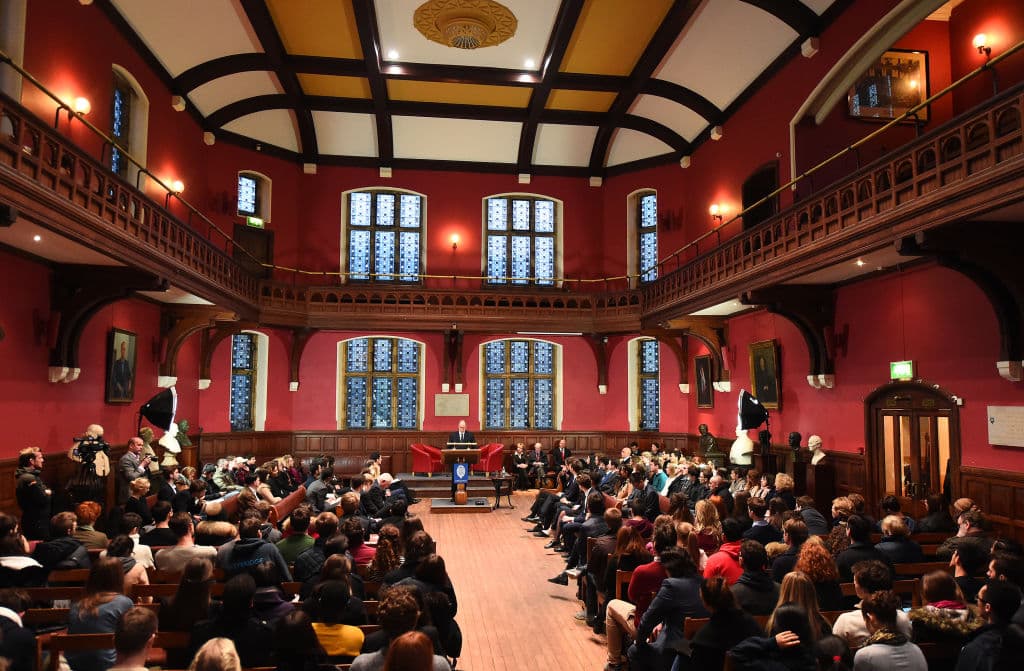
The Oxford Union’s vote on Thursday in favor of the motion that “Israel is a greater threat to regional stability than Iran” is a newsworthy moment in the global campus crisis. The vote, at 265 to 113, wasn’t close. Arguing against the motion was UN Watch’s Hillel Neuer, who called the outcome “deep satire.” In 2024, the Union, by a 278 to 59 margin held that “Israel is an apartheid state responsible for genocide.”
The Union appears to have entirely lost its way. Last month its president-elect, George Abaraonye, was ousted. That followed his comment on Instagram that “Charlie Kirk got shot loool,” which appeared to celebrate the murder of the conservative activist whom Mr. Abaraonye had himself debated at the Union. Five hundred and one members of the Union, though, would have kept Mr. Abaraonye despite his celebration of the murder of Mr. Kirk.
The Union’s antipathy toward the Jewish state recalls the darkest day in its 200-year history. On February 9, 1933, the Union supported, by a 275 to 153 vote, the motion “That this House will under no circumstances fight for its King and country.” The motion’s sponsor, Kenelm Hubert Dingy, argued that “the only country fighting for the cause of peace,” was Soviet Russia, which “rid itself of the war-mongering clique.”
The journalist Joseph Alsop reckoned that the vote “made a tremendous impression upon Hitler himself … Hitler customarily cited the oath whenever the German general staff warned him of the risks of his next move forward. It was proof, Hitler said, that Britain was rotten to core.” Alsop adds that the vote, which came to be known as “the Oxford Oath,” even played “a certain role in bringing on World War II.”
Alsop’s judgment that the Oxford Oath expressed Britain’s “moral and material disarmament” could be said about the vote privileging the Islamic Republic of Iran over the Jewish state. The nation of Churchill and Weizmann is experiencing a surge of hostility to Jews, especially on its campuses. Last week a lecturer at University College London and a former Unrwa employee, Samar Maqusi, taught a 19th-century blood libel, the Damascus Affair, as fact.
Ms. Maqusi told students during a Students for Justice in Palestine event that during Passover Jews “make these special pancakes, or bread, and part of the holy ceremony is that drops of blood from someone who’s not Jewish, which the term is ‘gentile,’ has to be mixed in that bread.” Also last week the rector of Glasgow University, Dr. Ghassan Abu-Sittah, accused Israel of harvesting organs of Gazans. Israel calls him “a propagandist and a fraud.”
The Jewish state’s envoy to London denounces Dr. Abu-Sittah’s accusations as “a modern reworking of the classic blood libels levelled against Jews and Israelis for generations.” The irony is that the blood libel is what the barrister and scholar Anthony Julius reckons is England’s landmark contribution to the history of antisemitism. It was pioneered in 1144 at Norwich, just a three hour drive east from Oxford.
Which brings us back to the Union. Arguing for Iran was Tehran’s former minister of culture, Ata’ollah Mohajerani. Mr. Neuer noted after the debate that Mr. Mohajerani was a high officer of Iran “when hundreds of assassinations of dissidents in Europe were attempted and committed.” Mr. Mohajerani is also an enthusiastic supporter of the fatwa against the author Salman Rushdie. A greater affront to the principles of debate is hard to imagine.