The United Nations at 80
One could, with apologies to Churchill, well say of the UN that never have so few done so little for so many.

The United Nations this fall is marking its 80th birthday, but it hardly seems an occasion to celebrate. Looking back on the global body’s origins — it was midwived, after all, by the Soviet spy Alger Hiss — and its track record of failures over the past eight decades, it’s hard to avoid a sense of disappointment. One could, with apologies to Churchill, well say of the UN that never have so few done so little for so many.
The UN’s flaws can be traced to its inception. Hiss, who, as a Department of State employee, was a communist and spied for Stalin, played a key role in the global body’s formation. As head of the body that organized the UN, Sam Tanenhaus writes, Hiss “presided over the intricate negotiations” that led to “the ratification and signing of the UN Charter.” Even Time was fooled, hailing “young, handsome” Hiss as being “in a class by himself.”
Despite the charter’s deceptive parchment-imitating “We the peoples” opening, Hiss’s role helps explain the UN’s tilt toward the communists. The party apostate, Whitaker Chambers, who became a leading conservative, said Hiss “represents the concealed enemy against which we are all fighting.” He described Hiss’s moral twilight, which one finds reflected in the character of the UN that the Soviet spy did much to create, as a “tragedy of history.”
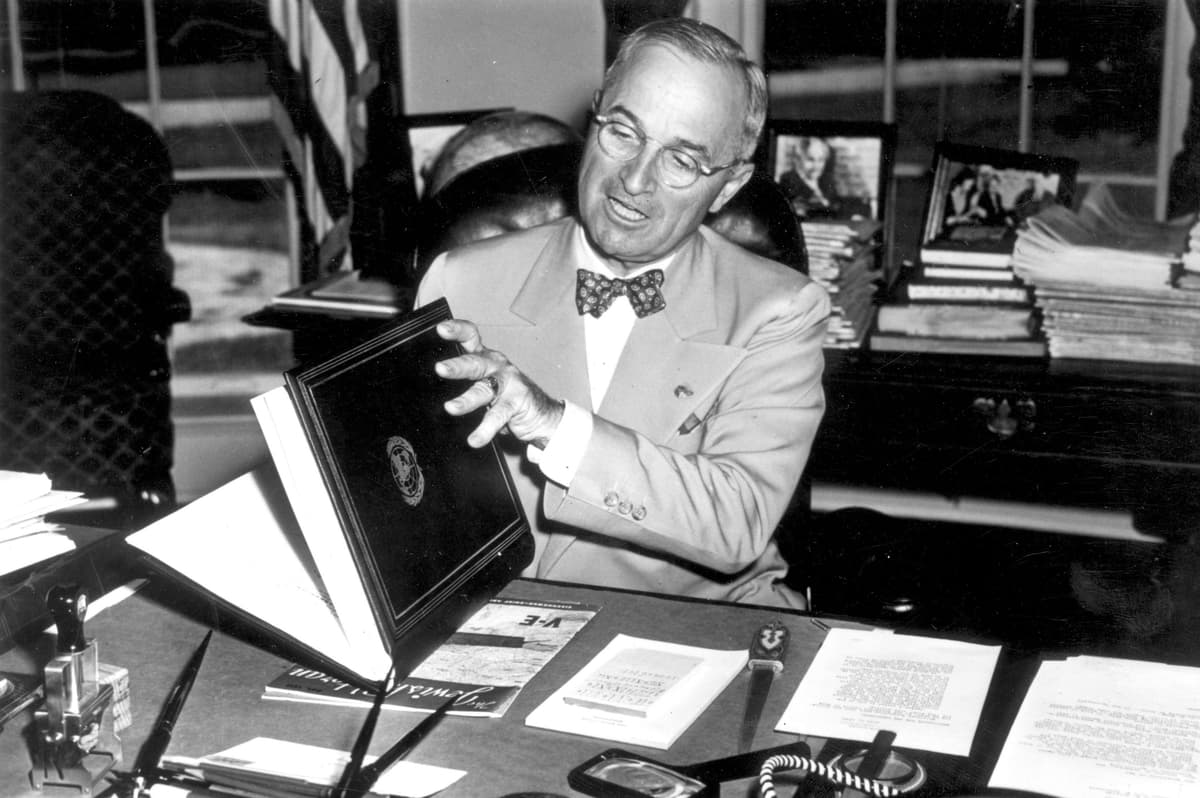
A Sun editorial in 1945 when the charter was drafted sounded a caution. “What a great day this can be in history,” President Truman exclaimed. The Sun saw Truman’s hesitation as a reminder that the “machinery, however elaborate,” of the UN, will not “work by itself” but depends on its members’ goodwill. Yet the Sun hailed the UN as “a new ark” full of the “expectations and aspirations of civilized mankind.” Quoth the Sun: “May she prove seaworthy.”
Such hopes proved misplaced. After Hiss laid the groundwork of the UN, the Soviets used the global body as a forum “to enhance the Soviet Union’s prestige as a great power,” historian Ilya Gaiduk reports. The Soviet bloc worked to concentrate power at the Security Council, where Moscow held a veto. In the UN’s first two years, per Gaiduk, Russia cast 17 of the 18 vetoes wielded in the council, making it an “arena of confrontation and ideology.”
This prefigured years of frustration among democracies over the UN’s ineffectiveness. The West lost its “working majority” with the accession of “newly independent Third World countries,” the CIA reported. The Soviets gained influence among the new members, and curried favor with Arab nations by fanning anti-Israel views. This culminated in 1975 when the Soviet bloc, with Arab allies, passed a resolution declaring that “Zionism is a form of racism.”
America’s envoy, Daniel Moynihan, warned that by “this infamous act” the “abomination of anti-Semitism has been given the appearance of international sanction.” Despite the resolution’s repeal, the UN is still a bastion of anti-Zionism. Special groups like the UN’s Relief and Works Agency deal with “Palestine” separately from the rest of the world. The General Assembly passes more anti-Israel resolutions per year than the rest of the world combined.
Such moral murk is par for the course for the UN, which in 1971 voted to replace on the Security Council the rightful government of China, the Taiwan-based Republic of China, with Mao Zedong’s communist regime. The betrayal of Free China was a breach of the UN Charter and would be echoed some 20 years later when, upon the Soviet Union’s collapse, the global body, in the dead of night, gave Moscow’s Security Council seat to the Russian Federation.
Just as the Soviets dominated the UN machinery in its early days, Beijing now mans key posts. China and Russia cast a shadow on the UN’s legitimacy. The stakes of the UN’s game of musical chairs would become clear, say, in the failure to prevent the Assad regime’s atrocities in Syria or Moscow’s invasion of Ukraine. More broadly the UN’s failures suggest the folly of multilateral global bodies so cherished by the left. After 80 years, is America ready to disembark?