

Is the Times’ Chinese Triumphalism Fit To Print?

The Gray Lady calls our military ‘ill prepared for today’s global threats,’ but overlooks America’s advantages.
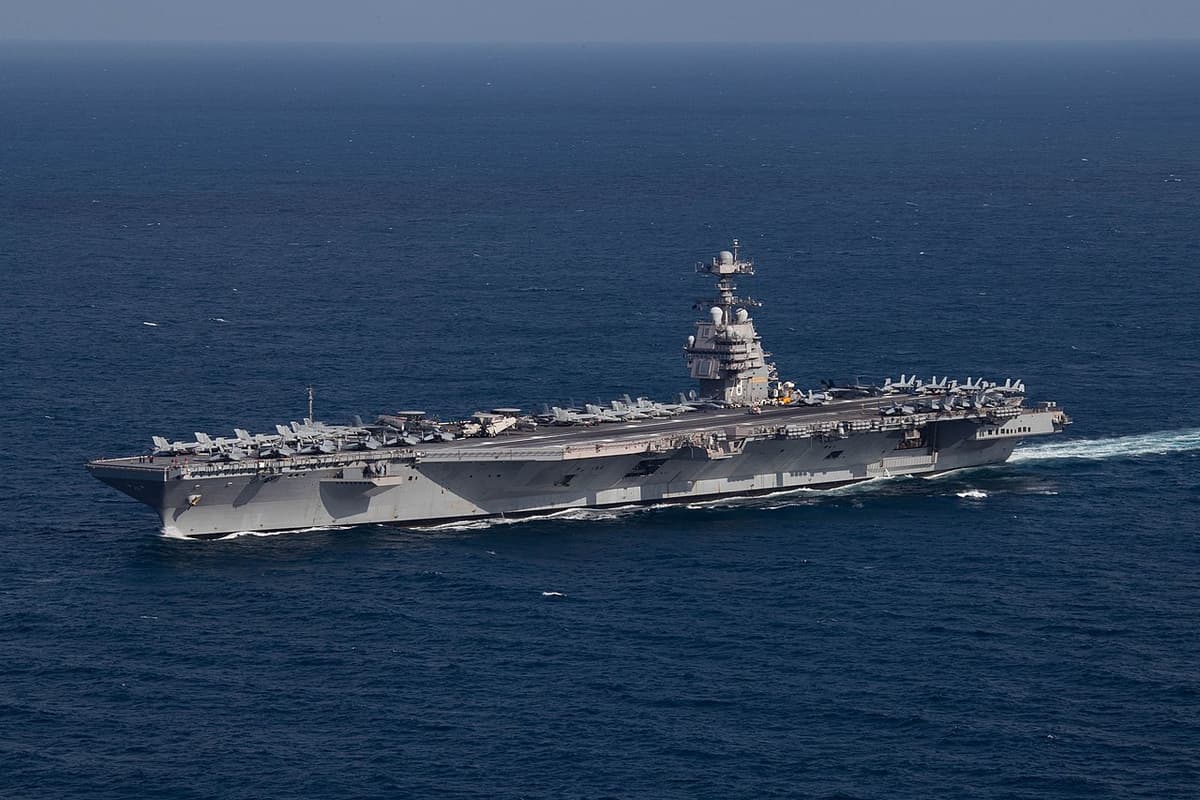
United States Navy/Jackson Adkins
United States Ship Gerald R. Ford steams the Atlantic Ocean, October 9, 2022. United States Navy/Jackson Adkins

Is America’s newest aircraft carrier, United States Ship Gerald R. Ford, a sitting duck for the People’s Liberation Army? That’s the fear mooted by the Times, which avers that Communist China has the military edge over America. “Overmatched,” the Times in an editorial calls our armed forces. It cites “a decades-long decline in America’s ability to win a long war with a major power.” The Times says the military is “ill prepared for today’s global threats.”

A good companion to the the Times editorial is the post on “The Editors” substack by Ira Stoll, proprietor of Smartertimes.com. The Times’ remarks reflect what he calls a recurring “theme recently in Times news and opinion coverage.” Mr. Stoll says this view reflects not the “current reality” but Xi Jinping’s “communist triumphalism.” Mr. Stoll takes his readers through the Communist Chinese boasts, one by one.

When it comes to, say, “economic prosperity,” or “military capability,” Mr. Stoll reckons, America leads the mandarins at Beijing. In political freedom, Mr. Xi’s despotic regime lags far behind America and other democratic nations. Personal liberty marks, too, a distinction between the Mainland and the island democracy of Taiwan. That’s one reason why Mr. Xi is keen to bring Free China into Beijing’s orbit.

Plus, too, political freedom in Taiwan, America, and the rest of the West are components in a larger arsenal of democracy that offer a strategic edge to these nations over a planned economy like China’s. In the past, the superiority of the free-market capitalist system helped push the Soviet Union to the graveyard of history. In the event of conflict with China, American innovation, nimbleness, and resilience could prove decisive.

No one, leastwise Mr. Stoll, rejects out of hand the concerns over military preparedness raised in the Times. Feature the fretting over the Ford, a $13 billion carrier that symbolizes the United States Navy’s prowess. Yet the vessel “is fatally vulnerable to new forms of attack,” the Times warns, pointing to Communist China’s “arsenal of around 600 hypersonic weapons.” These projectiles, per the Times, “can travel at five times the speed of sound and are difficult to intercept.”

While the Navy plans to build nine more Ford-class carriers in coming years, America “has yet to deploy a single hypersonic missile,” the Times editorial says. Could that “missile gap” prove as misleading as the one touted by JFK in the 1960 election? Mr. Stoll points to America’s 11 aircraft carriers, as opposed to the three Beijing fields, and our 1,770 deployed nuclear warheads, versus China’s 24, as indicators of America’s military predominance.

Even so, the defense secretary, Peter Hegseth, warned last November that in military simulations, “we lose every time” in a fight with China over Taiwan. He may have missed the simulation run in 2022 by the Center for Strategic Studies that showed an American win. In any event, the Times’ concerns over rising Chinese capabilities reflect a “reality” that is known within the Pentagon, a former editor of Military.com, Ward Carroll, tells us.   

The speed with which China’s military is “innovating and manufacturing,” Mr. Carroll says, is worrisome. Yet he also points to America’s century of expertise in carrier warfare as an edge that can’t be ignored, either. He reminds that at the outset of World War II, America wasn’t militarily ahead of its enemies. Yet when confronted with a threat, “the American spirit comes alive again.” Hence America’s mobilization and drive to the victories of 1945.

The Pentagon under President Trump is in a rebuilding drive meant, in part, to meet China’s threat. The fears for the Ford, meanwhile, evoke the old “Saturday Night Live” skits when Chevy Chase, as President Ford, would fall down like a bumbling oldster. It was a riff on Ford slipping on Air Force One, but it’s a moment to remember that in real life Ford was a former athlete who was in superb shape. Simulation has its pitfalls.


The New York Sun

© 2025 The New York Sun Company, LLC. All rights reserved.

Use of this site constitutes acceptance of our Terms of Use and Privacy Policy. The material on this site is protected by copyright law and may not be reproduced, distributed, transmitted, cached or otherwise used.

The New York Sun

Sign in or  create a free account

or
By continuing you agree to our Privacy Policy and Terms of Use