Trump Appeals on the National Guard

It looks like the riders of the Ninth Appeals Circuit could well have a different view of what federal statute says about the president and the militia.

Spencer Platt/Getty Images
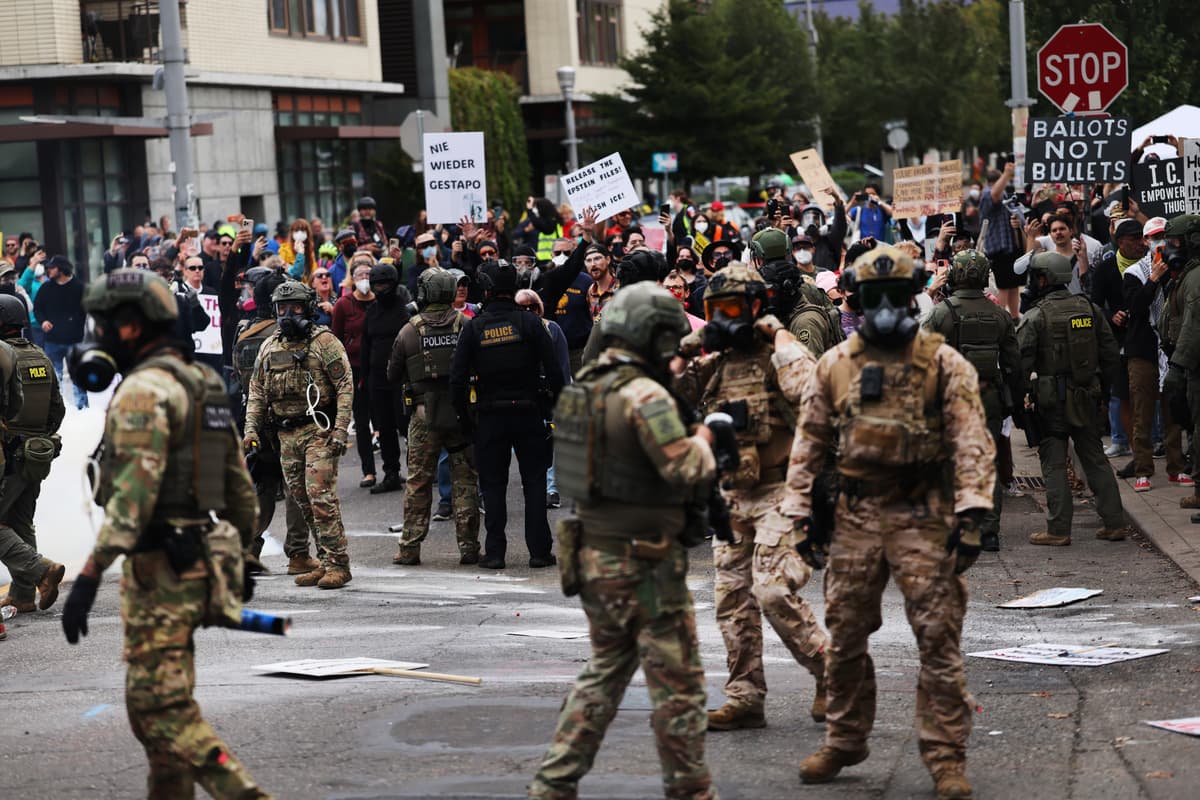
Federal agents and police clash with protesters outside a downtown Immigration and Customs Enforcement facility on October 4, 2025 at Portland, Oregon. Spencer Platt/Getty Images

A federal district judge in Oregon seems determined to deny President Trump the power to deploy the National Guard to quash what the commander in chief calls “lawless mayhem” at Portland. Judge Karin Immergut has halted, for now, Mr. Trump’s efforts to call in troops from Oregon or neighboring California. Yet she risks being overruled by the Ninth Circuit, which already found that Mr. Trump has power to call in the Guard when federal law is flouted.

Mr. Trump has already appealed Judge Immergut’s order. Late on Sunday, the judge — nominated to the bench by Mr. Trump — had halted the president’s attempt to send troops to Portland from the Golden State. That followed her earlier order thwarting Mr. Trump from deploying members of Oregon’s National Guard to address the rising disorder at Portland. Like many on the federal bench, she seems unable to resist the impulse to second-guess the president. 

Mr. Trump’s appeal to the Ninth Circuit alleges that “over several months, agitators conducted coordinated and violent attacks in an effort to prevent the enforcement of federal immigration law.” The Immigration and Customs Enforcement Office was damaged, the appeal states, and “federal officers were assaulted, threatened, doxed, and routinely trapped in their cars when entering and leaving the facility.” Yet local “police were largely unresponsive.”

Hence the need to bring in members of the National Guard. The statutory justification for this is found, Mr. Trump reports, in Title 10 of the United States Code, Section 12406. This statute allows the president, when he “is unable with the regular forces to execute the laws of the United States,” to “call into Federal service members and units of the National Guard of any State” in order “to execute the laws of the United States.”

What might seem a simple point of statutory interpretation, though, took a curious turn in Judge Immergut’s courtroom. Despite evidence of disorder and defiance of federal authority at Portland, the judge ruled that Mr. Trump’s contention that “the regular forces” had been “unable to execute the laws” was, in her view, “not persuasive.” In short, the district judge saw fit to peer over the presidential shoulder on a core constitutional function.

What appears to have rankled Judge Immergut, per her ruling, was Mr. Trump’s suggestion that the need for “support from another office” signaled a breakdown of law. She deems that “a routine aspect of law enforcement activity.” Using that standard, she cautions, means “the President could send military troops virtually anywhere at any time.” She frets that the case cuts to “the heart of what it means to live under the rule of law in the United States.”

Yet Judge Immergut seems to overlook the earlier ruling by a panel of riders on the Ninth Circuit after Mr. Trump deployed the Guard to quell similar disorder at Los Angeles. A local federal judge there, too, decided to second-guess the president on this head. Judge Charles Breyer groused that Mr. Trump was creating a kind of “a national police force with the President as its chief.” The circuit riders weighed the matter with more sang-froid.

“Longstanding precedent,” the riders held, suggested that courts “must be highly deferential” in reviewing presidential power to invoke Section 12406. They held “it was likely” that Mr. Trump had “lawfully exercised his statutory authority” to federalize the Guard when “the President is unable with the regular forces to execute the laws of the United States.” If that standard holds, Mr. Trump could be vindicated in his use of the Guard at Portland.


The New York Sun

© 2025 The New York Sun Company, LLC. All rights reserved.

Use of this site constitutes acceptance of our Terms of Use and Privacy Policy. The material on this site is protected by copyright law and may not be reproduced, distributed, transmitted, cached or otherwise used.

The New York Sun

Sign in or  create a free account

or
By continuing you agree to our Privacy Policy and Terms of Use